
Here's the thing: you don't have to decide anything immediately.
This matters more than ever right now. Cerulli Associates projects that $124 trillion will transfer through 2048, with $105 trillion of that going directly to heirs. That's an enormous generational shift, and most people receiving this money have never managed a windfall of this size before.
This guide walks through the immediate first steps, the tax rules you need to know, how to think about investing, and the mistakes that trip up even careful people.
Key Takeaways
- Pause before major decisions: park funds in an interest-bearing account first
- Map each asset type you inherited—cash, property, retirement accounts, stocks—tax rules differ for each
- Apply the step-up in cost basis to cut your capital gains tax bill
- Spread risk beyond the inherited portfolio with alternative assets, not just more stocks
- Build a coordinated team: financial advisor, tax professional, estate attorney
What To Do First When You Inherit Money
Before you touch a dollar, confirm how you actually received the inheritance. Was it an outright bequest, money held in a trust, or a direct beneficiary designation on a retirement account or life insurance policy? Each comes with different rules, different tax treatment, and different levels of control you'll have.
You also have the option to disclaim an inheritance entirely, refusing it so it passes to the next beneficiary in line. That choice is not casual paperwork. Per IRS guidance on qualified disclaimers under IRC 2518, the disclaimer must be:
- In writing
- Irrevocable and unconditional
- Received within 9 months of the transfer (or the disclaimant turning 21, if later)
- Made before accepting any benefit from the asset
Miss that window, and the option disappears.
Park the Money First
Once you know what you received and whether you're keeping it, resist the urge to invest or spend liquid proceeds immediately. Instead:
- Move funds into a high-yield savings account, money market fund, or short-term CD for 3-6 months
- Give yourself breathing room to think clearly
- FDIC insurance caps bank deposits at $250,000 per depositor, per bank, per ownership category, so split larger sums across institutions if needed
Grief clouds judgment. People often make worse financial decisions in the months after a loss. Big purchases, sudden career changes, and hasty investments can wait until that fog lifts.
Assessing Your Full Financial Picture
Before any real planning happens, build a complete inventory:
- Cash and bank accounts
- Brokerage accounts and individual stocks
- Retirement accounts (IRAs, 401(k)s)
- Real estate and business interests
- Personal property (vehicles, collectibles, jewelry)
Combine this inventory with your existing debts, income, and long-term goals. That full picture is what every later tax, investment, and estate decision should rest on.

Understanding the Tax Implications of an Inheritance
Taxes on inherited assets confuse almost everyone, mostly because the rules vary so much by asset type.
The Step-Up in Cost Basis
This is one of the most valuable rules in estate planning, and one of the most misunderstood. When you inherit an asset like stock or real estate, its cost basis typically resets to the fair market value on the date of death, per IRS Publication 551.
Example: Your parent bought stock for $10,000 decades ago. It's worth $200,000 when they pass. Your basis becomes $200,000, not $10,000. Sell it right away, and you owe little to no capital gains tax.

What's Actually Taxable
- The inheritance itself generally isn't subject to federal income tax
- Income the asset generates afterward (dividends, interest, rental income) is taxable
- Federal estate tax only applies above $13.99 million in 2025 — most estates never come close
- Only a handful of states impose their own estate or inheritance tax, including Maryland, which levies both, according to the Tax Foundation's 2025 state data
Inherited Retirement Accounts
This is where people get tripped up most often. Under current IRS rules, most non-spouse beneficiaries must follow the 10-year rule: the entire inherited IRA or 401(k) must be emptied by the end of the 10th year after the owner's death.
Exceptions exist for "eligible designated beneficiaries," including:
- Surviving spouses
- Minor children of the account owner
- Disabled or chronically ill individuals
- Beneficiaries less than 10 years younger than the deceased

Tax-Efficient Strategies Worth Considering
- Annual gifting: up to $19,000 per recipient in 2025 without triggering gift tax
- Charitable giving: reduces taxable estate while supporting causes you care about
- 529 plan contributions: a five-year gift-tax election lets you front-load up to $95,000 per beneficiary
Heirs facing a larger tax bill from inherited investment income or a big capital gains event sometimes look for ways to offset ordinary income more aggressively.
One route accredited investors research is intangible drilling cost (IDC) deductions through direct natural gas development investments. Structures like those PetroVybe offers have historically delivered deductions in the 91%–94% range against active income in past years. These are historical results, not guaranteed outcomes, and they only apply to accredited investors evaluating alternative assets as part of a broader tax strategy.
How Should You Invest an Inheritance?
Before deploying a single dollar, ask three questions:
- Does this money need to generate income now, or can it grow long-term?
- When will you actually need it — next year, or in twenty?
- Does adding this to your current holdings create new risk exposure?
Don't Just Merge Portfolios
A common mistake: dumping inherited stocks straight into your existing brokerage account. That portfolio was built for someone else's age, goals, and risk tolerance — not yours. If your inheritance overlaps heavily with what you already own (say, tech stocks on top of tech stocks), you've just created concentration risk. FINRA's guidance on this is direct: diversify across and within asset classes, rebalance regularly, and actually look at what's inside your funds — not just the fund names.
Allocate by Time Horizon
- Short-term needs (0-2 years): Cash, money market funds, short-term CDs
- Medium-term goals (3-7 years): Diversified bond and equity mix
- Long-term growth (8+ years): Growth-oriented equities, alternative assets

Consider Alternative Assets for Larger Inheritances
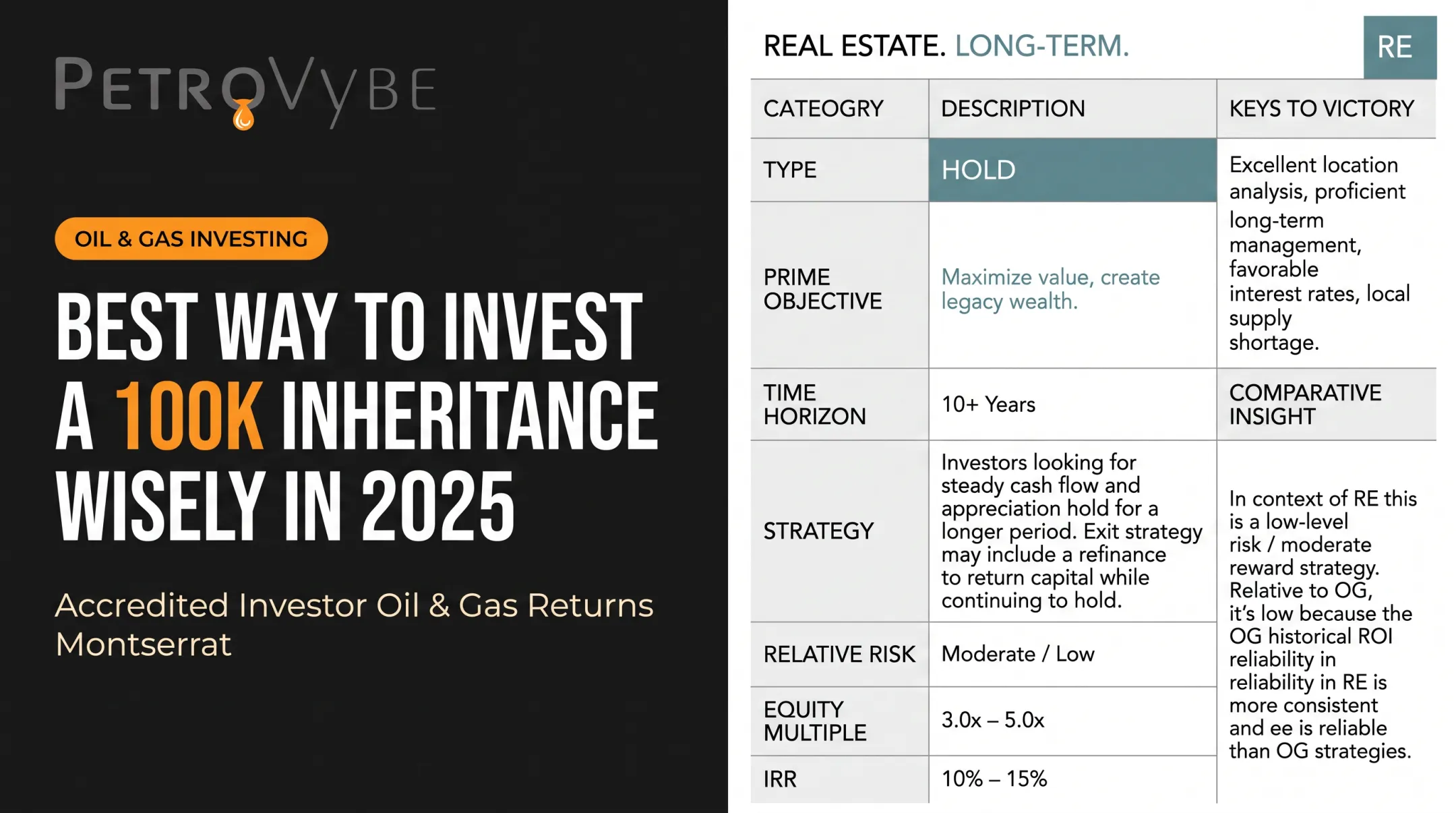
If a large inheritance is earmarked for long-term growth and you already have stocks and bonds covered, tangible assets outside public markets can reduce concentration. For accredited investors with $100,000 or more in liquidity, direct participation in natural gas development is one path: exposure that often moves differently from equities, with potential tax treatment tied to drilling and depletion rules. PetroVybe is one example of this structure — a Texas natural gas development partnership built around producing assets rather than paper securities:
- Position: ~58,000 acres in Lavaca County, Texas
- Operations: ~400 acquired wells and 57+ planned new wells
- Hold period: 10-year target
- Return framework: targeted ~2.2x–5.8x MOIC (multiple on invested capital) and ~26% IRR; first distributions may take 2–3 years This model is not a fit for every heir. It requires accredited status, illiquidity tolerance, and patience while production ramps.
Consider Dollar-Cost Averaging
Once you know the destination mix, the next decision is timing. If deploying a lump sum all at once feels risky, gradual investing can ease you in. Vanguard's research found that lump-sum investing outperforms cost-averaging roughly two-thirds of the time, but cost-averaging can reduce short-term regret when market timing keeps you up at night.
Updating Your Estate Plan After an Inheritance
A windfall is a clear reason to revisit your estate documents. Your financial picture just changed. Your plan should reflect that.
Review these immediately:
- Your will — does it still reflect your actual assets and wishes?
- Trust structures — could a trust improve tax efficiency for what you now hold?
- Powers of attorney and healthcare directives — still current, still the right people named?
- Beneficiary designations — retirement accounts and life insurance pass outside your will, so update them directly

Many heirs skip this step. Once assets are titled in your name, schedule a review with your estate attorney so the new balance sheet is written into your documents.
Common Mistakes to Avoid When Managing an Inheritance
- Moving too fast. One study found that roughly half of inherited wealth gets spent or lost rather than saved, based on a longitudinal survey of heirs across their 20s, 30s, and 40s.
- Ignoring tax rules. Retirement accounts, real estate, and investment income each carry different obligations, and the 10-year IRA rule alone catches many heirs off guard.
- Skipping professional advice. A Bank of America legacy study found only 55% of Americans over 55 even had a will, and just 18% had all three core estate documents in place, so many heirs face transfers with little prior guidance and still never bring in an advisor.
None of these mistakes are hard to avoid. Slow down, learn the tax rules that apply, and get advice before you move money.
Frequently Asked Questions
What is the first thing you should do when you inherit money?
Pause. Confirm the legal form of the inheritance and park funds in an interest-bearing account before making any major decisions. Rushing usually costs more than waiting does.
What is the best investment if you inherit money?
There's no single best investment. It depends on your time horizon, risk tolerance, and diversification needs. A mix of traditional assets and alternatives, such as direct natural gas development for accredited investors, can fit larger inheritances better than one option alone.
What kind of account should I put inheritance money in?
For short-term needs, use savings accounts, money market funds, or CDs. For long-term goals, a brokerage or retirement account typically makes more sense once you have a plan.
Do you have to pay taxes on an inheritance?
There's no federal inheritance tax, though a handful of states impose one. Income generated by inherited assets afterward (dividends, rental income, interest) is taxable.
How soon do you have to make financial decisions after an inheritance?
Most decisions aren't urgent and can wait several months. Exceptions include RMD deadlines on inherited retirement accounts and any applicable estate tax filing deadlines.