
This article is general education, not investment, tax, or legal advice. Tax rules change and apply differently to every taxpayer. Taxes are quietly the biggest drag on long-term wealth. A 7% annual return sounds great until the IRS takes a third of it every single year, compounding your losses right alongside your gains. That's why high-income earners spend so much time hunting for tax-free and tax-advantaged vehicles instead of just parking money in a standard brokerage account.
The good news: tax-free investments don't just shrink your IRS bill. They also help your money compound faster and hold its value better against inflation over decades.
This guide breaks down the top tax-free and tax-advantaged options available to US investors right now, how each one works, and how to figure out which fits your situation.
TL;DR
- Tax-exempt income vehicles (munis, Treasuries) keep interest off your return; tax-free accounts (Roth IRA, HSA, 529) shelter growth and qualified withdrawals
- Oil & gas development programs can deduct a large share of capital against active income (W-2, capital gains)—not only passive income
- Match the vehicle to your tax problem: bracket, liquidity needs, and time horizon decide the ranking
- For 2025–2026, the strongest US options cluster around munis, Roth structures, HSAs, 529s, and IDC-heavy energy partnerships. This treatment requires the investor to elect general partner status in the Subscription Agreement and may be limited in a given year by the excess business loss limitation under IRC §461(l).
Overview of Tax-Free Investments in the US Market
A tax-free investment is any asset or account where the income, growth, or withdrawal is exempt from federal (and sometimes state) tax. The catch: "tax-free" rarely means the entire investment is untouched. Usually it's specific income types, like interest or qualified withdrawals, that escape federal tax.
For tax year 2025, the top federal income tax rate is 37%, kicking in above $626,350 for single filers and $751,600 for married couples filing jointly.
If you're anywhere near that bracket, tax drag isn't theoretical. It's eating a third of every dollar you earn.
This is why accredited and high-net-worth investors increasingly look past the standard stocks-bonds-real estate playbook. They're searching for structures that offer deductions against active W-2 or capital gains income, not just passive income sheltered inside a retirement account.
Below is a ranked breakdown of the top tax-free and tax-advantaged options, scored on:
- Strength of tax exemption
- Accessibility
- Liquidity
- Growth potential
Top Tax-Free Investments for US Investors
Each option below is ranked by how strong the tax benefit is, how accessible it is to real investors, liquidity, and long-term growth potential.
PetroVybe Natural Gas Development Program
PetroVybe is a private Texas-based oil and natural gas development company offering accredited investors direct participation in natural gas development projects across a 58,000-acre position in Lavaca County, part of the Gulf Coast Basin.
The standout feature is the Intangible Drilling Cost (IDC) deduction. Unlike most tax breaks that only offset passive income, IDC deductions apply against active income, including W-2 earnings and capital gains. This treatment requires the investor to elect general partner status in the Subscription Agreement and may be limited in a given year by the excess business loss limitation under IRC §461(l).
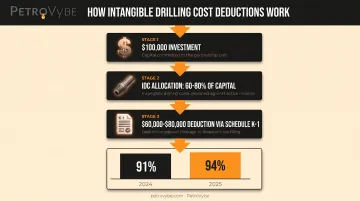
PetroVybe partners received a 94% tax deduction against active income in 2025. Prior result; not a promise of any future deduction. Those are achieved results, not projections.
Here's how the math works: IDCs typically represent a first-year deduction target of approximately 70–80% of invested capital in a new-drilling project. A $100,000 investment could generate a $60,000-$80,000 deduction, delivered via Schedule K-1, either upfront or spread over five years. This treatment requires the investor to elect general partner status in the Subscription Agreement and may be limited in a given year by the excess business loss limitation under IRC §461(l).
| Attribute | Detail |
|---|---|
| Tax Treatment | Up to 100% total deduction against active income via IDC write-offs; 94% achieved in 2025. Prior result; not a promise of any future deduction. |
| Target Returns | ~26% target IRR and 2.2x-5.8x modeled net exit MOIC over a 10-year window |
| Eligibility | Accredited investors with $100k+ liquidity seeking diversification beyond traditional securities This treatment requires the investor to elect general partner status in the Subscription Agreement and may be limited in a given year by the excess business loss limitation under IRC §461(l). |
The project is backed by an independent $48 million proved reserves valuation (PV-09, prepared by Lee Keeling & Associates, Tulsa, March 2026) and a clean 2025 audit from Weaver.
Roth IRA / Roth 401(k)
For investors who want tax-free growth with higher liquidity than a private energy partnership, Roth accounts are the standard option. They are funded with after-tax dollars, and qualified growth and withdrawals come out tax-free.
Why they stand out:
- No required minimum distributions (RMDs), so your money can keep compounding
- Contributions (not earnings) can be withdrawn anytime without penalty
- Ideal for anyone with decades left to let compounding work
| Attribute | Detail |
|---|---|
| Tax Treatment | Tax-free qualified withdrawals after age 59½ and a 5-year holding period |
| Contribution Limits | $7,000 for 2025, plus $1,000 catch-up at age 50+; Roth 401(k) deferral limit is $23,500 |
| Best For | Long-term retirement savers below income eligibility thresholds |
One wrinkle: Roth IRAs phase out at higher incomes ($150,000-$165,000 for single filers in 2025). Roth 401(k)s have no such ceiling, but your employer needs to offer the feature.
Health Savings Account (HSA)
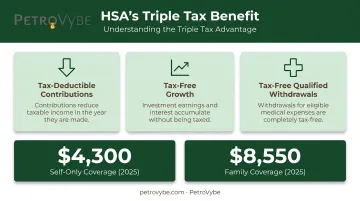
The HSA is the only account offering a genuine triple tax benefit: deductible contributions, tax-free growth, and tax-free withdrawals for qualified medical expenses.
You need to be enrolled in a high-deductible health plan (HDHP) to qualify. After age 65, an HSA also functions like a backup retirement account. Non-medical withdrawals just get taxed like ordinary income, with no penalty.
| Attribute | Detail |
|---|---|
| Tax Treatment | Triple tax advantage (deduction, growth, withdrawal) |
| Eligibility | Must be enrolled in an HDHP |
| Best For | Investors wanting to offset current and future medical costs tax-free |
For 2025, contribution limits sit at $4,300 for self-only coverage and $8,550 for family coverage, per IRS Publication 969.
Municipal Bonds & Municipal Bond Funds
Munis are issued by state and local governments, and their interest income is generally exempt from federal tax. Buy a bond issued in your home state, and you may also avoid state tax.
Yields run lower than taxable bonds, but for high earners, the after-tax math can favor munis heavily. As of late 2025, the 10-year tax-exempt benchmark yielded 2.710%, compared to 4.180% on the 10-year Treasury — a 65% ratio.
Run the taxable-equivalent yield to compare them fairly:
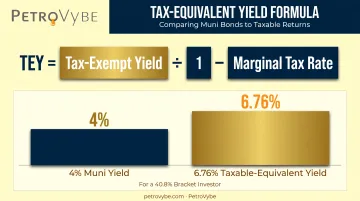
- TEY = tax-exempt yield / (1 - marginal tax rate)
- Example: a 4% muni yield equals roughly 6.76% taxable-equivalent yield for someone in the 40.8% combined bracket
| Attribute | Detail |
|---|---|
| Tax Treatment | Federal tax-exempt interest; potential state/local exemption |
| Risk Level | Low-to-moderate; subject to interest rate and credit risk |
| Best For | High-tax-bracket investors seeking stable, tax-exempt income |
One catch: capital gains on munis, if you sell above your purchase price, are still fully taxable.
529 Education Savings Plans
529 plans let money grow tax-free and come out tax-free, as long as it's spent on qualified education expenses. Contributions aren't federally deductible, but plenty of states offer their own deduction or credit.
| Attribute | Detail |
|---|---|
| Tax Treatment | Tax-free growth and withdrawals for qualified education expenses |
| Contribution Limits | Vary by state; Virginia's Invest529 caps at $675,000 per beneficiary |
| Best For | Parents and guardians saving for future education costs |
These aren't just for tuition anymore. Many plans now cover K-12 tuition, apprenticeship programs, and even limited student loan repayment.
How This Guide Selected the Best Tax-Free Investments
This guide scored each option against four criteria that decide whether a tax break actually improves after-tax wealth:
- Strength of the tax exemption or deduction
- Accessibility, including eligibility rules, minimums, and contribution caps
- Liquidity and how easily you can access or exit capital
- Fit for active versus passive income needs
Those filters cut through most of the marketing noise. Investors still trip over a few avoidable errors:
- Comparing muni yields to taxable yields without calculating the taxable-equivalent yield
- Ignoring state tax rules that can significantly change after-tax returns
- Confusing income-tax exemption with growth-tax exemption (they're not the same thing)
- Overlooking eligibility requirements until after committing capital
This guide also weighed contribution limits, eligibility thresholds, and third-party validation of projected returns. Not every "tax-advantaged" pitch comes with an independent audit or engineering report—and that gap is often where the risk hides.
Conclusion
There's no single tax-free investment that fits every investor. Your income bracket, timeline, and liquidity needs will point you toward a different mix, whether that's maxing out a Roth IRA, layering in municipal bonds, or exploring deductions against active income through alternative assets.
Before committing capital anywhere, calculate your taxable-equivalent yield and talk to a tax professional. The math changes fast depending on your bracket.
If you're an accredited investor carrying a heavy tax burden on W-2 income or capital gains and want active-income deductions paired with long-term passive income, explore PetroVybe's natural gas development opportunities.
Frequently Asked Questions
What is the most tax-efficient way to invest $100,000?
Diversify across tax-advantaged accounts first (Roth IRA, HSA), then layer in municipal bonds for income. High earners with active income may also consider oil & gas IDC deductions for substantial upfront write-offs. This treatment requires the investor to elect general partner status in the Subscription Agreement and may be limited in a given year by the excess business loss limitation under IRC §461(l).
Where should I invest after-tax money?
Taxable brokerage accounts with tax-efficient ETFs or index funds, municipal bonds, and Roth conversions are the most common destinations for after-tax dollars.
What are the best tax-free investments?
Roth IRAs, HSAs, municipal bonds, and 529 plans top the list for most investors. Each targets a different goal: retirement, healthcare, income, or education.
What are the top 3 safest investments?
US Treasuries, high-yield savings accounts or CDs, and municipal bonds rank among the safest options when capital preservation matters more than high returns.
Where can I get a 10% return on my investment?
Higher returns usually mean higher risk. Private alternatives—real estate, private equity, and energy development—can target 10%+, with illiquidity and principal risk; the S&P 500 has averaged about 10% annually since 1957.
Informational requests only. PetroVybe projects are offered solely to verified accredited investors. Submitting this form does not create an investment or advisory relationship.