This article is general education, not investment, tax, or legal advice. Tax rules change and apply differently to every taxpayer. Passive income has a branding problem. The name suggests money that arrives tax-free while you sleep. It doesn't. The IRS taxes most passive income at the same marginal rates as your paycheck, and high earners can owe an extra 3.8% on top of that.
This misconception costs investors real money every tax season. Many assume rental income or limited partnership distributions get some special break, then file surprised.
This guide breaks down what actually counts as passive income under IRS rules, how it's taxed, and where legal deductions—including some tied to natural gas development—can meaningfully cut the bill.
Key Takeaways
- Passive income is generally taxed at your ordinary marginal rate, not a discounted "passive" rate
- High earners face a possible 3.8% Net Investment Income Tax (NIIT) on top of regular tax
- Municipal bond interest and qualified Roth withdrawals can be tax-exempt
- Depreciation, depletion, and IDC deductions can shrink your taxable passive income substantially
- Certain oil and gas investments allow deductions against active income, not just passive income. This treatment requires the investor to elect general partner status in the Subscription Agreement and may be limited in a given year by the excess business loss limitation under IRC §461(l).
What Counts as Passive Income for Tax Purposes?
The IRS defines passive activity in Publication 925 as one of two things:
- A trade or business where you don't materially participate
- Rental activity, even if you're involved, unless you qualify as a real estate professional
That definition is narrower than everyday usage. Interest, dividends, and capital gains are portfolio income, not passive income, even though people casually lump them together.
Passive vs. Portfolio: The Confusion
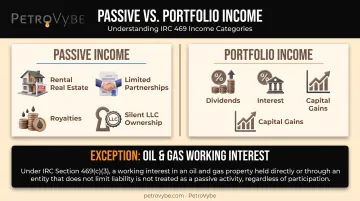
- Passive income: rental real estate, limited partnership interests, royalties, silent ownership in an S-corp or LLC
- Portfolio income: dividends, interest, most capital gains
The distinction matters because passive activity loss (PAL) rules only apply to passive income. Portfolio income sits outside those limits and is taxed under its own rules.
Material Participation Tests
Pub. 925 lists seven tests to determine if you materially participate in an activity. Meeting just one flips income from passive to active. The most common:
- More than 500 hours of participation during the year
- Your participation is substantially all the activity requires
- More than 100 hours, and no one else participates more than you
One notable exception: a direct working interest in an oil or gas well is automatically nonpassive under IRC 469(c)(3), regardless of material participation, as long as your liability isn't limited.
For accredited investors in oil and gas, that means qualifying losses and deductions can offset active income—including W-2 wages—instead of being trapped under PAL limits. This treatment requires the investor to elect general partner status in the Subscription Agreement and may be limited in a given year by the excess business loss limitation under IRC §461(l).
How Is Passive Income Taxed?
Here's the core fact: passive income is taxed at your ordinary marginal tax rate, the same brackets that apply to your salary.
2026 Federal Tax Brackets
| Filing Status | 22% Bracket Up To | 24% Bracket Up To | 32% Bracket Up To | 37% Begins Above |
|---|---|---|---|---|
| Single | $105,700 | $201,775 | $256,225 | $640,600 |
| Married Filing Jointly | $211,400 | $403,550 | $512,450 | $768,700 |
Source: Rev. Proc. 2025-32
The Passive Activity Loss (PAL) Rule
You generally can't use passive losses to offset your W-2 income or portfolio gains. Losses carry forward until you have passive income to absorb them, or until you sell the entire interest.
One exception: active participants in rental real estate can deduct up to $25,000 in losses against nonpassive income, provided they own at least 10% of the property. This allowance phases out between $100,000 and $150,000 in MAGI.
The 3.8% Net Investment Income Tax
High earners face an additional surtax on top of ordinary rates. NIIT applies to the lesser of your net investment income or the amount your MAGI exceeds:
- $200,000 for single filers
- $250,000 for married filing jointly
- $125,000 for married filing separately
These thresholds are not inflation-adjusted, so more taxpayers get pulled in every year as incomes rise.
Deductions Change the Math
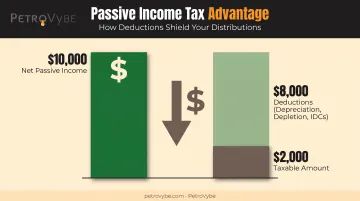
Depreciation, depletion, and Intangible Drilling Costs (IDCs) can cut the taxable slice of passive income sharply. A simplified example:
- $10,000 in net passive income
- $8,000 in eligible deductions (depreciation, depletion, IDCs)
- Taxable amount drops to just $2,000
You pay tax on $2,000, not $10,000. That gap is why depletion and IDC deductions matter so much in oil and gas partnerships.
Capital Gains Get a Better Deal
Long-term capital gains and qualified dividends use separate, lower brackets—0%, 15%, and 20%:
| Filing Status | 0% Rate Up To | 15% Rate Up To | 20% Begins Above |
|---|---|---|---|
| Single | $49,450 | $545,500 | $545,500 |
| Married Filing Jointly | $98,900 | $613,700 | $613,700 |
Hold longer than one year and you get these preferential rates. Sell within a year and the gain is taxed like wages.
Legal Strategies to Reduce Taxes on Passive Income
Several legal moves can lower what you owe on passive income:
- Group related activities into one "economic unit" under Reg. 1.469-4 when they share ownership, control, or a business connection—this simplifies material participation testing across properties or ventures
- Use tax-advantaged accounts: for 2026, IRA limits are $7,500 ($8,600 catch-up at 50+), and HSA limits reach $4,400 for self-only coverage; income inside grows tax-deferred or tax-free
- Hold assets past one year so gains move from ordinary rates into the lower long-term capital gains brackets covered above
- Consider municipal bonds: interest on most state and local bonds is federally tax-exempt, and sometimes state tax-exempt, per IRS Publication 550
- Evaluate upstream oil and gas: IDC deductions from qualifying partnerships are not locked in the passive basket and can offset active W-2 income and capital gains directly. This treatment requires the investor to elect general partner status in the Subscription Agreement and may be limited in a given year by the excess business loss limitation under IRC §461(l).
PetroVybe's structure shows how that last point works in practice. Partners in PetroVybe ONE received 94% deductions against active income in 2025. Prior result; not a promise of any future deduction. Those deductions flow through a Schedule K-1 and come largely from IDCs, which typically represent a first-year deduction target of approximately 70–80% of invested capital in a new-drilling project. This treatment requires the investor to elect general partner status in the Subscription Agreement and may be limited in a given year by the excess business loss limitation under IRC §461(l).

None of this replaces professional advice. A CPA who understands your full tax picture should confirm which strategies fit before you act.
Are Rental Properties and Airbnb Income Treated the Same Way?
Not quite. Rental real estate defaults to passive treatment unless you qualify as a real estate professional, which requires:
- More than 750 hours in real property businesses
- More than 50% of your total personal service hours in those businesses
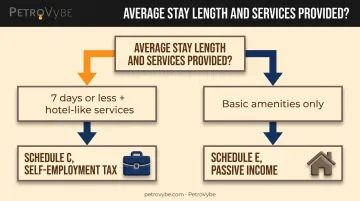
Airbnb and short-term rentals use different classification rules. Average stay length and the services you provide decide the outcome:
- Average stay 7 days or less + substantial hotel-like services (regular cleaning, linen changes, concierge-type help): treated as a business on Schedule C, subject to self-employment tax
- Basic amenities only, no significant services: stays on Schedule E as passive income—even when the average stay is short
Trash pickup and common-area maintenance do not count as “substantial services” for this test.
Why Natural Gas Development Offers a Different Tax Advantage
Most passive income deductions are trapped. Losses from a rental property, for example, can only offset other passive income. Oil and gas working interests break that rule.
Intangible drilling cost (IDC) deductions from qualifying natural gas and oil partnerships can offset active W-2 income and capital gains, not just passive income. That's a different tool for high earners who don't already have passive losses to draw against. This treatment requires the investor to elect general partner status in the Subscription Agreement and may be limited in a given year by the excess business loss limitation under IRC §461(l).
PetroVybe, a Texas-based natural gas development company, structures its PetroVybe ONE partnership around this principle. It targets up to 100% total tax deduction, with roughly 70% deductible in year one, passed through on Schedule K-1s as IDC and depletion deductions for accredited investors. This treatment requires the investor to elect general partner status in the Subscription Agreement and may be limited in a given year by the excess business loss limitation under IRC §461(l).
Key constraints and context:
- Open only to accredited investors with a documented $100,000 liquidity benchmark
- Targets and the 94% deduction figures from 2025 are historical or projected—not guarantees of future results. Prior result; not a promise of any future deduction.
For investors already maxing out traditional passive-loss strategies, the ability to apply these deductions against W-2 income and capital gains is the practical edge.
Frequently Asked Questions
What is the tax rate on passive income?
Passive income is generally taxed at your ordinary marginal rate, the same brackets that apply to wages. Long-term capital gains and qualified dividends are exceptions, taxed at lower preferential rates instead.
Who has to pay the 3.8% net investment income tax (NIIT) on passive income?
Single filers with MAGI above $200,000 and joint filers above $250,000. NIIT applies to the lesser of your net investment income or the amount your MAGI exceeds that threshold.
How can I reduce or avoid taxes on passive income?
Group related passive activities and use tax-advantaged accounts like IRAs. Hold assets over a year for capital gains treatment, and consider IDC-generating investments such as qualifying oil and gas partnerships.
What types of passive income are tax-exempt?
Municipal bond interest is generally federally tax-exempt. Qualified Roth IRA withdrawals after age 59½, with the account held at least five years, are also tax-free.
Can passive losses offset passive income?
Yes, in the same year. Excess losses carry forward. Active participants in rental real estate may also use a special $25,000 allowance against nonpassive income, subject to income phase-outs.
Are Airbnb and short-term rentals considered passive income?
It depends on services provided. Basic rentals under 7-day average stays still use Schedule E as passive income. Hotel-like services push the activity to Schedule C and self-employment tax.
Informational requests only. PetroVybe projects are offered solely to verified accredited investors. Submitting this form does not create an investment or advisory relationship.