
This guide breaks down exactly what an investment portfolio is, what goes into one, and how to build a structure that actually works for your income level and goals. If you're an accredited investor, a high-income W2 earner, or someone with $100,000 or more to deploy, this is especially relevant — because the strategies available to you go well beyond a standard brokerage account.
What you'll learn:
- The definition of an investment portfolio and how to think about it holistically
- The key asset classes that build a resilient portfolio
- A step-by-step process for constructing your own
- Why skipping alternative investments may be one of the most expensive decisions a high-income investor can make
Key Takeaways
- An investment portfolio spans multiple asset classes — not just stocks and bonds
- Asset allocation is the single greatest driver of long-term performance
- Diversification across sectors, geographies, and asset types reduces risk without sacrificing returns
- Alternative investments — real estate, commodities, energy development — deliver uncorrelated returns and tax advantages traditional portfolios can't match
- Consistent rebalancing beats chasing the "perfect" portfolio
What Is an Investment Portfolio?
An investment portfolio is the total collection of financial assets you own — stocks, bonds, mutual funds, real estate, cash, and alternative investments — viewed and managed as a unified whole rather than as separate, disconnected accounts.
That last part matters. Whether you hold a 401(k), a taxable brokerage account, and a real estate investment, all three together constitute your portfolio. Most investors manage each account in isolation and miss the bigger picture: how do these assets interact, overlap, and balance each other out?
That interaction — how your assets complement or undercut each other — is exactly what separates strategic portfolio management from reactive guesswork.
Strategic vs. Tactical Investing
Two broad approaches define how investors manage a portfolio:
- Strategic investing — setting long-term target allocations based on your goals and risk tolerance, then holding course through market cycles
- Tactical investing — shifting allocations short-term to exploit perceived market opportunities
The evidence strongly favors strategy over tactics. Vanguard's analysis found that tactical market timing had to be correct at least 75% of the time just to slightly edge a static 60/40 portfolio. That's a high bar — and most investors don't clear it.
What's in an Investment Portfolio: Key Asset Classes
A well-built portfolio draws from multiple asset classes, each serving a different role in the overall structure.
Stocks (Equities)
Stocks represent partial ownership in a company and generate returns through capital appreciation and dividends. Since 1926, U.S. equities have delivered roughly 10.5% nominal annualized returns, which makes them the primary growth engine of most portfolios.
The trade-off is volatility. Individual stocks carry concentrated risk, which is why most investors access equity exposure through index funds or ETFs rather than picking individual companies.
Bonds (Fixed Income)
Bonds are loans to governments or corporations, repaid with interest over time. They provide income stability and act as a counterbalance to equity swings, historically delivering around 5.4% nominal annualized returns since 1926.
Lower risk comes with lower return potential. During inflationary periods, fixed-rate bonds can also lose ground in real terms — a meaningful drawback for investors focused on purchasing power.
Mutual Funds and ETFs
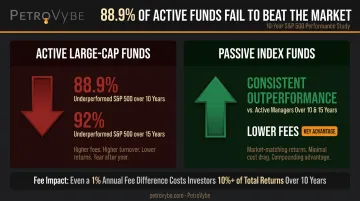
These vehicles let investors own a diversified basket of securities in a single holding. One important data point: according to SPIVA's 2024 scorecard, 88.9% of active large-cap funds underperformed the S&P 500 over 10 years and 92% underperformed over 15 years. Passive index funds win over the long run, primarily because of lower fees.
Cash and Cash Equivalents
Money market funds, Treasury bills, and similar holdings preserve liquidity — but they're not a wealth-building tool. After inflation, cash has historically delivered just 0.7% real annual return between 1960 and 2022. Use it as a liquidity buffer, not a wealth-building position.
Alternative Investments
Most individual investors underweight this category — and high-income earners often leave the most on the table here. Alternatives include:
- Real estate (direct and REITs)
- Commodities and precious metals
- Private equity and private credit
- Direct energy development investments
Alternatives typically carry lower correlation to public markets. Broad commodities, for example, show a 0.32 correlation with the S&P 500, meaning they often move independently of stock market swings. For investors whose portfolios are heavily concentrated in equities, that independence is where real diversification begins.
How to Build an Investment Portfolio Step by Step
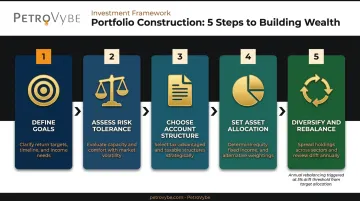
Step 1: Define Your Financial Goals
Every allocation decision flows from a clearly defined goal. Before selecting a single asset, identify what you're building toward:
- Retirement income
- Passive cash flow generation
- Wealth transfer to heirs
- Tax liability reduction
- A combination of the above
Each goal carries a different time horizon, risk tolerance, and asset mix. Combining them into one portfolio leads to misalignment — the result is an allocation that serves none of your objectives well.
Step 2: Assess Your Risk Tolerance and Time Horizon
Risk tolerance has two components: your financial capacity to absorb losses and your emotional willingness to sit through market downturns without panic-selling. Both matter.
A longer time horizon allows for more risk — there's more time to recover from inevitable drawdowns. Shorter horizons demand more conservative positioning.
A practical starting framework from Schwab's illustrative models:
| Time Horizon | Stocks | Bonds | Cash |
|---|---|---|---|
| 15+ years | 95% | 0% | 5% |
| ~10 years | 60% | 35% | 5% |
| 3–5 years | 20% | 50% | 30% |
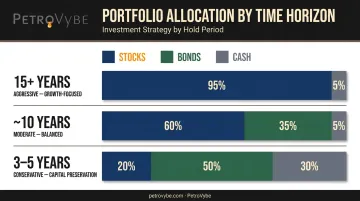
These are illustrative models, not prescriptions. The key variable is time: every decade closer to your goal typically warrants a meaningful shift toward capital preservation over growth.
Step 3: Choose the Right Account Structure
Account type affects both what you hold and what you keep after taxes. The basics:
- Tax-advantaged accounts (401(k), IRA, HSA) — ideal for tax-inefficient assets like bonds and actively traded funds
- Taxable brokerage accounts — better suited for tax-efficient growth assets like index funds held long term
Certain alternative investments, including direct energy participation programs, may carry distinct tax treatments that don't fit neatly into traditional account structures. Understanding where and how you hold each investment is a core part of portfolio construction — not an afterthought.
Step 4: Determine Asset Allocation
Asset allocation — how you distribute capital across asset classes — is the single greatest driver of long-term portfolio performance. Rules of thumb like "subtract your age from 110 to find your equity percentage" are reasonable starting points. They are not final answers.
Common allocation models:
- Aggressive — Heavy equities, minimal fixed income; suits long horizons (15+ years) where short-term volatility is tolerable
- Moderate — Balanced blend of growth and income; common for 7–12 year horizons
- Conservative — Bonds and cash dominant; prioritizes protecting capital over growing it
High-income investors with longer time horizons often err on the side of being too conservative — ironically, the more cautious stance can leave meaningful returns unrealized over decades.
That caution often shows up in another way: concentrating too narrowly within a single asset type. True diversification solves both problems at once.
Step 5: Diversify Within and Across Asset Classes
Owning 10 tech stocks isn't diversification. True diversification means spreading exposure across:
- Sectors (technology, healthcare, energy, financials)
- Geographies (domestic, international, emerging markets)
- Market caps (large, mid, small)
- Asset types (equities, fixed income, real assets, alternatives)
Assets with low correlation to each other smooth overall volatility. During the 2022 equity selloff, for instance, energy sector holdings gained more than 50% while broad stock indexes fell — a real-world demonstration of why asset-type diversification matters beyond just sector spreading.
Rebalancing keeps the portfolio aligned with its target. Vanguard's research supports annual rebalancing as optimal for most investors, with rebalancing triggered when any asset class drifts more than 5 percentage points from its target weight.
Why Alternative Investments Deserve a Place in Your Portfolio
Traditional stock-and-bond portfolios are well-understood — and they leave high-income investors exposed to two persistent problems: inflation erosion and heavy income taxation.
The 60/40 portfolio illustrates the vulnerability. According to Morningstar's 150-year stress test, a 60/40 portfolio fell nearly 17% nominally and 25.1% after inflation in 2022 — precisely because stocks and bonds declined together while inflation compounded the damage. It rebounded 11.1% in 2023, which shows why a single bad year doesn't condemn the model. It does, however, expose the structural limits of relying on just two correlated asset classes — and why alternatives exist.
The Case for Alternatives
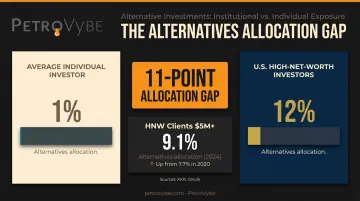
Research from KKR estimates that U.S. high-net-worth portfolios allocate roughly 12% to alternatives, compared to just 1% for the average individual investor. Cerulli Associates separately found that HNW clients (with $5M+ investable assets) averaged 9.1% in alternatives — up from 7.7% in 2020. That gap is wide, and it likely accounts for a measurable share of the return differential between sophisticated and retail investors.
Energy Development as an Alternative Asset
Natural resource and energy investments are real-asset alternatives with pricing tied to commodity demand rather than market sentiment — a genuinely different return driver than equities or fixed income.
The structural backdrop for natural gas is strengthening. Goldman Sachs projects approximately 3.3 Bcf/d of incremental U.S. natural gas demand by 2030, driven by data center power needs as AI-driven electricity consumption accelerates. The IEA separately projects global data-center electricity use to more than double, reaching around 945 TWh by 2030.
For accredited investors looking to access this sector directly, companies like PetroVybe offer natural gas development positions in South Texas (Lavaca County), structured as limited partnership units with a minimum investment of $100,000. These positions combine long-term asset appreciation with substantial upfront tax deductions — including Intangible Drilling Costs (IDC) that may be applied against active W2 income and capital gains, not just passive income.
In 2024 and 2025, PetroVybe partners received tax deductions of 91% and 94%, respectively, against active income. High-income earners carrying significant tax liability should understand how that structure differs from most alternatives before ruling out direct energy participation.
Important note: IRS rules for IDC deductions require a qualifying working interest structure, and individual tax situations vary. Consult a qualified tax professional before making any investment decision based on tax treatment.
Alternatives do carry meaningful trade-offs:
- Higher minimum investments (private equity SEC minimums are often $250,000+)
- Longer lock-up periods (private equity fund terms average 11+ years; private credit around 8.5 years)
- Less liquidity than publicly traded assets
- Greater variation in manager quality
These characteristics make alternatives most appropriate for accredited investors with sufficient deployable capital and a long time horizon.
Common Portfolio-Building Mistakes to Avoid
Most portfolio mistakes don't come from picking the wrong stocks — they come from predictable behavioral and structural errors that erode returns quietly over time. Accredited investors with complex tax situations face an added layer: mistakes that hurt average portfolios can be especially costly when active income and capital gains are already in play.
Mistake 1 — Chasing Performance
Rotating into last year's best-performing asset class is one of the most consistent ways to underperform. DALBAR found that the average equity investor earned 16.54% in 2024 versus 25.02% for the S&P 500 — an 848-basis-point gap attributed largely to poorly timed moves in and out of the market. Pick a sound allocation, then hold it through the noise.

Mistake 2 — Hidden Concentration
A portfolio of 10 tech stocks isn't diversified. Neither is a portfolio of 10 funds that all track capitalization-weighted benchmarks — because the top 10 S&P 500 constituents currently represent 36.4% of the index weight. Holdings that look diverse on the surface can be highly correlated underneath.
Mistake 3 — Ignoring Tax Drag
Returns that ignore taxes tell an incomplete story. Fidelity estimates that investors gave up approximately 2 percentage points of annual return to taxes over the 10 years through 2023. For high-income W2 earners in the top brackets, that drag compounds severely over a decade. Before committing capital, evaluate:
- After-tax return, not just gross return
- Account placement (tax-deferred vs. taxable accounts)
- Whether the investment structure offers any built-in tax offset — such as IDC deductions available through direct participation in oil and gas development
Frequently Asked Questions
What is in an investment portfolio?
A portfolio typically contains stocks, bonds, mutual funds, ETFs, and may include alternative assets like real estate, commodities, and energy investments. All holdings — across one or multiple accounts — are managed as a collective whole rather than in isolation.
How much money do I need to invest to make $3,000 a month?
It depends on the yield. At a 6% annual yield, you'd need roughly $600,000 in assets ($600,000 × 0.06 = $36,000/year ÷ 12 = $3,000/month). Higher-yield alternatives can reduce this threshold but typically carry greater risk.
What is the 30/30/30/10 rule for investing?
This framework — commonly described as 30% stocks, 30% bonds, 30% real estate or alternatives, 10% cash or speculative assets — is one of many informal allocation models. No recognized institutional origin has been verified, so use it to prompt thinking about balance across asset classes, not as a prescriptive formula.
What is the 12/20/80 rule?
Generally described as: keep 12 months of expenses in emergency savings, invest 20% of income, and allocate 80% of invested assets to long-term growth vehicles. It offers a structural starting point for savings discipline, though the right ratios vary by income level, tax situation, and investment goals.
How often should I rebalance my investment portfolio?
Annual rebalancing is the baseline recommendation for most investors. Trigger a rebalance when any asset class drifts more than 5% from its target allocation. Investors using robo-advisors or target-date funds may have rebalancing handled automatically.
Disclosure: PetroVybe and its team members are not licensed financial advisors, and nothing on this website constitutes financial or investment advice or a recommendation to buy, sell, or hold any investment. PetroVybe and its team members are not tax advisors, accountants, or tax strategists, and nothing on this website constitutes tax advice or a tax strategy. PetroVybe and its team members are not attorneys, and nothing on this website constitutes legal advice. All content is provided for general informational purposes only. You should consult your own independent financial advisor, tax professional, and legal counsel before making any decision.