This article is general education, not investment, tax, or legal advice. For decades, direct exposure to oil and gas exploration and production sat behind institutional walls. Pension funds, endowments, and family offices got the deal flow. Everyone else got shares of publicly traded energy stocks, if they wanted energy exposure at all.
That's shifted. Accredited investors now have access to direct working-interest positions in E&P projects, often with tax advantages that outperform real estate depreciation.
Many high-income earners face a familiar problem: a heavy W-2 or capital gains tax bill with few active-income offsets. Add inflation chipping away at fixed-income returns, and the case for tangible, cash-flowing assets gets stronger. This article breaks down what E&P investment actually is, how the structure works, the tax mechanics, the risks, and how to vet an opportunity like PetroVybe's Texas natural gas development.
Key Takeaways
- Direct E&P stakes put capital into oil and gas wells and can unlock large first-year tax deductions
- Qualified IDC structures may offset active income, including W-2 wages and capital gains
- Operator skill, well performance, and commodity prices drive returns; diligence is essential
- AI and data-center power demand is renewing investor focus on natural gas development This treatment requires the investor to elect general partner status in the Subscription Agreement and may be limited in a given year by the excess business loss limitation under IRC §461(l).
What Does E&P Stand For? Understanding the Basics
E&P stands for Exploration & Production — the upstream segment of the oil and gas industry. It covers finding reservoirs, drilling wells, and extracting hydrocarbons.
This is distinct from the rest of the value chain:
- Upstream (E&P): Discovery, drilling, extraction
- Midstream: Pipelines, gathering, storage, transport
- Downstream: Refining, petrochemicals, retail marketing
Investor capital in a direct E&P deal goes toward leasing, drilling, and producing wells, not toward pipelines or gas stations.
Two roles define how that capital is put to work:
- Operator: Manages drilling, permitting, and day-to-day production (PetroVybe OpCo LLC, for example, operates under a Texas Railroad Commission license)
- Passive working-interest partners: Fund a share of costs and receive a proportional share of revenue, without running daily operations
How Oil & Gas E&P Investment Works
The core mechanic is the working interest model: investors fund a share of drilling and development costs in exchange for a proportional share of production revenue. No revenue without production; no deduction without qualifying costs.
Types of E&P Investment Structures
| Structure | What You Own | Trade-off |
|---|---|---|
| Working interest | Operating stake, cost + revenue share | Liability exposure, but eligible for active-income IDC treatment |
| Royalty interest | Revenue share, no cost obligation | No drilling deductions; less control |
| Private placement/fund | Pooled stake managed by adviser | Fees, less transparency, entity-dependent tax treatment |
Direct working interests, such as PetroVybe units. Participation begins at one unit of $100,000, with add-on subscriptions from $25,000, put capital into a specific well’s cost and revenue stream. Public E&P shares offer market-price exposure and dividends, but not direct IDC treatment or well-level upside.
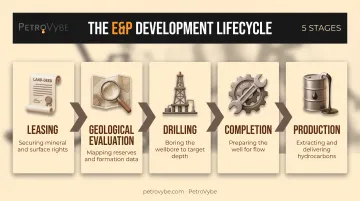
The Development Lifecycle: From Lease to Production
Every project moves through the same basic phases:
- Leasing — securing mineral and surface rights
- Geological evaluation — mapping subsurface data to identify drillable locations
- Drilling — physically boring the well
- Completion — fracturing, casing, and preparing for flow
- Production — ongoing extraction and revenue generation
Reducing dry-hole risk at the evaluation stage is the single biggest lever on project economics. PetroVybe’s Chief Geophysicist, Michael Stamatedes, has a documented 75.2% success rate in profitable location selection, versus an industry peer average below 40%, backed by third-party engineering validation of reserves. Disclaimer: these results were achieved at prior companies.
Key Financial Metrics Investors Should Understand
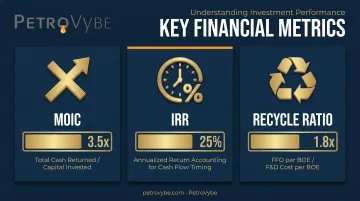
Once a well is producing, three numbers matter most when you compare deals:
- MOIC (Multiple on Invested Capital): Total cash returned divided by capital invested. A 3x MOIC means $3 back for every $1 in.
- IRR (Internal Rate of Return): Annualized return that accounts for when cash flows arrive. Two deals with the same MOIC can post very different IRRs depending on distribution timing.
- Recycle Ratio: FFO per BOE divided by F&D cost per BOE—how efficiently spending converts into producing reserves.
Always ask whether MOIC and IRR figures are gross or net of fees, and request the dated cash-flow schedule behind the headline number.
Why Investors Are Turning to Oil & Gas E&P Now
Three forces are driving the shift: tax treatment that reaches active income, structural demand from AI power loads, and diversification beyond stocks, bonds, and real estate.
Tax Mechanics That Actually Move the Needle
Intangible Drilling Costs (IDCs) cover labor, fuel, and site prep with no salvage value. These costs can often be expensed in year one rather than depreciated over years.
When held through a qualifying structure, the deduction can offset active income, including W-2 earnings and capital gains — not just passive income, where most real estate losses get stuck.
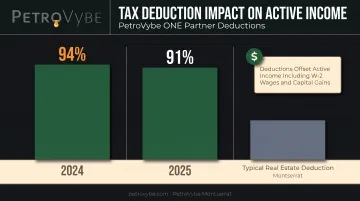
PetroVybe's own partner data backs this up: 94% tax deduction against active income in 2025. Prior result; not a promise of any future deduction. That outcome differs sharply from the passive-loss limitations most investors hit with rental real estate.
The AI Electricity Story
Natural gas is increasingly positioned to meet electricity demand from AI data centers. U.S. data-center electricity use hit 176 TWh in 2023, or 4.4% of national consumption, according to a 2024 Lawrence Berkeley National Laboratory report.
Deloitte projects data-center-related gas demand could reach 3-12 Bcf/d by 2030. The range is wide, but the direction is clear: more gas-fired generation will be needed to power that load.
Inflation Hedging and Market Momentum
Commodities have historically provided diversification during high-inflation periods, according to S&P Dow Jones Indices research. Tangible, producing assets behave differently than stocks and bonds when prices rise.
Capital flows tell a mixed story. Hart Energy reported in mid-2024 that upstream private-equity fundraising had declined amid ESG pressure and weaker historical returns. That's a signal of capital scarcity, not a green light. It also means well-run, transparent operators face less competition for good deals.
For investors with $100,000+ in liquidity, direct E&P offers genuine diversification beyond the usual stock-bond-real estate mix.
Risks Every E&P Investor Should Weigh
No serious discussion skips the downside. E&P is not a bond substitute.
Three risks dominate:
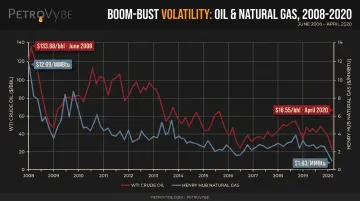
- Commodity price volatility — WTI crude ran from $133.88/bbl in June 2008 to $16.55 in April 2020. Henry Hub natural gas swung from $12.69/MMBtu to $1.63 over roughly the same window, per EIA historical pricing data. Boom-bust cycles are the norm, not the exception.
- Operational and geological risk — Dry holes happen. Wells underperform type curves. Operator track record and independent reserve validation matter more here than in almost any other asset class.
- Illiquidity — Direct working interests aren't exchange-traded. Unlike a public energy stock you can sell in seconds, a private placement typically locks capital for the full hold period, often a decade.
How to Evaluate an E&P Investment Opportunity
Vetting an operator takes more than reading a pitch deck. Look for:
- Third-party reserve validation — an independent PV-9 or PV-10 report from a licensed engineering firm, not just operator projections
- Technical team track record — geological success rate versus industry norms, and financial leadership's history scaling EBITDAX
- Transparency practices — reporting cadence, MOIC/IRR modeling, and data access
- Regulatory standing — confirm the operator holds proper state licensing, such as a Texas Railroad Commission operator license
- Investor eligibility — confirm the offering is limited to verified accredited investors under SEC rules for private placements
PetroVybe’s Gulf Coast Basin position in Lavaca County maps cleanly to several of these checks:
- ~58,000 acres with ~400 producing wells and 57+ planned new wells
- $48 million PV-09 valuation from a licensed third-party engineering firm. Prepared by Lee Keeling & Associates, Tulsa, March 2026.
- Quarterly reporting plus a data portal with offering documents, K-1 samples, and engineering reports
- Target 10-year MOIC of ~2.2x–5.8x and a 26% IRR
Those return figures are forecasts, not guarantees. Discuss them directly with the operator before committing capital.
Frequently Asked Questions
What does E&P stand for?
E&P stands for Exploration & Production, the upstream segment of the oil and gas industry focused on finding and extracting reserves. It excludes transportation, refining, and marketing activities.
Who can invest in oil and gas E&P projects?
These opportunities are typically limited to accredited investors under SEC private placement rules—meeting set income or net-worth thresholds. Many offerings also require a minimum investment. For PetroVybe units, participation begins at one unit of $100,000, with add-on subscriptions from $25,000.
How much tax deduction can E&P investors expect?
Intangible Drilling Cost (IDC) deductions can offset a large share of invested capital in year one—often 70–100%—against active income, including W2 earnings. Exact amounts vary by project and your tax structure. This treatment requires the investor to elect general partner status in the Subscription Agreement and may be limited in a given year by the excess business loss limitation under IRC §461(l).
What is the difference between a working interest and a royalty interest?
A working interest shares both drilling costs and production revenue. A royalty interest receives revenue from production without any cost or liability obligations.
How risky is investing in oil and gas E&P compared to stocks?
E&P investments carry higher volatility and illiquidity than public equities, plus geological and commodity-price risk. In exchange, they offer tax efficiency and return potential that public stocks rarely match.
What returns can investors typically target in E&P deals?
Target ranges vary widely by project, but MOIC and IRR figures should always be discussed directly with the operator. PetroVybe's own project targets a 10-year MOIC of roughly 2.2x-5.8x and a ~26% IRR, presented as forecasts rather than guarantees.
Informational requests only. PetroVybe projects are offered solely to verified accredited investors. Submitting this form does not create an investment or advisory relationship.