
Introduction
You receive a payment from an oil and gas operator. For high-income investors, the question that follows is the one that shapes your entire tax return: is this royalty income or business income?
The answer determines which IRS form you file, whether you owe self-employment tax, and which deductions you can claim — and against what income. For a landowner receiving passive mineral rights royalties, the classification is relatively straightforward.
For an accredited investor holding a working interest in a drilling partnership, it's a different story. The distinction can mean deducting losses against W2 wages or being locked out of those deductions entirely.
This guide breaks down exactly how the IRS distinguishes between these two income types, how to report each correctly, and why the classification carries outsized strategic weight for high-income investors.
Key Takeaways
- Schedule E Part I covers royalty income from mineral rights: no self-employment tax, but losses can't offset active income
- Working interest income is non-passive under IRC §469(c)(3), reported on Schedule C or a partnership K-1
- Intangible Drilling Costs (IDCs) are deductible against active income, including W2 wages and capital gains
- Self-employment tax hits working interest income at a combined 15.3% rate
- Misclassifying income type triggers IRS audit risk, back taxes, and forfeited deductions
Royalty Income vs Business Income: Quick Comparison
| Attribute | Royalty Income | Business (Working Interest) Income |
|---|---|---|
| IRS Form | Schedule E Part I | Schedule C or K-1 → Schedule E Part II |
| Self-Employment Tax | Generally none | 15.3% applies |
| Income Classification | Portfolio income (not passive activity income) | Non-passive (active) |
| Primary Deductions | Percentage depletion (15% of gross income) | IDCs, depreciation, LOEs, depletion |
| Who Earns It | Mineral/land rights owners | Working interest holders |
| Form Received | 1099-MISC Box 2 | 1099-NEC Box 1 or K-1 |
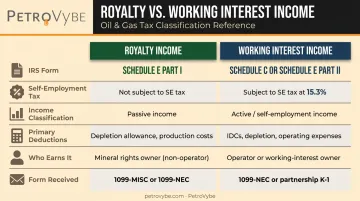
One nuance worth flagging: working interest income flowing through a partnership arrives on a Schedule K-1, not a Schedule C. It still reports in the nonpassive columns of Schedule E Part II — a separate section from the Part I used for simple royalties.
What Is Royalty Income in Oil and Gas?
Royalty income is the payment a mineral rights or land owner receives from an operator in exchange for allowing resource extraction from their property. The royalty owner contributes no capital toward drilling costs, bears no operational risk, and has no involvement in running the well. They simply collect a share of production revenue.
How the IRS Taxes Royalty Income
Per the 2025 Schedule E Instructions, oil, gas, and mineral royalties are reported in Schedule E Part I, using property type code 6, with gross royalties on line 4.
Royalties are classified as portfolio income, not passive activity income under IRC §469. IRS Publication 925 and the temporary regulation at 26 CFR §1.469-2T(c)(3) confirm this classification.
The practical effect: royalty income sits outside the passive activity loss system. You cannot use passive losses to offset it, but it's also not active income.
Key tax features of royalty income:
- Not subject to self-employment tax under IRC §1402(a)(1)
- Eligible for the percentage depletion deduction — currently 15% of gross income from the property for qualifying independent producers and royalty owners under IRC §613A(c)
- Cannot be offset by drilling or operating expense deductions, since those costs are borne entirely by the operator
What Royalty Owners Receive
The operator issues a Form 1099-MISC with the royalty amount in Box 2, when gross royalties reach the $10 reporting threshold. Working interest payments are explicitly excluded from Box 2 — they go on a different form entirely.
What Is Business Income from Oil and Gas?
A working interest is fundamentally different from a royalty. The working interest holder owns an operating stake in the well — sharing both production revenue and the costs of drilling and ongoing operations. That cost exposure is what drives the different tax treatment, and why the IRS carves out special rules for it.
The IRC §469(c)(3) Rule
Working interests in oil and gas property are excluded from passive activity treatment under IRC §469(c)(3)(A) — but only when held "directly or through an entity which does not limit the liability of the taxpayer." Under §469(c)(3)(B), this exclusion applies regardless of material participation. You don't have to physically work the well to qualify.
The liability condition matters significantly:
- General partner with unlimited liability → non-passive treatment generally applies
- Limited partner or LLC member with limited liability → non-passive treatment is not automatic; must satisfy ordinary material participation tests instead
Key Deductions Available to Working Interest Holders
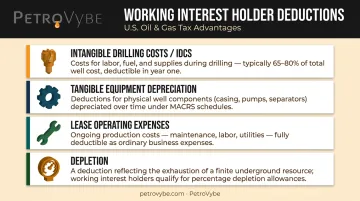
Working interest owners can access a far broader set of deductions than royalty owners:
- Intangible Drilling Costs (IDCs) — wages, fuel, chemicals, supplies, and contractor costs related to drilling and well preparation, deductible under IRC §263(c)
- Tangible equipment depreciation — casing, tanks, pipelines (capitalized, not IDC-eligible)
- Lease operating expenses — ongoing production costs
- Depletion — via percentage method (if qualifying as an independent producer under IRC §613A) or cost depletion under IRC §611–612
Schedule C vs Schedule E: How to Report Each Correctly
Misclassifying royalty income as business income — or vice versa — can cost you the IDC deductions you're entitled to, trigger unexpected self-employment tax, or raise an audit flag when the IRS cross-references your 1099 forms against your return.
Schedule E Part I: For Mineral Royalty Income
Passive mineral rights royalties belong on Schedule E Part I. A typical royalty owner reports:
- Gross royalties received (pulled from 1099-MISC Box 2)
- Depletion deduction (percentage method at 15% of gross income, subject to limits)
- Any directly allocable allowable expenses
No Schedule C. No self-employment tax. No IDC deductions.
Schedule C: For Direct Working Interest Owners
When a sole proprietor holds a working interest directly — not through a partnership — the net income or loss reports on Schedule C. Key implications for direct working interest owners:
- Subject to self-employment tax at 15.3% combined rate (12.4% Social Security + 2.9% Medicare), per the 2025 Schedule SE Instructions
- Income reported on Form 1099-NEC Box 1 (not 1099-MISC)
- Eligible for IDC deductions, but SE tax applies to net earnings
The Partnership K-1 Path: Schedule E Part II
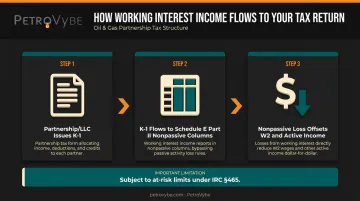
Most oil and gas working interest investments are structured as partnerships or LLCs. In these cases, the investor receives a Schedule K-1 (Form 1065) that flows onto Schedule E Part II — specifically into the nonpassive income or loss columns (columns i and k), not the passive columns.
This is where investors often get confused: Schedule E Part II looks similar to Part I, but the columns serve completely different functions. A qualifying general-partner working interest goes in the nonpassive columns.
That placement matters. It makes IDC-driven losses available against active income — including W2 earnings — subject to at-risk limits under IRC §465.
Documentation investors should maintain:
- Evidence of the type of interest held (general vs. limited partner)
- Records confirming liability is not limited (if claiming §469(c)(3) non-passive status)
- All K-1s and supporting partnership documentation
- Cost basis tracking for at-risk calculations
The Critical Reporting Error to Avoid
Reporting working interest income on Schedule E Part I as if it were passive royalty income is one of the more costly misclassifications an oil and gas investor can make. It forfeits the ability to apply IDC deductions against W2 or other active income.
It also creates a clear audit flag. The IRS cross-references 1099-NEC filings against Schedule E Part I — and a mismatch is exactly the kind of inconsistency that triggers a closer look.
Why Working Interest Classification Is a Tax Advantage for High-Income Investors
Most investment vehicles — stocks, REITs, bonds — produce income that cannot offset W2 wages. Oil and gas working interests are one of the few IRS-recognized exceptions, and the IDC deduction is the mechanism that makes this possible.
How IDC Deductions Work
Under IRC §263(c) and Treasury Regulation §1.612-4, an operator (which includes working interest holders) may elect to expense IDCs in the year paid or incurred rather than capitalizing them. Qualifying costs include wages, fuel, repairs, hauling, supplies, and similar costs necessary for drilling and preparing wells for production.
What doesn't qualify: physical equipment with salvage value — casing, tanks, pipelines, and recoverable hardware. Those get capitalized and depreciated.
According to API's January 2025 industry analysis, IDCs can represent up to 85% of the costs of drilling a well, though the actual proportion varies by project. The election to expense IDCs is made for the first tax year in which they are paid or incurred and is generally binding going forward.
The Active Income Offset Advantage
Because a qualifying working interest is non-passive under §469(c)(3), losses from IDC deductions are not entered on Form 8582 (the passive activity loss form). The allowed loss reduces nonpassive taxable income directly — including W2 wages — rather than sitting in a passive loss carryforward.
That said, several rules govern how much you can deduct in a given year.
Key limitations:
- Deductions are capped by your amount at risk (capital contributed plus qualifying recourse debt)
- Excess business loss rules under IRC §461(l) may limit current-year deductions for high-income filers
- The AMT preference for excess IDCs under IRC §57(a)(2) can affect the net benefit for some taxpayers
How PetroVybe's Structure Applies
These rules apply in practice — here's how one structure executes them.
PetroVybe's accredited investor partners participate through PetroVybe Partners LP and receive K-1 tax documents reflecting IDC deductions and partnership income or loss. PetroVybe OpCo LLC serves as the operator of record with the Texas Railroad Commission, holding a direct working interest in development projects in Lavaca County, South Texas.
Recent partner results illustrate the scale of this deduction:
- A $600,000 capital contribution generated $401,772 in IDC-related deductions (per a redacted 2025 K-1 sample), applied against ordinary income
- Partners received a 94% tax deduction against ordinary income in 2024 and 91% in 2025
- Verified investor Nizar A. reported eliminating a $30,000 tax liability through PetroVybe's K-1 structure
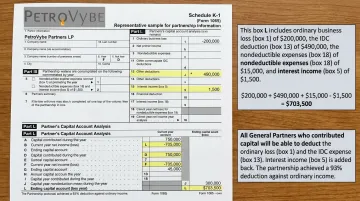
One cost to factor in: working interest income flowing through a general partnership is subject to self-employment tax. For most high-income investors, the net savings from IDC deductions and depletion far exceed that cost — but investors should model the full picture with a CPA familiar with oil and gas taxation before committing capital.
Conclusion
The classification question — royalty income or business income — is not a technicality. It determines your forms, your deductions, and your exposure to self-employment tax.
Here's how the two paths compare in practice:
- Royalty income — Schedule E Part I, portfolio income, no SE tax, percentage depletion only. Fits mineral and land rights owners collecting production payments without operational involvement. Low complexity, but limited tax planning upside.
- Working interest income — K-1 flows to Schedule E Part II (nonpassive) or Schedule C; SE tax applies; IDC deductions available against active income. Fits investors willing to bear operational risk in exchange for a far deeper deduction profile.
For high-income W2 earners or investors with substantial capital gains, the right classification isn't just a filing decision — it's a material tax strategy. Working interest structures, for instance, can unlock IDC deductions that offset active income — including W2 wages and capital gains — in the year drilling occurs. Royalty arrangements offer none of that. A CPA who specializes in oil and gas partnerships can confirm your classification, lock in every allowable deduction, and keep you clear of the audit risk that misclassification invites.
Frequently Asked Questions
Are royalties considered active business income?
Royalties are generally portfolio income — not active business income and not passive activity income under IRC §469. The exception applies when the taxpayer is actively in the trade or business of generating that income (for example, operating a resource extraction business). Standard oil and gas royalties from mineral rights ownership do not meet this threshold.
Where do I report royalty income on my tax return?
Most royalty income is reported on Schedule E Part I. If the royalty income comes from a trade or business you actively operate, it may move to Schedule C. Working interest investors in oil and gas partnerships report through Schedule E Part II (nonpassive columns) via a K-1.
What is the difference between royalty income and working interest income?
Royalty income compensates a property owner for allowing extraction — no operational costs, no risk. Working interest income comes from holding an active stake in the drilling and production operation, where you share in both revenues and costs.
Do oil and gas royalties go on Schedule C or Schedule E?
Oil and gas royalties from mineral rights ownership go on Schedule E Part I as portfolio income, with no self-employment tax. Schedule C applies only if the landowner is also actively participating in the extraction business as a trade or business — rare in practice for most landowners.
Is oil and gas royalty income subject to self-employment tax?
Passive royalty income from mineral rights is generally not subject to self-employment tax. Working interest income — where the investor bears operational risk — is subject to SE tax at a combined rate of 15.3%, even if the investor does not physically work the well.
What is the depletion deduction, and who can claim it?
The depletion deduction offsets the gradual exhaustion of a finite resource like oil or gas reserves — and both royalty owners and working interest holders can claim it. Royalty owners and qualifying independent producers may use percentage depletion at 15% of gross income under IRC §613A(c), subject to income limits; working interest holders may alternatively use cost depletion under IRC §611–612.
Disclosure: PetroVybe and its team members are not licensed financial advisors, and nothing on this website constitutes financial or investment advice or a recommendation to buy, sell, or hold any investment. PetroVybe and its team members are not tax advisors, accountants, or tax strategists, and nothing on this website constitutes tax advice or a tax strategy. PetroVybe and its team members are not attorneys, and nothing on this website constitutes legal advice. All content is provided for general informational purposes only. You should consult your own independent financial advisor, tax professional, and legal counsel before making any decision.