

Right now, one of the largest wealth movements in American history is underway. Trillions of dollars are shifting from Baby Boomers to their children and grandchildren, and how that money gets structured will determine whether it grows or disappears within a generation.
This article breaks down what intergenerational wealth actually means, shows real examples of it in action, and walks through strategies, including tax-advantaged alternative investments, that high-income earners can use to build and protect it.
Key Takeaways
- Intergenerational wealth requires ongoing growth and structuring, not a single inheritance event.
- Diversifying into alternative assets helps families weather market volatility and inflation.
- Trusts, gifting, and IDC tax deductions shape how much wealth survives the transfer.
- Financial education for heirs often decides whether wealth lasts beyond one generation.
What Is Intergenerational Wealth?
Intergenerational wealth refers to financial assets, property, and knowledge that pass from one generation to the next and continue growing along the way. Rather than a single check written at death, it operates as an ongoing system of growth and transfer.
This wealth typically includes:
- Cash and investment accounts — brokerage portfolios, retirement funds, trusts
- Real estate — rental properties, land, family homes that appreciate over decades
- Business ownership — companies passed to children who continue operating them
- Non-financial assets — education, values, and financial habits taught to heirs
Building this kind of wealth typically happens over decades. Consistent investing, ownership of appreciating assets, tax-efficient planning, and disciplined reinvestment all work together to keep capital compounding instead of leaking away to taxes.
Examples of Intergenerational Wealth in Action
Two patterns show up again and again in families that successfully build multi-generational wealth:
- Family businesses and real estate portfolios. A manufacturing company passed from grandfather to father to daughter, or a rental portfolio that keeps producing income long after the original owner is gone.
- Diversified investment structures. Portfolios blending stocks, trusts, and alternative assets, built specifically to transfer tax-efficiently to children and grandchildren.
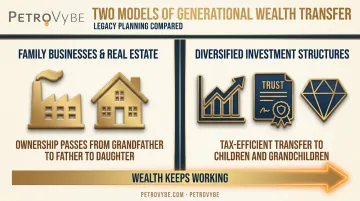
In each case, the wealth keeps working long after the first generation is gone.
Intergenerational Wealth vs. Simple Inheritance
An inheritance is a one-time transfer that happens at death. Intergenerational wealth is different. It's an ongoing strategy that combines structuring and growth, reinforced by education passed across multiple generations.
Inheritance is a single event; intergenerational wealth is an ongoing practice built across generations.
The Great Wealth Transfer: Why This Moment Matters
The numbers behind this shift are large. Cerulli Associates projects $124 trillion in wealth will transfer through 2048, with $105 trillion going directly to heirs and $18 trillion to charity. Nearly 81% of that total originates from Baby Boomers and older generations.
Here's the part that matters most for anyone reading this: the transfer isn't evenly distributed. High-net-worth and ultra-high-net-worth households represent just 2% of all households, yet that same 2% is projected to account for more than 50% of the total transfer volume — roughly $62 trillion.
That concentration means proactive planning matters far more for families in this bracket than the averages suggest. And the planning window is shrinking. Interest rates and inflation have shifted the math on nearly every asset class, and tax law keeps moving the goalposts.
Congress recently locked in a $15 million lifetime gift and estate exclusion for 2026, avoiding a scheduled reduction.
That's good news today, but tax law rarely stays fixed for long. Families that wait for "someday" to structure their wealth transfer often find the rules have changed by the time they act.
Core Strategies to Build & Preserve Intergenerational Wealth
Building wealth that survives multiple generations takes more than traditional financial planning. It requires combining time-tested tools with newer, tax-efficient investment approaches.
Diversify Beyond Traditional Assets
Stocks, bonds, and real estate form a solid foundation, but relying on them exclusively leaves a family exposed to shared market cycles, inflation risk, and downturns all at once.
Accredited investors have another option: direct investments in alternative assets like natural gas and oil development. These offerings can generate passive income streams alongside substantial upfront tax deductions against active income, something most traditional investments can't touch.
This matters more now because of where electricity demand is headed. The International Energy Agency projects US data-center electricity consumption will grow roughly 130% from 2024 to 2030, with data centers accounting for nearly half of all US electricity-demand growth in that window.
Natural gas already supplies more than 40% of the power used by data centers today, and it's projected to remain the largest source of additional supply.
PetroVybe is one example of this type of opportunity. It's a private, Texas-based natural gas development company that gives accredited investors direct access to early-stage energy assets in Lavaca County and the Gulf Coast Basin, through its PetroVybe ONE partnership.
Rather than buying into a mature, already-priced-in energy stock, investors take a direct equity position at the development stage, where value gets created.
The structure carries meaningful tax weight. Through Intangible Drilling Cost deductions, PetroVybe partners received a 94% deduction against active income in 2024 and a 91% deduction in 2025, applying against W-2 wages and capital gains, not just passive income.

That's a distinction real estate investors don't typically get unless they qualify as full-time real estate professionals.
Use Trusts and Strategic Gifting
Trusts remain one of the most reliable tools for controlling how and when wealth moves to the next generation. They can:
- Protect assets from creditors, lawsuits, and divorce settlements
- Control distribution timing (staggered payouts instead of a lump sum)
- Reduce estate tax exposure through irrevocable structures
Gifting strategies work alongside trusts. For 2026, the annual gift-tax exclusion sits at $19,000 per recipient, meaning a couple can give $38,000 per child, per year, with zero tax consequences.
The lifetime exclusion, now set at $15 million per individual, allows for much larger transfers during one's lifetime rather than waiting until death.
Build Financial Literacy in the Next Generation
Money without knowledge doesn't last. Teaching heirs about compound interest, diversification, and stewardship is what keeps wealth intact past the first handoff.
RBC's research on this is telling: among high-net-worth individuals, 66% reported high financial confidence when their education started before age 18, compared to just 41% when it started at age 55 or later. The gap widens the longer families wait.
Practical steps that work:
- Include heirs in annual financial reviews, even informally
- Walk them through actual account statements, not just concepts
- Give them small decision-making responsibilities early, with guardrails
- Discuss the "why" behind investment choices, not just the "what"
Common Challenges in Transferring Wealth Across Generations
Even well-funded families run into predictable obstacles. Knowing them ahead of time is half the battle.
- Communication breakdowns. Poor communication and unresolved family dynamics cause more failed transitions than tax mistakes or bad advisors combined.
- Tax and legal complexity. Estate tax exemptions shift with legislation, and 12 states plus D.C. still levy estate or inheritance taxes, making professional guidance essential.
- Overconcentration risk. Tying too much wealth to one heir or asset class magnifies the damage if that asset underperforms. Diversifying into alternative assets, such as direct energy investments, spreads that risk across generations.
None of these challenges are unusual. They're the reason planning early, and revisiting the plan regularly, matters more than the size of the estate itself.
Frequently Asked Questions
What is intergenerational wealth?
Intergenerational wealth is the combination of financial assets, resources, and values passed and grown across multiple generations. It differs from a single inheritance because it involves ongoing strategy, not a one-time transfer.
What is an example of generational wealth?
Common examples include family businesses passed down through relatives and real estate portfolios generating rental income for heirs. Diversified investment accounts structured for multi-generational tax efficiency are another common vehicle.
How much money do you need for generational wealth?
There's no fixed dollar threshold. What matters more is consistent investing paired with tax-efficient structuring and long-term asset appreciation.
What's the difference between generational wealth and a simple inheritance?
Inheritance is typically a one-time asset transfer that occurs at death. Intergenerational wealth, by contrast, involves ongoing structuring and growth, paired with education that benefits multiple future generations.
When should a family start planning for intergenerational wealth transfer?
Start as early as possible, even with modest assets. Early planning maximizes compounding and gives families time to set up trusts and gifting strategies before tax law or circumstances change.
How can alternative investments help build tax-efficient generational wealth?
Alternative investments, such as PetroVybe's direct energy development partnerships, offer diversification beyond stocks and real estate. These structures can generate passive income and significant upfront tax deductions that support long-term legacy goals.