Most articles explain Intangible Drilling Cost (IDC) deductions in the abstract. Few show what actually happens on a real tax return, or how a poorly structured deal can turn a "guaranteed" write-off into a passive loss that sits unused for years.
This article breaks down the specific tax code provisions behind oil and gas investing, the real dollar advantages, the mistakes that quietly erase them, and how to structure a position so you actually capture the benefit.
Key Takeaways
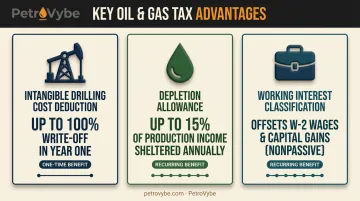
- IDC deductions can offset up to 100% of your investment against active income in year one.
- Depletion allowances shelter up to 15% of production income annually for a well's life.
- A working interest, unlike passive investments, can offset both W-2 wages and capital gains.
- Passive activity and at-risk rules can trap deductions if the ownership structure is wrong.
What Are Oil & Gas Investment Tax Benefits?
These benefits are a set of federal tax code provisions rooted in the Tax Reform Act of 1986 and codified across IRC §469(c)(3) and §263(c). They let investors in domestic drilling projects deduct drilling and operating costs against taxable income.
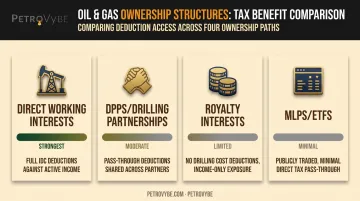
They apply differently depending on how you hold your position:
- Direct working interests: the strongest tax treatment, discussed below
- Direct Participation Programs (DPPs) and drilling partnerships: similar deductions, spread across multiple investors
- Royalty interests: generally excluded from these benefits
- MLPs and oil and gas ETFs: minimal access to these deductions
These provisions build tangible asset wealth by pairing upfront tax savings with years of potential cash flow long after the initial deduction is filed.
Key Tax Advantages of Oil & Gas Investments
Three advantages drive most of the tax appeal here, and each one answers a different question: how much of your investment is deductible, when you can take it, and against what type of income.
Intangible & Tangible Drilling Cost Deductions
Intangible Drilling Costs (IDCs) cover labor, chemicals, and drilling prep work. Industry sources commonly cite these costs as representing 60% to 80% of a well's total cost, and under IRC §263(c), operators can elect to deduct 100% of qualifying IDC in the year it's paid or incurred, even on a well that never produces a barrel.
Tangible Drilling Costs (equipment, casing, wellheads) work differently. These are depreciated under MACRS: 5-year recovery for contract-drilling property, 7-year recovery for producer assets like wellheads and gathering equipment.
Here's why front-loading matters. Say you invest $100,000 and roughly 70% is allocated to IDC in year one, a figure PetroVybe's own partners have realized in recent tax years. At the current top federal rate of 37%, that's a **$25,900 reduction in your tax bill** in the same year you invest, before any production income even starts.
PetroVybe partners saw this play out directly: 94% of investment deducted against active income in 2024, and 91% in 2025. That's not a theoretical benchmark. It reflects how a well-run development program allocates real capital between drilling and equipment costs.
KPIs this affects:
- Effective tax rate for the current year
- After-tax cost of capital
- Net cash outlay required in year one
This advantage matters most if you're a high-income W-2 earner, a business owner, or someone facing a large capital gains event this year. The catch: the deduction has to be taken in the year the well is spud, so timing your investment matters as much as the deduction itself.
Depletion Allowance: Ongoing Tax-Sheltered Income
Once a well starts producing, the tax benefit shifts from a one-time deduction to a recurring one. Under IRC §613A, independent producers and royalty owners can shelter up to 15% of gross income from that property every year through percentage depletion.
In practice, this means a portion of the distribution reported on your K-1 arrives tax-free, similar to how depreciation shelters part of a rental property's cash flow. Depletion isn't unlimited, though. It generally caps at 100% of taxable income from the property and 65% of the taxpayer's overall taxable income, with any excess carried forward.
Eligibility here depends on independent producer and royalty owner status, not a generic "small producer" label. The relevant limit is a 1,000-barrel-per-day average production threshold (or the natural gas equivalent), which most individual investors in a syndicated well never approach.
KPIs this affects:
- After-tax yield on distributions
- Net cash flow per payout
- Long-term MOIC over the hold period
This one matters most if you're planning to hold a position through the 5-10 year production life of a well. It's built for investors chasing durable passive income, not a single tax-season write-off.
Active Income Classification: The Working Interest Exception
This is the most misunderstood piece of the puzzle, and one of the most valuable. Under IRC §469(c)(3), a working interest held without liability protection is automatically treated as nonpassive, meaning losses can offset W-2 wages, business income, and capital gains, not just other passive income.
Compare that to royalty interests or typical limited partnership structures, which are usually classified as passive and can only offset passive income you may not have.
For an investor in the 37% bracket with a large bonus, business sale, or stock gain this year, that distinction is worth real money. It's a core reason accredited investors turn to oil and gas as a year-end planning tool rather than waiting for passive income to materialize elsewhere.
PetroVybe designs its partnership offerings with this working interest characteristic in mind, though the exact tax treatment always depends on how your specific unit is documented. Any investor pursuing this benefit should confirm the classification of their position with a CPA before relying on it.
KPIs this affects:
- Taxable income reduction
- Adjusted gross income (AGI)
- QBI deduction eligibility for pass-through income
This matters most for specialized service business owners phasing out of QBI deductions, or anyone facing a one-time income spike they need to offset before year-end.
What Happens When These Rules Are Misunderstood or Ignored
The tax code rewards precision, and it punishes assumptions. Three mistakes show up again and again:
The passive activity trap. Invest through the wrong entity (an LLC or limited partnership that shields liability), and your losses convert from valuable nonpassive deductions into passive losses. Those losses often sit unused for years, since matching passive income rarely shows up in the same tax year.
The at-risk limitation surprise. IRC §465 limits deductible losses to your amount at risk, tracked on Form 6198. Over-claim beyond that limit, and you'll face deduction recapture in later years. IRS Publication 925 details this calculation, essential reading before claiming a large first-year deduction.
Operator risk. A well-drafted PPM means nothing if the wells don't produce. Partnering with an unproven or opaque operator can turn what looked like a tax play into a straight capital loss. Deductions don't matter if the underlying asset fails.
None of these mistakes are exotic. They're common, and each one is avoidable with the right entity structure, careful at-risk tracking, and a vetted operator with a proven, transparent track record in place before you invest.
How to Maximize Your Oil & Gas Tax Benefits
Getting the tax treatment right starts before you sign anything, not after.
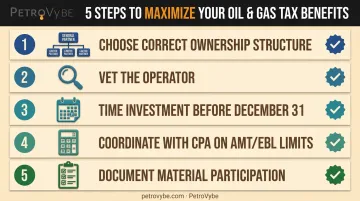
- Choose the correct ownership structure first. Working interest versus a liability-limited entity determines whether your losses are nonpassive or passive, and getting it wrong compromises every deduction that follows.
- Vet the operator, not just the deduction. Prioritize independent engineering validation over headline tax numbers. PetroVybe's wells, for example, carry a $48MM third-party PV-09 valuation and a 75.2% success rate, well above the industry's sub-40% average.
- Time your investment before December 31. The IDC deduction must be captured in the year the well is spud. Waiting until January can push your write-off into next year's return.
- Coordinate with a CPA on Alternative Minimum Tax (AMT) and Excess Business Loss limits. 2025 EBL thresholds sit at $313,000 single and $626,000 married filing jointly, though these figures change annually.
- Document participation if you're pursuing material participation status as an alternative path to nonpassive treatment, rather than relying solely on the working interest exception.
Due diligence should feel as thorough as your tax planning. Ask for reserve reports, audited financials, and public regulatory records (Texas Railroad Commission filings, for instance) before wiring capital.
Conclusion
The real value in oil and gas tax benefits comes from matching structure to your income situation (working interest versus passive entity), not from chasing the biggest deduction headline. First-year IDC write-offs, ongoing depletion shelter, and long-term production income aren't separate perks. They compound together over the life of a well.
This compounding is reinforced by the market itself, as AI-driven electricity demand accelerates the need for domestic natural gas, keeping this space rich with opportunity. Accredited investors should still treat operator due diligence, such as verifying third-party reserve reports from developers like PetroVybe, with the same seriousness they bring to the tax code itself. The deduction only matters if the well behind it actually produces.
Frequently Asked Questions
Does investing in oil and gas reduce taxes?
Yes, qualifying working interest investments can reduce taxable income through IDC deductions and depletion allowances on tangible drilling costs. These benefits still fall under passive activity and at-risk rules, which determine how much of the deduction you can actually use.
What are the benefits of investing in oil and gas?
The main benefits are upfront IDC tax deductions, ongoing depletion-sheltered cash flow once wells produce, and diversification into a tangible, inflation-resistant asset class outside stocks and real estate.
Is it a good idea to invest in oil and gas right now?
It depends on your accreditation status, risk tolerance, tax situation, and liquidity needs. AI and data center electricity growth is a genuine demand tailwind, but commodity price swings and operator risk remain real factors to weigh.
Who qualifies to invest in oil and gas drilling programs like these?
These programs are typically limited to accredited investors who meet SEC income or net worth thresholds ($200,000 individual/$300,000 joint income, or $1 million net worth excluding primary residence), given their private placement structure.
Can oil and gas investment losses offset W-2 income?
Only qualifying working interests held without liability protection are treated as nonpassive and can offset W-2 wages under IRC §469(c)(3). Most royalty interests and limited partnership positions don't qualify for this treatment.
What's the difference between the IDC deduction and the depletion allowance?
IDC is an upfront, largely one-time deduction on drilling costs taken in the year a well is spud. Depletion is an ongoing annual deduction against production income, available every year the well generates revenue.