
Here's the uncomfortable truth: two retirees with identical $1 million portfolios can end up with wildly different lifetime tax bills, simply because one understood how withdrawal order, account type, and timing interact. Tax-efficient investing isn't about dodging taxes. It's about sequencing and structuring your income so you legally keep more of what you earned.
This article covers how different accounts get taxed, the withdrawal strategies that actually move the needle, and a few lesser-known tools, including alternative assets, that retirees often overlook.
TL;DR
- Retirees keep more income by minimizing taxes on withdrawals, capital gains, and other retirement sources
- Account type (Traditional, Roth, taxable) determines exactly how each withdrawal gets taxed
- Strategic withdrawal sequencing and Roth conversions can cut lifetime tax liability
- Natural gas development and similar tax-advantaged alternatives can offset ordinary income for accredited investors
- Consult a qualified tax advisor before implementing any strategy
Understanding How Retirement Accounts Are Taxed
Your retirement savings likely sit in three different tax "buckets," and each one gets treated differently when you pull money out.
Traditional 401(k) and IRA
Withdrawals are taxed as ordinary income at your regular federal rate. Every dollar you pull out stacks on top of Social Security, pensions, or other income, potentially pushing you into a higher bracket. Every dollar you pull out stacks on top of Social Security, pensions, or other income, potentially pushing you into a higher bracket. After age 73, required minimum distributions (RMDs) force these withdrawals whether you need the cash or not.
Roth Accounts
Because you already paid tax on contributions, qualified withdrawals are completely tax-free. To qualify, you generally need to be at least 59½ and have held the account for five years. Because you already paid tax on contributions, qualified withdrawals are completely tax-free. To qualify, you generally need to be at least 59½ and have held the account for five years. Roth IRAs also have no RMDs during the original owner's lifetime, which gives you more control over when taxable income shows up.
Taxable Brokerage Accounts
These are subject to capital gains tax rates rather than ordinary income rates. Depending on your total taxable income, you might even land in the 0% long-term capital gains bracket — for 2025, that's up to $48,350 for single filers and $96,700 for married couples filing jointly, according to the IRS capital gains guidance.
Understanding this breakdown matters because it's the foundation for every strategy below. Which bucket you pull from, and when, determines your tax bill more than almost any investment decision you'll make.

Top Tax-Efficient Investing Strategies for Retirees
These strategies are ordered by how much impact they typically have on lifetime tax burden and how broadly they apply to retiree situations.
Strategic Withdrawal Sequencing
The conventional wisdom from firms like Vanguard, Fidelity, and T. Rowe Price all point to the same default order: taxable accounts first, then tax-deferred, then Roth last. This approach lets tax-deferred and Roth balances keep compounding as long as possible. That strict order can backfire later. Once taxable accounts are gone, large tax-deferred withdrawals often land right as Required Minimum Distributions (RMDs) begin, creating a mid-retirement tax bump that can push you into a higher bracket than necessary. An alternative, sometimes called proportional or bracket-aware withdrawal, spreads withdrawals across account types each year instead of draining one bucket at a time. Retirement researcher Michael Kitces argues for a dynamic, bracket-aware approach: fill lower tax brackets (including the 0% capital gains bracket) each year rather than saving all the tax-deferred pain for later. Exact savings depend on your income mix and future rates, but the tradeoff is clear:
- Strict sequential order maximizes tax-deferred compounding but risks a future tax bump
- Bracket-aware/proportional order smooths taxable income and can lower lifetime taxes if RMDs or future rates are expected to rise

Roth IRA Conversions
Converting Traditional IRA funds to a Roth means paying tax now on the converted amount, in exchange for tax-free growth and withdrawals later. The trick is timing it right. The best conversion windows are low-income years: early retirement before Social Security or pension income starts, or a year with unusually low investment income. Converting when your account balance is temporarily depressed also means you pay tax on a smaller number. As financial advisor Brian Schmehil put it, "Conversions only make sense if you're achieving some form of tax arbitrage, meaning paying less now to avoid higher taxes in the future," according to Kiplinger's coverage of Roth conversions. A few practical notes:
- Conversions cannot be reversed once made, per IRS Publication 590-B
- Spreading a large conversion over several years helps you avoid jumping brackets in any single year
- Waiting until late in the year gives you a clearer picture of total income before deciding how much to convert
Qualified Charitable Distributions (QCDs)
If you give to charity and are 70½ or older, a QCD lets you send money directly from your IRA to a qualified charity. That amount counts toward your RMD but is excluded from taxable income entirely. For 2025, the annual QCD limit is $108,000 per individual, per IRS Publication 526. Married couples can each use their own limit, doubling the potential exclusion. This is one of the few strategies that reduces both your RMD obligation and your taxable income simultaneously, without requiring you to itemize deductions.
Tax-Loss Harvesting and Asset Location
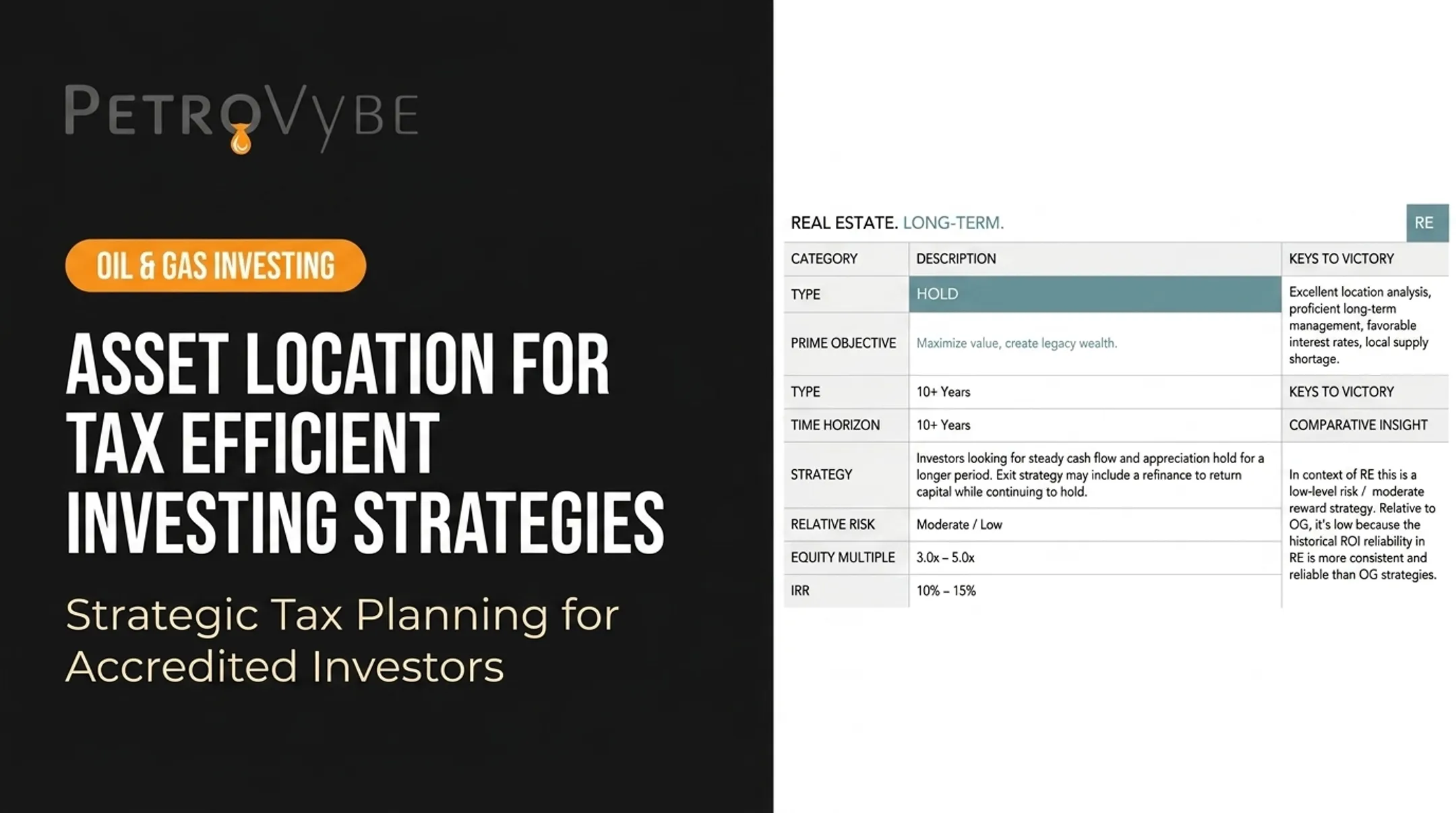
Asset location means placing the right investments in the right account type. Bonds and high-turnover funds generate taxable interest or short-term gains, so they belong in tax-deferred accounts. Tax-efficient index funds and stocks, which benefit from favorable capital gains rates, fit better in taxable accounts. Vanguard's research found this isn't just theoretical:
- Asset location adds roughly 6.1 basis points annually for investors heavily concentrated in a 401(k)
- For investors with a more balanced account mix, it adds about 13.3 basis points per year in after-tax returns Compounded over 20–30 years of retirement, those fractions of a percent become real money. Tax-loss harvesting is the companion strategy: selling losing positions to offset realized capital gains elsewhere in your portfolio. Just watch the wash-sale rule — you can't buy a "substantially identical" security within 30 days before or after the sale, or the loss gets disallowed.

Alternative Investments with Built-In Tax Advantages
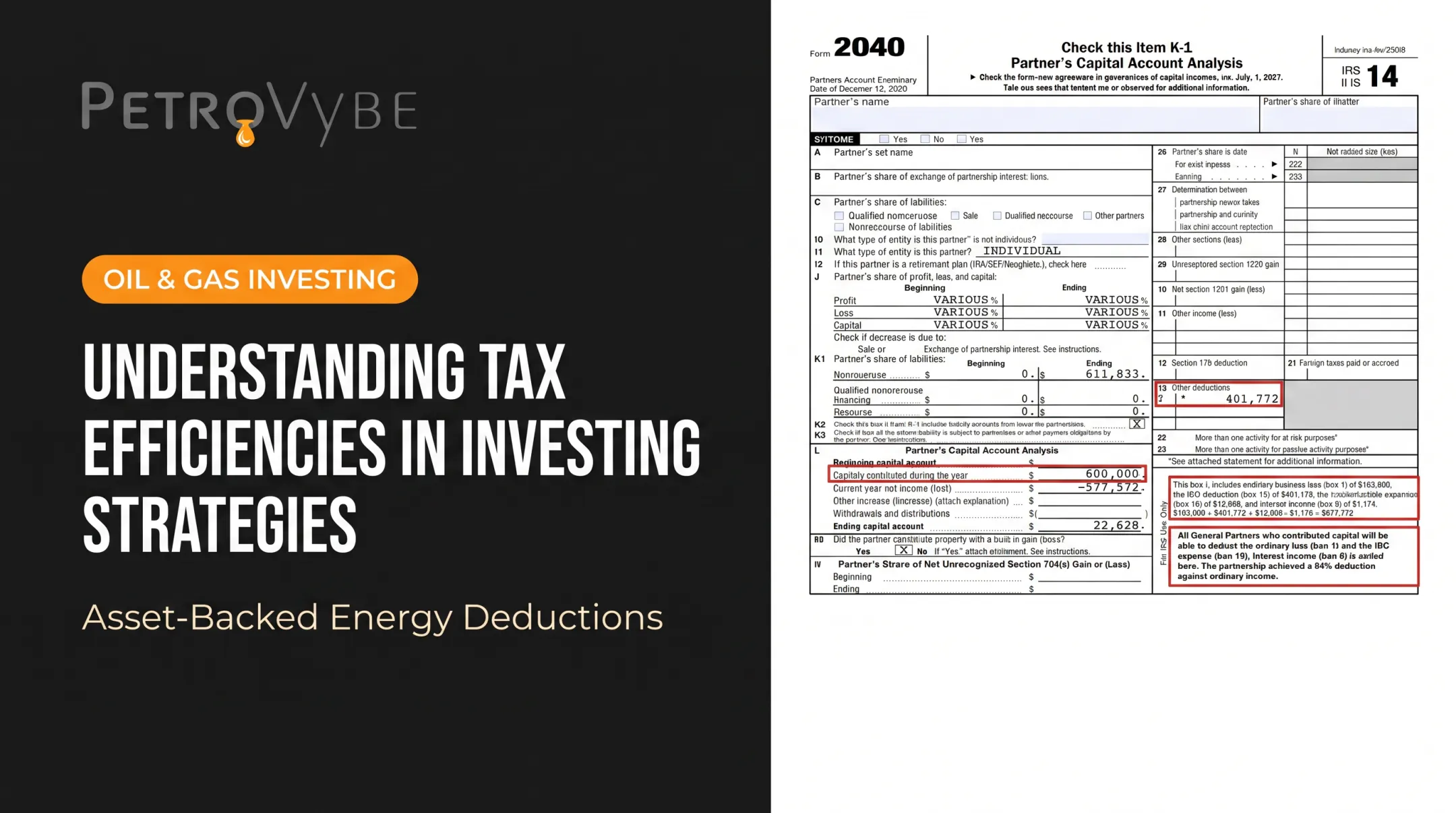
Account sequencing and portfolio location help most retirees. Accredited investors with a still-high tax bill have another option: direct oil and natural gas development with tax-code deductions. The mechanism is called an Intangible Drilling Cost (IDC) deduction. Under IRS Publication 535, costs like wages, fuel, and supplies used in drilling and developing a well can be deducted as a current business expense rather than capitalized over time. Combined with depletion allowances, these deductions can offset a substantial share of active income, including W-2 wages and capital gains, not just passive income. This is where PetroVybe, a private natural gas development company in South Texas's Gulf Coast Basin, fits the strategy. Partners have reported deductions of 91% in 2024 and 94% in 2025 against active income through its IDC and depletion structure. The project base includes roughly 58,000 acres in Lavaca County, Texas, about 400 acquired legacy wells, and 57-plus planned new wells, supported by a $48 million third-party reserve valuation and a clean 2025 independent audit. PetroVybe positions this as a diversification tool, not a core retirement holding. It is illiquid, so plan on at least 2–3 years before initial distributions and a 10-year target window. Forecast MOIC is about 2.2x–5.8x with a roughly 26% target IRR. Those figures are projections, not guarantees. Here's how it compares at a glance:
| Factor | Detail |
|---|---|
| Deduction potential | Up to ~70–100% of investment may be deductible against active income and capital gains in year one |
| Investor eligibility | Accredited investors with $100k+ liquidity |
| Risk / liquidity | Illiquid 10-year target horizon; higher risk than traditional retirement accounts |
| This isn't a fit for every retiree. It's suited for those with significant W-2 income, capital gains exposure, or a high tax burden who are also comfortable with illiquidity and energy-sector risk. |

How to Choose the Right Tax-Efficient Strategy for Your Situation
There's no universal answer. The right mix depends on your facts:
- Income level: current bracket versus the brackets you expect later
- Account mix: how much sits in taxable, tax-deferred, and Roth accounts
- RMD timing: when required distributions will start pushing income up
- Estate goals: whether you want to leave tax-free Roth assets to heirs Common mistakes retirees make:
- Ignoring RMD timing until the year it hits, and missing years of conversion opportunity
- Over-concentrating in one account type, leaving no flexibility to manage taxable income
- Setting a plan once and never revisiting it as tax laws, brackets, and circumstances change Work with a tax advisor or financial planner who can model multiple scenarios before you commit to any single path. A one-hour planning session can save far more than it costs.
Conclusion
Tax-efficient investing isn't a decision you make once and forget. Tax brackets shift, RMD rules change, and your own income needs evolve year to year. What worked in year one of retirement might not serve you by year ten.
Revisit your withdrawal strategy and account mix annually. For accredited investors carrying a heavy tax burden, alternative assets like natural gas development can add a layer of tax-advantaged diversification beyond what traditional accounts typically provide.
If that fits your situation, review PetroVybe's PetroVybe ONE project preview. You can also schedule a discovery conversation with the team to see whether it aligns with your goals.
Frequently Asked Questions
What is the most tax-efficient way to withdraw money from my 401(k)?
Consider proportional withdrawals across account types rather than draining one bucket first. This keeps you within lower brackets and helps avoid the tax bump that RMDs can trigger later.
What is the most tax-efficient way to save for retirement?
Max out tax-advantaged accounts first, and balance contributions between Roth and Traditional based on your current versus expected future tax bracket. This gives you flexibility later.
What is the best investment strategy for a retiree?
Build a diversified, income-focused portfolio and place assets in the right account types for your brackets. Align withdrawals with income needs and risk tolerance so tax drag stays low across market cycles.
How long will $500,000 last using the 4% rule?
The 4% rule suggests roughly 25-30 years of income, though Morningstar's 2026 research puts a more conservative safe withdrawal rate closer to 3.9%. Taxes and market returns both affect actual longevity.
How can Qualified Charitable Distributions reduce my tax bill in retirement?
If you're 70½ or older, a QCD lets you send up to $108,000 directly from your IRA to charity. That amount satisfies your RMD while being excluded from taxable income entirely.
Are alternative investments like oil and gas development a good tax strategy for retirees?
For accredited investors, oil and gas development can deliver large upfront deductions—often 70–100% of the investment—against active income or capital gains. Illiquidity and sector risk mean they should complement traditional retirement accounts, not replace them.