

This article is general education, not investment, tax, or legal advice. Physicians rank among the highest-taxed W-2 professionals in the United States. You've spent a decade in training, carry six figures of student debt, and started earning real income a decade later than most professionals. Yet the IRS treats your income the same as any other high-earning wage-earner, with few of the built-in shelters business owners and investors enjoy.
Many doctors struggle with this reality every April: high gross income, disappointing net income, and a tax bill that seems to grow faster than take-home pay. Part of the problem is structural. Physician income is overwhelmingly W-2 or high-earning 1099 income, taxed at ordinary rates with limited natural deductions.
This guide covers why physicians face such steep tax burdens, the traditional strategies that help (and their limits), and an advanced option, direct investment in oil and gas development, that can offset active income in ways retirement accounts simply can't. This treatment requires the investor to elect general partner status in the Subscription Agreement and may be limited in a given year by the excess business loss limitation under IRC §461(l).
Key Takeaways
- Physicians commonly land in the top federal tax brackets, which start at $626,350 for single filers in 2025.
- Traditional shelters (401(k)s, HSAs, entity structuring) cap out quickly for high W-2 earners.
- Intangible Drilling Cost (IDC) deductions from oil and gas development can offset active income, including W-2 wages.
- A tax pro who can layer alternative strategies with standard shelters usually saves more than any single deduction alone. This treatment requires the investor to elect general partner status in the Subscription Agreement and may be limited in a given year by the excess business loss limitation under IRC §461(l).
Why Physicians Face Such a High Tax Burden
Most physicians earn W-2 wages or high 1099 income taxed at ordinary rates. There's no capital gains treatment, no depreciation shield, and no natural offset built into a paycheck.
For 2025, the top 37% bracket begins at $626,350 for single filers and $751,600 for married filing jointly. Many physicians push a meaningful share of income above that line.
The Phase-Out Problem
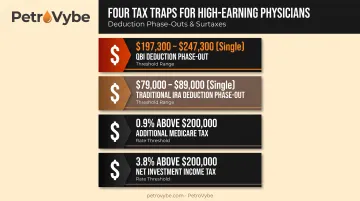
High earnings don't just mean higher rates. They also trigger deduction phase-outs and surtaxes that stack on ordinary income tax:
- Qualified Business Income (QBI) deduction: Physician practices are a "specified service trade or business," so the deduction phases out between $197,300 and $247,300 single ($394,600–$494,600 joint) in 2025.
- Traditional IRA deductions: Phase out between $79,000 and $89,000 (single, covered by a workplace plan) or $126,000–$146,000 (MFJ).
- Additional Medicare Tax: An extra 0.9% on wages above $200,000 single or $250,000 MFJ.
- Net Investment Income Tax (NIIT): A 3.8% surtax on investment income once MAGI exceeds $200,000 single or $250,000 MFJ.
Layer on state income tax in high-tax states, and the priority becomes clear: deductions that offset active income—not only passive losses from a side rental.
Common Tax Reduction Strategies for Physicians
Most physicians start with the standard playbook. It works, up to a point.
Retirement Accounts and HSAs
- 401(k) contributions: $23,500 employee limit for 2025, with a $70,000 total defined-contribution cap including employer contributions.
- Backdoor Roth IRA: Useful for high earners locked out of direct Roth contributions. It requires Form 8606 and can trigger a partial tax bill if you hold other pre-tax IRA balances.
- Defined benefit plans: Practice owners can potentially shelter far more than a 401(k) alone, since contributions are actuarially calculated rather than capped at a flat number.
- HSAs: Triple tax advantage—contributions deductible, growth tax-free, qualified withdrawals tax-free. 2025 limits: $4,300 (self-only) and $8,550 (family).
Entity Structuring and Real Estate
Physicians with private practices or 1099 side income sometimes elect S-corp status to manage payroll tax exposure. It requires paying yourself "reasonable compensation" before taking distributions, and the IRS scrutinizes this closely.
Real estate depreciation and cost segregation get talked about a lot in physician finance circles. The catch: rental losses are generally passive.
Unless you qualify as a real estate professional, the $25,000 active-participation allowance disappears once your MAGI crosses $150,000. For most physicians, that means depreciation doesn't touch W-2 income at all.
That's the core limitation with traditional strategies: they either cap out fast (retirement accounts) or only shelter passive income (real estate) unless you have the material participation hours to prove otherwise. Few physicians have that kind of spare time.

Advanced Strategy: Direct Investment in Oil & Gas Development
For physicians with high active income and real capital to deploy, direct oil and gas investment changes the tax math.
How IDC Deductions Work
Intangible Drilling Costs (IDCs) include wages, fuel, supplies, and contractor drilling expenses with no salvage value. Under IRC 263(c), you can expense them in the year incurred. The real advantage is how the loss is classified.
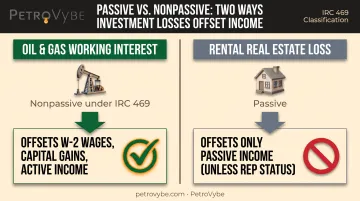
A working interest in an oil or gas well, held directly or through an entity without limited liability, is classified as nonpassive under IRC 469, regardless of your participation level. That means the loss isn't boxed into the passive-loss rules that trap rental real estate. It can offset active income, including W-2 wages and capital gains. This treatment requires the investor to elect general partner status in the Subscription Agreement and may be limited in a given year by the excess business loss limitation under IRC §461(l).
That differs from a rental property loss, which stays stuck offsetting only passive income unless you qualify as a real estate professional.
What This Looks Like in Practice
PetroVybe, a private natural gas development company operating in South Texas's Gulf Coast Basin, offers accredited investors direct partnership units in oil and gas development projects. Their PetroVybe ONE structure reported:
- A 94% first-year deduction against active income for 2025 partners. Prior result; not a promise of any future deduction.
- Distributions projected to reach $10,000+ per month during peak production, backed by roughly 400 producing wells and 57+ planned new wells across a 58,000-acre Lavaca County position

The structure pairs legacy well optimization with new drilling. The IDC deduction—typically a first-year deduction target of approximately 70–80% of invested capital in a new-drilling project—sits next to long-term production income, not a one-time write-off. This treatment requires the investor to elect general partner status in the Subscription Agreement and may be limited in a given year by the excess business loss limitation under IRC §461(l).
You get two outcomes in one structure: a large deduction against this year's tax bill, and ongoing participation in a tangible producing asset. That is a different proposition than a tax shelter with no underlying economics.
Who This Is Actually For
This isn't for every physician. It requires:
- Accredited investor status (net worth over $1 million excluding primary residence, or income over $200,000 individually / $300,000 jointly for two consecutive years)
- Roughly $100,000+ in liquidity to participate meaningfully
- High active income tax exposure that makes a large first-year deduction worth the illiquidity
If you're an early-career physician still paying down debt with modest disposable income, this probably isn't your first move. If you're a partner-track surgeon or specialist with six figures of W-2 exposure at the 37% bracket, it's worth a real conversation with your CPA.
Choosing the Right Tax Professional
Not all tax help is the same, and physicians often don't realize it until they've overpaid for years.
| Professional Type | What They Do | Best For |
|---|---|---|
| General tax preparer | Files your return, applies standard deductions | Simple W-2 situations |
| CPA specializing in physician finances | Understands practice structures, QBI limits, physician-specific timing | Practice owners, side 1099 income |
| Proactive tax strategist | Plans year-round, models alternative investments and entity structures | High W-2 earners seeking active-income offsets |
When you compare candidates, prioritize:
- Experience with high W-2 earners, not just small business owners
- Familiarity with alternative investment deductions like IDCs, not just real estate
- Fee transparency upfront, before you sign anything. This treatment requires the investor to elect general partner status in the Subscription Agreement and may be limited in a given year by the excess business loss limitation under IRC §461(l).
A basic Form 1040 with itemized deductions typically runs around $323. Returns that include pass-through entities cost more.
Proactive planning costs more than basic filing, but the ROI is straightforward: if a strategist finds $30,000 in legitimate deductions, a $3,000 fee pays for itself many times over.
Common Tax Mistakes Physicians Make
Three mistakes show up again and again in physician finances:
- Waiting until March to think about taxes. Tax strategy is a year-round exercise. By the time you're filing, most of your options for that tax year are already gone.
- Over-relying on retirement accounts alone. They're necessary, but they don't come close to touching the tax exposure of a $400,000+ W-2 income once you've maxed contribution limits.
- Chasing deductions without vetting the underlying investment. A tax break attached to a bad investment is still a bad investment. Before committing capital anywhere, verify:
- The operator's track record delivering promised deductions to past partners
- Independent, third-party validation, such as an audit or engineering reserve report
- Realistic production and distribution projections, not just the tax angle
The deduction should be the second reason you invest, not the first.
Frequently Asked Questions
Why do doctors get taxed so much?
Most physician income is classified as active W-2 or 1099 income taxed at top marginal rates. Unlike business owners or investors, physicians have limited natural deductions built into how their income is earned and reported.
How much does a tax consultant cost?
Costs vary by complexity. Basic filing may run a few hundred dollars, while planning for high-income physicians can run into the thousands—usually justified by the tax savings.
Can a CPA do wealth management?
Some CPAs offer wealth management, but it typically requires separate licensing like a CFP certification or RIA registration. Most physicians benefit from a coordinated team of a CPA and a licensed financial advisor.
How much is the average doctor's net worth?
Net worth varies widely by specialty and career stage. Many physicians eventually cross $1 million, but high income alone doesn’t guarantee high net worth once taxes and lifestyle costs are factored in.
What is an Intangible Drilling Cost deduction?
IDCs are expenses tied to drilling, such as wages, fuel, and supplies, that can often be deducted in large part in the first year. Unlike many deductions, they can offset active income, including W-2 wages. This treatment requires the investor to elect general partner status in the Subscription Agreement and may be limited in a given year by the excess business loss limitation under IRC §461(l).
Is investing in oil and gas right for every physician?
No. This strategy suits accredited investors with high active income. Participation begins at one unit of $100,000, with add-on subscriptions from $25,000. Always consult a tax advisor before committing capital to confirm it fits your specific situation.
Informational requests only. PetroVybe projects are offered solely to verified accredited investors. Submitting this form does not create an investment or advisory relationship.