
This article is general education, not investment, tax, or legal advice. Accredited investors in 2026 have access to a growing universe of private-market opportunities beyond stocks and bonds, from private credit to natural gas development, that most retail investors can't touch. These deals sit outside public markets, which means less competition for allocation and, often, better structural terms.
Many high-income earners struggle with a single problem: too much taxable income and too few tools to manage it. Private-market opportunities can improve tax efficiency, add real diversification, and generate inflation-resistant income that doesn't move in lockstep with the S&P 500.
The pool of eligible investors keeps expanding. The SEC's latest estimate puts qualifying US households at 24.3 million, or 18.5% of all households, up from 17.0 million (13.2%) in 2019 — a meaningful jump in just three years, based on SEC data on qualifying households. This piece breaks down where that growing capital is actually going.
TL;DR
- Qualify with $200K individual/$300K joint income or $1M net worth (excluding primary residence)
- Prioritize private credit, real estate, private equity, natural gas/energy development, and fine art
- Weigh minimum investment, target returns, tax treatment, and sponsor track record before committing
- Energy development offers upfront tax deductions most other asset classes can't match
Overview of Accredited Investor Opportunities in the US Market
The SEC defines an accredited investor through income, net worth, or professional credentials. Meet those thresholds and you can buy unregistered securities—private placements that never appear on public exchanges.
Current qualification paths:
- Individual income above $200K (or $300K joint) for the past two years, with reasonable expectation of the same this year
- Net worth above $1M, excluding your primary residence
- Series 7, 65, or 82 licenses
- Being a director, executive officer, or knowledgeable employee of the issuing entity
This isn't a small market. US private credit alone is approaching $1.3 trillion. SEC-reporting private funds held $29.6 trillion in gross assets as of Q4 2025, according to SEC private fund statistics. That capital funds deals most non-accredited investors never see.
The SEC's 2026 regulatory agenda signals wider retail access to private markets, but that remains a proposal—not current law. Until rules change, accredited status is still the gate to the opportunity types that follow.
Best Investment Opportunities for Accredited Investors in the US
This ranking weighs tax efficiency, target returns, minimum investment, transparency, and sponsor track record — not just headline numbers.
PetroVybe – Natural Gas Development with Tax-Advantaged Returns
PetroVybe is a private Texas oil and natural gas development company offering direct access to early-stage natural gas liquids (NGL) development across East Texas and Gulf Coast basins. The current flagship project, PetroVybe ONE, holds a position in a 58,000-acre Gulf Coast Basin footprint in Lavaca County, combining roughly 400 legacy producing wells with 57+ planned new wells.
Leadership credentials are unusually deep for a direct drilling participation. COO Blaine Yeary scaled a $5 billion asset from zero to 35,000 BOEPD over eight years at a prior company. Chief Geophysicist Michael Stamatedes brings a 48-year track record and a 75.2% well-selection success rate, versus an industry average typically below 40%. Disclaimer: these results were achieved at prior companies.
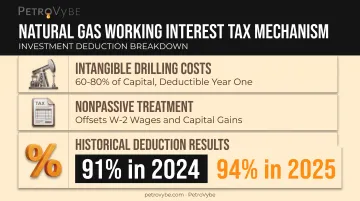
What makes this category distinct from private credit or real estate is the tax mechanism:
- Intangible drilling costs (IDCs): fully deductible in the year incurred; typically a first-year deduction target of approximately 70–80% of invested capital in a new-drilling project
- Nonpassive treatment: IRS rules can allow a directly held working interest’s qualifying losses to offset active income, including W-2 wages and capital gains (IRS Publication 925)
- Historical partner results: 94% deduction in 2025 against active income. This treatment requires the investor to elect general partner status in the Subscription Agreement and may be limited in a given year by the excess business loss limitation under IRC §461(l). Prior result; not a promise of any future deduction.
| Feature | Details |
|---|---|
| Minimum investment | $100,000+ in liquidity; passive structure, no active involvement required |
| Tax benefits | Up to 100% deduction against active income; 94% historical achievement. Prior result; not a promise of any future deduction. |
| Target returns | ~26% target IRR over 10 years; 2.2-5.8x modeled net exit MOIC |
The project's reserves carry a $48 million PV-09 valuation from a licensed third-party engineering firm, prepared by Lee Keeling & Associates, Tulsa, March 2026. PetroVybe's 2025 financials also received a clean audit opinion from Weaver, an independent auditor.
Forecasted distributions can reach $10,000+ per month during peak production. Those figures remain projections, not guarantees.
Individual tax outcomes vary. Talk to a tax advisor before assuming any deduction percentage applies to your situation.
Percent – Private Credit
Percent ranks well on minimum check size and hold period: it opens institutional-style private credit deals at a much lower entry point than traditional channels.
- Minimum investment: $500
- Target returns: Percent reports a 13.7% trailing-12-month net return after losses and fees (period reported through March 2026); recent deal coupons have ranged roughly 12.5%-18.0% — historical, not promised, per Percent's platform disclosures
- Liquidity: Secondary market accepts buy/sell indications; Percent manually matches price and size, and both sides pay a 50-basis-point fee
Most deals run 6-24 months, which is short compared to real estate or energy holds. That shorter duration helps if you want private-market yield without a decade-long lockup.
Real Estate Syndications (e.g., EquityMultiple, DLP Capital)
Real estate syndications score on tangible collateral and tax sheltering: investors take equity or debt positions in commercial deals without buying a building outright, and depreciation often offsets a portion of the income.
Minimums and targets vary widely by sponsor:
| Sponsor Example | Minimum | Target Return | Hold Period |
|---|---|---|---|
| EquityMultiple (Metro Multifamily) | $25,000 | 17.5% target net IRR | 3 years |
| DLP Housing Fund | $500,000 | 10-12% target annual net return | Evergreen |
Both sponsors are explicit that these are hypothetical targets, not guarantees. Real estate syndications typically run 3-7 years, shorter than most private equity commitments, which makes them a reasonable middle ground for investors who want tangible-asset exposure without a decade-long lockup.
Private Equity / Venture Capital Funds
PE and VC funds rank highest on institutional deal access and lowest on liquidity. They pool capital to acquire or invest in private companies accredited investors rarely reach alone.
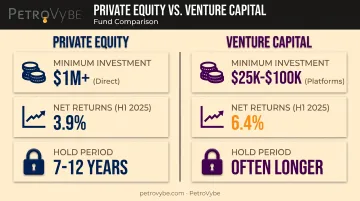
- Minimum investment: Traditional direct PE often starts at $1M+; platforms like Moonfare bring that down to roughly $25K-$100K depending on structure
- Target returns: No universal benchmark exists. Cambridge Associates reported 3.9% (PE) and 6.4% (VC) net returns for the first half of 2025 — a short-window snapshot, not a long-term target
- Hold period: Typically 7-12 years, often longer for VC
This is the least liquid category on this list. If you can't stomach a decade-plus commitment, this isn't the right fit.
Fine Art and Alternative Collectibles (e.g., Masterworks, Vinovest)
Fractional art and wine platforms rank primarily on diversification: near-zero correlation to public markets, not yield certainty.
- Minimum investment: Masterworks sets a $15,000 minimum per offering
- Historical returns: The Artprice100 blue-chip index averaged 8.9% annualized from 2000-2017, then fell 8.3% in 2024 — not a smooth ride
- Liquidity: Some secondary markets exist, but long holding periods remain the norm
Art carries real drawdown risk, plus fees, insurance, and authentication costs the index return doesn't capture. Treat it as a diversification play, not a core allocation.
How This Guide Selected the Best Accredited Investor Opportunities
The most common mistake accredited investors make? Chasing the highest advertised return without checking who's actually running the deal.
Evaluation criteria used across this list:
- Regulatory compliance: Reg D 506(c) status and proper accredited-investor verification
- Tax efficiency: How the structure treats deductions and income
- Third-party validation: Independent audits, engineering reports, and reserve valuations
- Minimum investment fit: Entry point relative to your liquidity position
- Sponsor incentive alignment: Carried interest structures, profit splits, and whether the sponsor's upside matches yours
PetroVybe's structure, for example, uses an 80/20 profit split favoring investors, alongside independent engineering validation of its $48 million PV-09 reserve figure. Aligned incentives plus third-party proof is the bar a deal has to clear before it belongs on this list.
Conclusion
There's no single "best" opportunity here. The right fit depends on your liquidity needs, tax bracket, and appetite for illiquidity, not just the biggest number on a pitch deck.
Before committing capital, pressure-test the basics:
- Sponsor track record across full cycles
- Fee transparency and how the sponsor gets paid
- Third-party audits and engineering reports that back the claims
For accredited investors looking for tax-advantaged, tangible-asset exposure to the energy sector powering AI-driven electricity demand, PetroVybe's natural gas development opportunities in East Texas and the Gulf Coast merit a full diligence review.
Frequently Asked Questions
How do I qualify to be an accredited investor?
You qualify with $200K individual income (or $300K joint) for two consecutive years, or a $1M net worth excluding your primary residence. Series 7, 65, or 82 license holders also qualify.
How much do I need to invest to generate a specific monthly income?
It depends on cash yield and asset class. At a 12% net yield, $2,000/month needs roughly $200,000 invested. Higher-return private deals may need less capital for the same income goal, but usually with more risk and less liquidity.
What are the investment opportunities for accredited investors?
Main categories include private credit, real estate syndications, private equity/VC funds, natural gas and energy development, and fine art or collectibles.
What are the new rules for accredited investors?
The SEC's 2020 amendments added professional certification pathways. Its 2026 agenda signals a proposal to expand retail access further, but no new rules have taken effect yet.
Do accredited investors get better returns than retail investors?
Access to a wider deal pool can mean higher potential returns, but it also means higher risk and less liquidity. There's no guarantee private deals outperform public markets.
Is natural gas development a good investment for accredited investors in 2026?
Natural gas supplies roughly 42% of US grid power, and data-center electricity demand could hit 35 gigawatts by 2030. With IDC tax deductions and tangible asset backing, it can suit tax-sensitive accredited investors seeking energy exposure.
Informational requests only. PetroVybe projects are offered solely to verified accredited investors. Submitting this form does not create an investment or advisory relationship.