
Investors who don't recognize when sentiment has flipped often get caught flat-footed. On August 5, 2024, the Cboe Volatility Index spiked to an intraday high of 65.73, roughly 42 points above the prior Friday's close, while the S&P 500 fell nearly 3% that same day. That's how fast a risk-on market turns risk-off.
This guide breaks down what risk-off assets actually are, how to spot the shift before it hits your statements, and why tangible, cash-flowing alternative assets deserve a look outside the usual stocks-and-bonds cycle.
Key Takeaways
- Risk-off means capital moving from higher-risk assets into safer havens like bonds, gold, and cash
- Risk-on and risk-off sit on opposite ends of one sentiment spectrum, driven by data, policy, and geopolitics
- Classic safe havens: US Treasuries, gold, the Japanese yen, Swiss franc, and US dollar
- The VIX and US Dollar Index are the fastest gauges of current market sentiment
- Tangible, income-producing alternatives offer diversification that doesn't rise and fall with daily market swings
What Is a Risk-Off Asset?
A risk-off asset is a lower-volatility investment that investors flock to when uncertainty spikes. The goal is capital preservation, not maximum return.
This behavior traces back to a simple human instinct: fear triggers flight. When headlines turn ugly, investors reduce their risk capital exposure (the portion of a portfolio they're willing to expose to loss) and park it somewhere steadier. Risk capital behaves very differently from core savings, which most investors won't touch regardless of market noise.
Shared Characteristics of Risk-Off Assets
Most instruments in this category share a few traits:
- Low volatility: price swings are modest compared to equities
- High liquidity: easy to buy and sell without moving the market
- Low or negative correlation to stocks: they often rise when equities fall
- Government or institutional backing: think sovereign debt or central bank currencies
Risk-on assets sit at the opposite end: equities, high-yield bonds, and commodities that thrive on optimism but get punished when confidence cracks.
Gold's behavior during the COVID-19 shock illustrates the pattern well. In the first half of 2020, gold-backed ETFs absorbed a record 734 metric tons of inflows, and dollar-denominated gold prices climbed 17%, according to the World Gold Council. Investors sought shelter, not upside.
Risk-On vs Risk-Off: How Market Sentiment Shifts
How do you know which phase the market is in right now? Watch the conditions and the money flows.
Risk-On Market Conditions
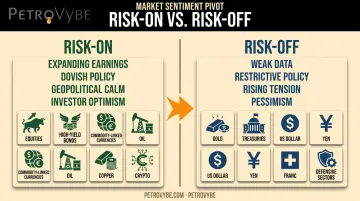
Risk-on sentiment tends to show up alongside:
- Expanding corporate earnings
- Dovish central bank policy (rate cuts, easy liquidity)
- Geopolitical calm
- General investor optimism
Common risk-on assets include equities, high-yield corporate bonds, commodity-linked currencies (AUD, NZD, CAD), oil, copper, and cryptocurrencies.
Risk-Off Market Conditions
The mood flips when earnings disappoint, economic data weakens, geopolitical tension rises, or central banks turn restrictive. Investors respond by unwinding carry trades (positions built by borrowing cheap in low-yield currencies to chase higher returns elsewhere) and rotating into defensive positioning almost overnight.
Common risk-off assets include gold, U.S. Treasuries, the U.S. dollar, Japanese yen, Swiss franc, and defensive sectors like utilities and consumer staples.
Key Indicators That Signal a Shift
Two tools help investors read the tape:
The VIX ("fear gauge"): It measures the market's expected 30-day volatility using S&P 500 options pricing, and it has a historically strong inverse relationship with equities, per Cboe. When the VIX spiked to 65.73 intraday on August 5, 2024, the S&P 500 dropped nearly 3% in the same session.
The US Dollar Index (DXY): This tracks the dollar against a basket of major currencies. A rising DXY often signals risk-off, since capital flows back into USD-denominated assets when fear rises.
Examples of Risk-Off Assets and Safe-Haven Currencies
Not every "safe" asset behaves the same way. Here's how the main categories stack up.
Government Bonds and Cash Equivalents
US Treasuries remain the textbook risk-off instrument. Government backing plus deep liquidity make them the default landing spot during turmoil. During the July-August 2024 equity turbulence, the 10-year Treasury yield fell from roughly 4.5% to 3.9% in about a month as bond prices climbed.
Cash and money market funds sit even lower on the volatility spectrum. They won't grow your wealth, but they won't lose it overnight either.
Gold and Precious Metals
Gold's reputation as a crisis-era store of value isn't just folklore. On October 13, 2023, spot gold jumped more than 3% in a single day as Middle East tensions escalated, a clear safe-haven bid.
Safe-Haven Currencies
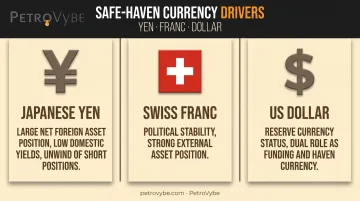
Three currencies dominate this conversation:
- Japanese yen: Japan's large net foreign asset position and low domestic yields make the yen a magnet during stress, largely through unwinding of short positions and hedging flows, per a 2013 IMF working paper on safe-haven currency dynamics
- Swiss franc: backed by Switzerland's political stability and a strong external asset position
- US dollar: its reserve currency status means it acts as both a funding currency and a haven, a somewhat contradictory role
Safe-haven status isn't fixed. Interest rate differentials and inflation trends can reshuffle which currencies investors treat as "safe" in any given cycle.
How Risk-Off Sentiment Impacts Different Markets
Risk-off doesn't hit every asset class the same way. It ripples through equities, currencies, commodities, and bonds in distinct ways.
Equities: Money rotates out of high-beta growth and tech names into defensive, consumer-staple sectors. From the S&P 500's July 16, 2024 record through August 6, utilities gained 4% while the broader index dropped roughly 7%. The Nasdaq 100 fell more than 10% from its mid-July peak during that same stretch.
Forex and commodities: Carry trade unwinds weaken commodity-linked currencies. The Australian dollar posted its third straight weekly decline in early August 2024, partly tied to yen-funded carry positions unwinding. Oil and copper typically slide too. Brent crude fell nearly 1% on August 5, 2024 alone, while copper traded roughly 20% below its May 2024 record by early August.
Fixed income: Treasury yields fall as bond prices rise, driven by a surge in safe-haven demand. That inverse relationship between yields and prices is the mechanical core of the risk-off rotation.
Diversifying Beyond the Risk-On/Risk-Off Cycle
Traditional risk-off assets do their job during acute stress, but they have real limits over longer stretches:
- Near-zero real yields on Treasuries and cash during low-rate environments
- Currency devaluation risk tied to monetary policy shifts
- Limited income growth once you're parked in defensive positions
That's where tangible, cash-flowing alternative assets enter the conversation. Private natural gas development is one example: an asset class whose value isn't reset daily by equity or bond sentiment.
PetroVybe operates directly in this space. Through direct partnership units in natural gas development projects across South Texas's Gulf Coast Basin, accredited investors gain exposure to producing wells rather than trading instruments. A few specifics:
- Tax-advantaged structure: Intangible Drilling Cost (IDC) deductions delivered a 94% deduction against active income in 2024 and 91% in 2025 for PetroVybe partners. Unlike most real estate deductions, IDCs apply against W-2 income and capital gains, not just passive income.
- Long-term income potential: Monthly passive distributions are projected to peak above $10,000 per month per unit during peak production, though a 2-3 year hold typically precedes the first distribution
- Target returns: A 10-year MOIC window of roughly 2.2x to 5.8x and an IRR near 26%, backed by a $48 million third-party engineered reserves valuation

None of this eliminates commodity price risk. But it decouples a portion of your portfolio from the daily tug-of-war between risk-on optimism and risk-off panic, giving you exposure to assets that move on their own fundamentals rather than market sentiment.
Frequently Asked Questions
What does risk-off asset mean?
A risk-off asset is a lower-volatility, capital-preserving investment that investors move toward during periods of uncertainty. Examples include Treasuries, gold, and safe-haven currencies.
Is it risk-on or risk-off?
Check indicators like the VIX and US Dollar Index alongside current economic data and geopolitical headlines. A rising VIX and strengthening dollar typically point to risk-off; the reverse signals risk-on.
What is an example of a risk asset?
Risk-on assets include equities, high-yield bonds, commodities, and cryptocurrencies. These contrast with risk-off assets like government bonds and gold, which investors favor when confidence drops.
Which currencies are risk off?
The Japanese yen, Swiss franc, and US dollar are the primary safe-haven currencies. Each earns that status through different fundamentals: Japan's large net foreign asset position, Switzerland's low debt and stable banking system, and the dollar's role as the world's reserve currency.
How can investors protect their portfolio during risk-off periods?
Diversify into traditional safe havens like Treasuries and gold, but also consider tangible alternative assets, such as tax-advantaged natural gas development, that aren't tied to daily market sentiment swings.