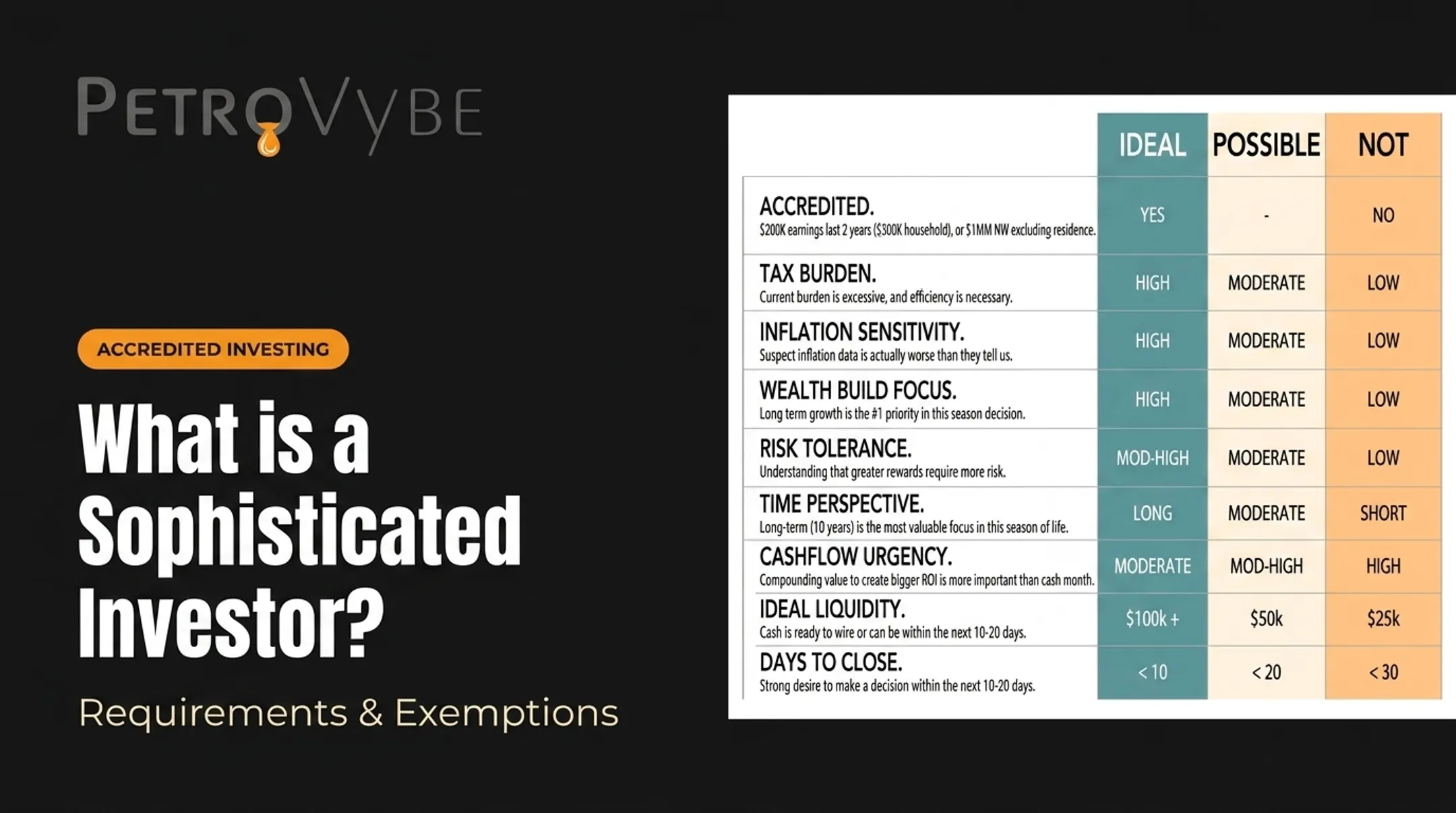
This article is general education, not investment, tax, or legal advice. Rising inflation and heavy tax bills are pushing sophisticated investors past traditional stocks and bonds. Many are chasing tangible assets that offer real diversification and genuine tax efficiency.
High-income W-2 earners and investors sitting on capital gains often hit a wall. Institutional-grade deals exist, but access typically requires the right connections or the right classification.
This guide breaks down what actually makes an investor "sophisticated," which asset classes this group pursues, and why natural gas development has become a serious contender in that mix.
Key Takeaways
- Sophistication is measured by knowledge and experience, not by net worth under the accredited investor standard
- Private placements, real estate syndications, private equity, and energy development top the sophisticated investor's toolkit
- Natural gas development can deliver substantial tax deductions against active income and long-term passive income
- Your investor classification determines which private deals you can legally access. This treatment requires the investor to elect general partner status in the Subscription Agreement and may be limited in a given year by the excess business loss limitation under IRC §461(l).
What Is a Sophisticated Investor?
The SEC defines a sophisticated investor as someone with enough knowledge and experience in financial and business matters to evaluate the merits and risks of a prospective investment, either alone or with a purchaser representative. Investor.gov explains this standard under Rule 506 of Regulation D.
Unlike "accredited investor," sophistication has no dollar figure attached.
- No minimum net worth requirement
- No minimum income threshold
- The issuer decides sophistication, not the SEC directly
Sophistication and accreditation aren't the same thing—you can hold one status, the other, or both.
Rule 506(b) specifically allows issuers to sell to an unlimited number of accredited investors plus up to 35 non-accredited investors, as long as those 35 meet the sophistication test.
Sophisticated vs. Accredited Investors: Key Differences
Accreditation runs on hard numbers. Sophistication runs on judgment.
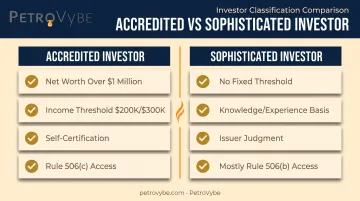
| Factor | Accredited Investor | Sophisticated Investor |
|---|---|---|
| Basis | Net worth or income thresholds | Knowledge and experience |
| Net worth test | Over $1 million (excluding primary residence) | No fixed threshold |
| Income test | $200,000 individual / $300,000 joint, two years running | No fixed threshold |
| Who decides | Self-certification against SEC criteria | Issuer's qualitative judgment |
| Offering access | Rule 506(c), including publicly advertised deals | Mostly Rule 506(b) |
Accreditation isn't only a wealth test. According to the SEC's guidance on accredited investors, other paths include holding a Series 7, 65, or 82 license, or being a "knowledgeable employee" of a private fund.
Where you can invest still hinges on which rule the issuer uses:
- Rule 506(c): General solicitation allowed, but every purchaser must be accredited
- Rule 506(b): No advertising, yet up to 35 non-accredited buyers may participate if they meet the sophistication test
What Are Good Investments for Sophisticated and High-Net-Worth Investors?
Sophisticated and high-net-worth investors gravitate toward assets that don't move in lockstep with the stock market. That's the whole point.
Common alternative asset classes include:
- Private equity — direct ownership stakes in private companies
- Venture capital — early-stage company investments with higher risk, higher upside
- Real estate syndications — pooled capital for commercial or multifamily properties
- Hedge funds — actively managed strategies across asset classes
- Private credit — direct lending outside traditional bank channels
- Oil and natural gas development — tangible asset ownership with unique tax treatment
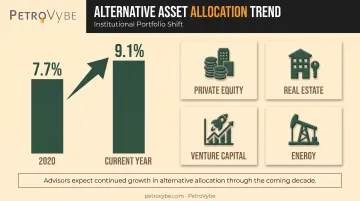
This isn't a fringe trend anymore. Cerulli Associates reported that high-net-worth alternative allocations grew from 7.7% in 2020 to 9.1%, with advisors expecting that figure to climb further. Over half of surveyed advisors planned to increase private equity allocations in the following two years.
Private equity draws most of that attention. Natural gas development sits in a quieter corner of the same alternatives set, with a demand picture that is shifting fast.
Natural Gas: The Overlooked Play
Oil and gas development rarely makes most standard alternative-asset roundups, yet it offers active-income tax treatment and reserve-backed hard assets that private equity and real estate typically cannot match.
Why it's gaining attention now: AI data centers need power, and natural gas is filling much of the gap. The IEA projects U.S. data-center electricity consumption will rise roughly 240 TWh, about 130%, between 2024 and 2030, with natural gas positioned as the largest source of new supply.
That's a demand tailwind. It doesn't guarantee returns on any specific project, but it's a structural shift worth understanding.
Why Sophisticated Investors Are Turning to Natural Gas Development
Natural gas development offers something rare: a way to offset active income, not just passive income, while owning a hard asset.
The Intangible Drilling Cost Deduction
Under IRS rules, taxpayers can elect to deduct eligible Intangible Drilling Costs (IDCs) as a current expense rather than capitalizing them. This covers drilling wages, fuel, hauling, and other well-development costs.
What makes this powerful for high earners: a working interest held directly, or through an entity that doesn't limit liability, is treated as nonpassive. That means qualifying losses aren't automatically boxed in by the passive-activity-loss rules that trap most real estate deductions.
PetroVybe, a Texas-based natural gas developer, has seen this play out with real numbers. Partners in the PetroVybe ONE program realized a 94% deduction against active income in 2025, combining IDC and depletion benefits. Prior result; not a promise of any future deduction. These are historical results tied to specific project milestones, not a guarantee for every future partner or tax year. This treatment requires the investor to elect general partner status in the Subscription Agreement and may be limited in a given year by the excess business loss limitation under IRC §461(l).
Long-Term Return Potential
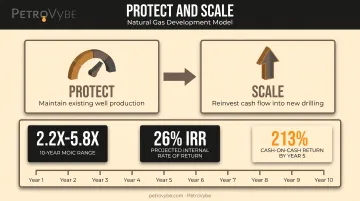
Beyond the upfront deduction, natural gas development offers a longer runway. PetroVybe targets a 10-year MOIC of roughly 2.2x to 5.8x and an IRR near 26%, built on a "Protect and Scale" model:
- Protect: maintain and optimize legacy production from existing wells
- Scale: reinvest cash flow into new drilling to compound output over time
The company's forecast includes roughly 213% cash-on-cash return by Year 5, though PetroVybe is clear that commodity prices, drilling costs, and execution can all shift actual results.
Why Operator Quality Matters
Not every operator is equal, and geology risk can sink a project before it starts. PetroVybe's Chief Geophysicist, Michael Stamatedes, spent 48 years at ExxonMobil and carries a reported 75.2% success rate in well-site selection, well above the industry peer average of under 40%. Disclaimer: these results were achieved at prior companies.
That track record, paired with third-party engineering validation, is a core screen before committing capital.
Asset mix matters too. Natural gas liquids (NGLs) command premium pricing versus dry gas, and PetroVybe focuses on liquids-rich production to capture that margin.
Risks and Due Diligence Considerations
Private, illiquid deals carry real risk. The SEC's investor bulletin on private placements is blunt about it: these securities are often restricted, hard to resell, and come with less disclosure than public markets require.
Before wiring capital, ask these questions:
- What's the operator's track record across prior projects?
- Has an independent engineering firm validated the reserves?
- Is the operator properly licensed with state regulators (in Texas, that's the Railroad Commission)?
- How transparent is ongoing reporting, and what do audited financials show?

PetroVybe, for example, points investors to the Texas Railroad Commission database to verify operator licensing and well API numbers directly. The company also underwent a clean 2025 audit performed by Weaver.
Tax treatment is part of diligence too. Always consult a licensed tax or financial advisor before assuming any deduction will offset your specific W-2 or capital gains position—individual situations vary.
How to Qualify and Get Started as a Sophisticated Investor
There's no formal registration process for sophisticated investor status. Issuers determine it themselves, typically through:
- Investor questionnaires covering financial background
- Professional credentials or investing history
- Direct conversations assessing your ability to evaluate risk
Practical steps to prepare:
- Gather documentation of your income, net worth, and investment experience
- Be ready to discuss past private placements, real estate deals, or business ownership
- Work only with issuers who provide clear, third-party-verified offering materials
Many direct natural gas development opportunities go a step further: they are reserved for accredited investors under Rule 506(c). That means meeting SEC income or net worth thresholds and verifying status before you invest.
PetroVybe works with accredited investors on development projects across East Texas and the Gulf Coast Basin. Offerings are supported by independent reviews and third-party verification on platforms like Invest Clearly.
Frequently Asked Questions
What are some good investments for rich people?
Private equity, real estate syndications, venture capital, and energy development are common diversification strategies for high-net-worth investors. Each carries different liquidity timelines and risk profiles, so fit depends on your goals.
What is considered a sophisticated investor?
The SEC's standard is qualitative: someone with sufficient knowledge and experience to evaluate an investment's risks and merits. This differs from the accredited investor test, which relies on fixed income and net worth thresholds.
Can a sophisticated investor who isn't accredited still invest in private offerings?
Yes, under Rule 506(b), issuers may sell to up to 35 non-accredited sophisticated investors per offering, provided specific disclosure requirements are met. Access is more limited than for accredited investors under Rule 506(c).
Are natural gas development investments only for accredited investors?
Most direct development opportunities, including PetroVybe's, target accredited investors because they're structured under Rule 506(c), which requires all purchasers to be accredited and verified.
How much tax deduction can sophisticated investors get from oil and gas investments?
Deductions vary by project and tax year. PetroVybe partners realized 94% in 2025 against active income, but these are historical results, not guarantees for future investments. Prior result; not a promise of any future deduction.
What's the difference between a qualified purchaser and a sophisticated investor?
A qualified purchaser is defined by the Investment Company Act as someone owning at least $5 million in investments. A sophisticated investor has no fixed dollar threshold and is instead judged on knowledge and experience.
Informational requests only. PetroVybe projects are offered solely to verified accredited investors. Submitting this form does not create an investment or advisory relationship.