

This article is general education, not investment, tax, or legal advice. Tax rules change and apply differently to every taxpayer.
Introduction
The more you earn, the more the IRS takes — and without deliberate planning, a substantial portion of that wealth erodes each year. High-net-worth individuals don't just face one tax category; they face several simultaneously: ordinary income, capital gains, net investment income, and estate taxes often apply at the same time, compounding the burden.
The gap between those who preserve wealth and those who surrender it to taxes rarely comes down to income level. It comes down to knowing which legally available tools apply to your specific income sources, asset mix, and goals — and using them before December 31.
A physician with heavy W-2 income has different priorities than a business owner sitting on appreciated stock. The right strategies are layered, coordinated, and executed proactively.
This guide covers the approaches that work best for high earners:
- Maximizing tax-advantaged retirement accounts
- Charitable giving vehicles that reduce current-year liability
- Capital gains timing and harvesting strategies
- Oil and gas investment structures with immediate deductions against active income — a significant tax tool available to accredited investors
Key Takeaways
- HNWIs benefit most from layering strategies across retirement, investment, estate, and alternative asset categories.
- Tax-loss harvesting, charitable giving vehicles, and trust structures can significantly reduce both ordinary income and capital gains exposure.
- Oil and gas direct participation programs let accredited investors deduct a large portion of their investment against W-2 and capital gains income, not just passive income. This treatment requires the investor to elect general partner status in the Subscription Agreement and may be limited in a given year by the excess business loss limitation under IRC §461(l).
- Estate planning through strategic gifting and trusts should begin well before exemption thresholds are reached.
- Coordinating a CPA, tax attorney, and financial advisor is essential to execute these strategies without compliance risk.
Maximize Contributions to Tax-Advantaged Retirement Accounts
Maximizing pre-tax retirement contributions is the most accessible starting point for any HNWI. Every dollar contributed to a qualifying account reduces taxable income dollar-for-dollar in the current year.
2025 Contribution Limits
IRS Notice 2024-80 sets the following limits for tax year 2025:
| Account | Standard Limit | Catch-Up (Age 50+) | Enhanced Catch-Up (Age 60–63) |
|---|---|---|---|
| 401(k) | $23,500 | $7,500 | $11,250 |
| SEP-IRA | Lesser of 25% of compensation or $70,000 | None | None |
| SIMPLE IRA | $16,500 | $3,500 | $5,250 |
| HSA (self-only) | $4,300 | $1,000 (age 55+) | — |
| HSA (family) | $8,550 | $1,000 (age 55+) | — |
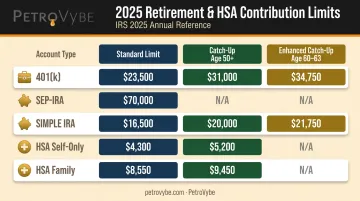
The enhanced catch-up for ages 60–63 is a SECURE 2.0 provision: it differs from the standard age-50 catch-up and represents a meaningful additional deduction for HNWIs in their peak earning years.
The HSA Triple Advantage
The Health Savings Account is the only account in the tax code that offers three layers of tax benefit:
- Contributions are tax-deductible
- Growth is tax-free
- Withdrawals for qualified medical expenses are tax-free
There are no income restrictions for HSA eligibility. The only requirement is enrollment in a qualifying high-deductible health plan (HDHP), which for 2025 requires a minimum deductible of $1,650 (self-only) or $3,300 (family).
Roth Conversions for High Earners
Direct Roth IRA contributions phase out between $236,000 and $246,000 MAGI for married filing jointly in 2025. Above that threshold, direct contributions aren't allowed — but Roth conversions have no income ceiling.
The backdoor Roth strategy involves a nondeductible traditional IRA contribution followed by a Roth conversion. The mega backdoor Roth takes this further using after-tax 401(k) contributions (where the plan allows), up to the 2025 Section 415(c) annual additions limit of $70,000. Both approaches require careful Form 8606 tracking and attention to the pro-rata rule.
Converting in lower-income years — following a business sale, a job transition, or after retirement — minimizes the tax hit on the converted amount. Sequencing conversions strategically across multiple years can also prevent bracket creep on the converted balance.
Reduce Capital Gains Exposure Through Tax-Loss Harvesting and Charitable Giving
Capital gains can be one of the most manageable tax categories for HNWIs — if the portfolio is actively monitored throughout the year.
How Tax-Loss Harvesting Works
Tax-loss harvesting means selling underperforming investments to realize a loss, which then offsets realized gains elsewhere in the portfolio. If losses exceed gains, up to $3,000 applies against ordinary income annually, with remaining losses carried forward indefinitely.
One critical compliance rule: the wash sale rule disallows the loss if a substantially identical security is repurchased within 30 days before or after the sale — a 61-day window in total. Investors navigate this by purchasing highly correlated but not identical securities, such as a different S&P 500 index fund rather than the exact fund sold.
Tax-loss harvesting is particularly valuable for investors subject to the Net Investment Income Tax (NIIT): a 3.8% surtax applied to the lesser of net investment income or MAGI exceeding $250,000 for married filing jointly. That threshold is not inflation-indexed, meaning more HNWIs cross it every year.
Tax-loss harvesting addresses gains already realized. Strategic charitable giving goes further — it can eliminate the embedded gain before it's ever recognized.
Reduce Taxes Through Strategic Charitable Giving
Donating appreciated securities — stocks, mutual funds, or ETFs held longer than one year — directly to a qualified charity or donor-advised fund eliminates the embedded capital gain entirely. The donor claims a deduction at fair market value without triggering a taxable event. Donating the security directly rather than selling it first and donating cash avoids a tax hit that can run into the tens of thousands on a concentrated position.
Key mechanics to understand:
- No capital gains recognized on appreciated securities held more than one year when donated directly
- Deduction at fair market value, not your cost basis
- 30% AGI cap applies to long-term appreciated property donated to a public charity, with a five-year carryover for excess amounts
Donor-advised funds (DAFs) let a taxpayer contribute a large lump sum in a high-income year, claim the full deduction immediately, then distribute grants to specific charities over time. This works well alongside bunching — concentrating two or three years of charitable giving into a single tax year to push itemized deductions above the applicable standard deduction for married filing jointly.
Leverage Oil and Gas Investments to Unlock Significant Tax Deductions
For accredited investors with high W-2 income or significant capital gains, oil and gas direct participation programs offer a significant tax tool available to accredited investors.
How the IDC Deduction Works
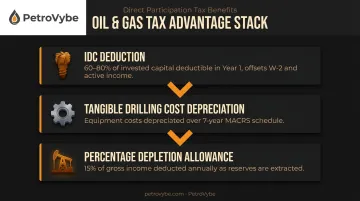
Under IRC Section 263(c), investors in qualifying oil and gas development projects can elect to expense Intangible Drilling Costs (IDCs) — labor, chemicals, and other non-salvageable drilling costs — in the year they are incurred rather than capitalizing them. Development projects focused on new drilling target a first-year deduction of approximately 70–80% of invested capital.
Unlike most deductions, this one is not restricted to passive income. Under Section 469(c)(3), a working interest held without liability limitation can qualify as nonpassive — meaning the deduction can offset W-2 wages, capital gains, and other active income. This treatment requires the investor to elect general partner status in the Subscription Agreement and may be limited in a given year by the excess business loss limitation under IRC §461(l). For high earners whose income is primarily active, this distinction is what makes oil and gas participation genuinely useful. Most alternative deductions can't touch W-2 wages.
The first-year IDC deduction is just part of the picture. Two other tax benefits compound the advantage:
- Tangible drilling cost depreciation — equipment and hardware costs are depreciable over a 7-year MACRS schedule
- Percentage depletion allowance — independent producers may deduct 15% of gross income from the property annually as reserves are extracted, subject to production and income limitations
PetroVybe's Prior-Program Results
PetroVybe, a Texas-based natural gas development company, structures investments specifically for accredited investors through limited partnership units in development projects. Its current PetroVybe ONE project is focused on East Texas and the Gulf Coast Basins.
Prior-program results on tax deductions:
- 2025 partners: 94% first-year tax deduction against active income
This is a prior-program result and not a promise of any future deduction.
Beyond the tax deduction, the investment structure models long-term returns:
- 10-year MOIC: a modeled range of approximately 2.2–5.8x across conservative, base, and optimistic cases, with a base case of approximately 4.2x
- Modeled IRR: approximately 26% in the base case, with conservative and optimistic cases at approximately 13% and 36%, all based on the 10-year NYMEX strip average of $3.58 gas and $65.53 oil
- Proved reserves valuation: $48MM (PV-09), prepared by Lee Keeling & Associates, Tulsa, March 2026
- Distributions: quarterly, estimated to begin in Q1 2027
Modeled returns are projections, not promises, and are not guaranteed.
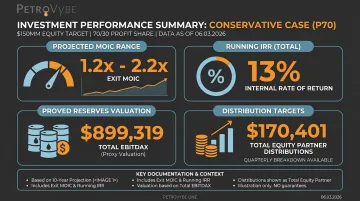
Distributions are estimated to begin in Q1 2027, with return of capital targeted 48–72 months from the first distribution.
The minimum investment is $100,000, with add-on subscriptions from $25,000, and participation is limited to accredited investors who can provide third-party verification of their status.
Important disclaimer: Oil and gas investments carry inherent risks including commodity price volatility, drilling execution risk, and regulatory changes. Investor capital is subject to loss. Tax treatment depends on individual circumstances, and the active-income offset is subject to basis, at-risk, excess business loss, and AMT rules. Consult a qualified CPA or tax attorney before investing to assess eligibility and suitability. PetroVybe is not a registered investment adviser, broker-dealer, or tax or legal advisor. The offering is available only to verified accredited investors under SEC Regulation D 506(c). This is not an offer to sell — any offer is made only through the confidential Private Placement Memorandum.
Use Trusts and Strategic Gifting to Minimize Estate Tax Exposure
Understanding the 2025 and 2026 Exemptions
The federal estate tax exemption for 2025 is $13.99 million per individual. A married couple can shelter nearly $28 million combined through portability.
The formerly anticipated TCJA sunset — which would have cut the 2026 exemption to roughly $7 million per person — is now obsolete. P.L. 119-21 set the 2026 basic exclusion at $15 million, indexed thereafter. That's more runway, but irrevocable structures take time to execute properly. Starting early preserves your options.
Trust Structures for Wealth Transfer
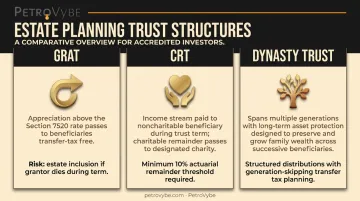
Several trust vehicles allow HNWIs to remove appreciating assets from the taxable estate:
- GRATs (Grantor Retained Annuity Trusts) — Appreciation above the Section 7520 rate passes to beneficiaries with minimal gift tax exposure. If the grantor dies during the term, however, assets may be pulled back into the estate.
- CRTs (Charitable Remainder Trusts) — Pay a noncharitable beneficiary an income stream, then pass the remainder to charity. The charitable deduction is based on the present value of the remainder; the charitable remainder must meet a minimum 10% actuarial threshold.
- Dynasty trusts — Span multiple generations, combining long-term asset protection with structured distributions across multiple heirs.
Annual Gifting Strategies
The 2025 annual gift tax exclusion is $19,000 per recipient, per donor. A married couple can combine exclusions to transfer $38,000 per recipient annually without touching the lifetime exemption.
Additional strategies that don't draw on the lifetime exemption:
- 529 superfunding — Front-load up to $95,000 per beneficiary ($190,000 for couples), treated ratably over five years for gift-tax purposes
- Direct tuition and medical payments — Qualifying tuition paid directly to educational institutions and medical costs paid directly to providers are excluded from gift tax entirely under IRC Section 2503(e) — with no dollar limit
Because GRATs, CRTs, and dynasty trusts are irrevocable once established, execution requires close coordination among a tax attorney, CPA, and financial advisor. These structures are difficult or impossible to unwind — getting the structure right from the start matters.
Real Estate Depreciation and Qualified Opportunity Zones
Depreciation and Cost Segregation
Real estate investors can deduct operating expenses — mortgage interest, property taxes, insurance, maintenance — plus depreciation of the property's structure: 27.5 years for residential rental property, 39 years for nonresidential real property.
Cost segregation studies identify building components that qualify as shorter-lived property (5-, 7-, or 15-year MACRS), accelerating deductions into earlier years. Investors who qualify as real estate professionals under IRS rules must meet two tests: more than 750 hours in materially participated real property trades or businesses, and real property work representing more than half of all personal services. Meeting both thresholds allows these deductions to offset active income rather than passive income only.
Qualified Opportunity Zones
For investors with large realized capital gains, Qualified Opportunity Zones (QOZs) offer a way to defer the original tax liability by reinvesting gains into a Qualified Opportunity Fund within 180 days. Key rules and deadlines to know:
- Deferral deadline: Deferred gain on legacy investments is recognized no later than December 31, 2026
- 10-year hold benefit: Investors may eliminate gain on appreciation inside the fund through a basis step-up to fair market value
- Sales window: Qualifying sales are permitted through December 31, 2047
- New QOZ round: P.L. 119-21 opens a new program beginning January 1, 2027, with a rolling five-year deferral regime — extending the planning window considerably
Frequently Asked Questions
How do high-net-worth individuals approach tax planning?
HNWIs take a multi-strategy, year-round approach, working with coordinated teams of tax advisors, attorneys, and financial professionals. Strategies span retirement accounts, charitable giving, estate planning, alternative investments, and capital gains management. The most effective planning happens throughout the year, not in December.
What is the difference between deductions that offset passive income versus active income?
Passive activity deductions — like most real estate losses — can typically only offset passive income. Certain deductions, notably Intangible Drilling Costs (IDCs) from oil and gas working interests, are authorized to offset active ordinary income including W-2 wages and capital gains. This treatment requires the investor to elect general partner status in the Subscription Agreement and may be limited in a given year by the excess business loss limitation under IRC §461(l). That distinction makes IDCs considerably more valuable to high earners whose income is primarily active.
What makes oil and gas investments a unique tax strategy for accredited investors?
Unlike most alternative investments, oil and gas direct participation allows investors to deduct a substantial portion of their invested capital in the first year against active income — not just passive income. Investors also receive ongoing depletion allowances and the potential for passive income and long-term capital appreciation over the investment's holding period.
How much can a high-net-worth individual realistically reduce their tax burden through strategic planning?
It depends on income level, investment mix, and strategies employed. Programs of this type target first-year deductions of approximately 70–80% of invested capital against ordinary income — PetroVybe partners achieved a 94% deduction in 2025, a prior-program result and not a promise of any future deduction. Layering those deductions with retirement contributions, charitable giving, and estate planning tools can substantially lower an HNWI's effective tax rate.
When should a high-net-worth individual start tax planning for the year?
Immediately, and then continuously. Strategies like establishing trusts, executing gifting programs, or timing Roth conversions require advance planning and cannot be retroactively applied after December 31. Year-end scrambles rarely capture the full opportunity.
Informational requests only. PetroVybe projects are offered solely to verified accredited investors. Submitting a contact form does not create an investment or advisory relationship.
Disclosure: PetroVybe and its team members are not licensed financial advisors, and nothing on this website constitutes financial or investment advice or a recommendation to buy, sell, or hold any investment. PetroVybe and its team members are not tax advisors, accountants, or tax strategists, and nothing on this website constitutes tax advice or a tax strategy. PetroVybe and its team members are not attorneys, and nothing on this website constitutes legal advice. All content is provided for general informational purposes only. You should consult your own independent financial advisor, tax professional, and legal counsel before making any decision.