

That gap between earning power and tax-advantaged saving room is exactly why alternative income-producing investments have become so popular among high-net-worth households. Municipal bonds, real estate syndications, mega backdoor Roth strategies, and direct energy investments all offer paths to reduce tax exposure while generating cash flow.
High-net-worth investors have taken notice. Their average allocation to alternative assets climbed from 7.7% in 2020 to 9.1% in 2022, according to Cerulli Associates, with advisors projecting continued growth. This article breaks down the top options, ranked by tax efficiency and accessibility.
Key Takeaways
- 401(k) and IRA limits cover only a small slice of high-earner income, forcing you to look further
- Municipal bonds, real estate syndications, and after-tax 401(k)s each trade liquidity for tax efficiency
- Direct oil and gas working interests offer outsized first-year deductions that can offset active W-2 income
- The right choice depends on your income mix, liquidity needs, and risk tolerance, not headline returns
Why the Rules Are Different for High-Income Earners
Standard retirement accounts weren't built with seven-figure earners in mind. The IRS caps contributions at fixed dollar amounts, and those caps don't move in step with rising salaries or business income. Roth IRA eligibility disappears entirely once modified adjusted gross income crosses $246,000 for married couples filing jointly in 2025.
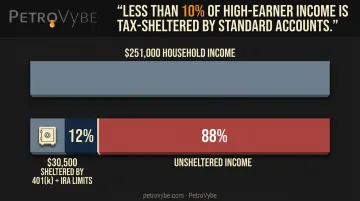
The math makes the gap obvious. For a household earning the Census Bureau's 90th-percentile income of $251,000, standard retirement accounts shelter a fraction of what actually needs sheltering:
| Account Type | 2025 Limit | % of $251,000 Income |
|---|---|---|
| 401(k) employee deferral | $23,500 | 9.4% |
| Traditional/Roth IRA | $7,000 | 2.8% |
That's the structural problem high earners run into every single year: less than 10% of income shielded in the accounts most financial advice assumes everyone uses.
The sections below rank the top income-generating investment categories for this exact situation, weighing tax efficiency, income potential, and how accessible each option actually is for accredited investors.
Top High-Income Investments for High-Income Earners
Each option below is evaluated on four criteria: tax efficiency, income potential, accessibility, and diversification value beyond the typical stock-bond-real estate mix.
Municipal Bonds & Tax-Exempt Fixed Income
Municipal bonds are debt issued by state and local governments to fund public projects. Their biggest draw for high earners: interest income is typically exempt from federal tax, and often state tax too if you buy bonds issued in your home state.
For someone in the top marginal bracket, that exemption can make a mediocre-looking yield outperform a taxable bond on an after-tax basis. A 4% muni yield might beat a 5.5% corporate bond yield once you run the numbers through a 37% tax rate.
| Factor | Details |
|---|---|
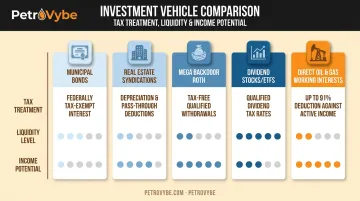
| Tax Treatment | Federal tax-exempt interest; may also be state-tax-exempt for in-state residents |
| Typical Returns | Benchmark AAA municipal yields ranged from roughly 2.4% to 4.4% across maturities as of early 2026 |
| Liquidity | Moderate — tradable on secondary markets but subject to price swings |
Real Estate Syndications & Depreciation-Driven Real Estate
Syndications let high earners buy into large commercial or multifamily properties without becoming landlords. A sponsor handles acquisition, management, and eventual sale, while investors receive quarterly or monthly distributions.
The tax appeal comes from depreciation and cost segregation studies, which can accelerate deductions and shelter rental income. There's a catch, though: passive activity loss rules restrict these deductions to offsetting passive income, not your W-2 salary.
| Factor | Details |
|---|---|
| Tax Treatment | Depreciation deductions subject to passive activity loss rules |
| Typical Returns | Varies widely by sponsor and asset class; institutional private real estate has recently posted low single-digit quarterly total returns |
| Liquidity | Low — capital is typically locked for multi-year hold periods |
Mega Backdoor Roth & After-Tax 401(k) Contributions
If your employer plan allows it, you can contribute after-tax dollars beyond the standard $23,500 deferral limit, then convert those dollars to a Roth account. Growth and withdrawals from that point forward are tax-free.
This strategy stands out because it's one of the only ways to move much more money into Roth-style growth without running into income phase-outs. It's not available everywhere, though. Your plan document has to explicitly permit after-tax contributions and in-plan conversions.
| Factor | Details |
|---|---|
| Tax Treatment | Tax-free growth and withdrawals once converted to Roth |
| Contribution Capacity | Combined employee-plus-employer 401(k) limit reaches $70,000 for 2025 |
| Complexity | Requires employer plan support and professional tax guidance |
Dividend-Paying Blue-Chip Stocks & ETFs
Established, profitable companies (and the ETFs that hold baskets of them) offer something most alternatives can't: liquidity. You can buy or sell within seconds, and qualified dividends receive preferential tax treatment.
Qualified dividends are taxed at the same 0%, 15%, or 20% rates that apply to long-term capital gains, depending on your taxable income and filing status. That's a meaningful discount compared to ordinary income rates that can reach 37%.
| Factor | Details |
|---|---|
| Tax Treatment | Qualified dividends taxed at 0%, 15%, or 20% rates instead of ordinary income rates |
| Liquidity | High — shares trade daily on public exchanges |
| Risk | Exposed to market volatility; dividends are not guaranteed |
Direct Oil & Gas Working Interest Investments
Working interests are direct ownership stakes in developing or producing wells. Historically, this asset class stayed locked behind institutional doors and industry insiders, but private placements have opened it up to accredited investors.
Here's what separates this category from everything else on this list: Intangible Drilling Cost (IDC) deductions can offset active income, including W-2 wages and capital gains. That's not typical. Most passive investments, including real estate, restrict deductions to passive income only.
PetroVybe, a Texas-based operator, gives accredited investors direct access to this structure through development projects across South Texas and the Gulf Coast Basin.
| Factor | Details |
|---|---|
| Tax Treatment | Up to 100% total deduction, with roughly 70% deductible in year one against active income (per PetroVybe's investor structure) |
| Target Returns | 10-year target MOIC of approximately 2.2x-5.8x and IRR of approximately 26% |
| Investor Type | Reserved for accredited investors, typically with $100,000+ in investable liquidity |
Why Direct Natural Gas Development Deserves a Bigger Slice of a High-Income Portfolio
Most tax-advantaged investments only shelter passive income. That's a problem if your income is mostly W-2 wages or capital gains, which describes the majority of high earners. Direct working interests in oil and gas wells work differently because of how the IRS treats Intangible Drilling Costs.
IDC deductions apply directly against active income sources. Unlike real estate depreciation, which gets trapped by passive activity loss limitations unless you qualify as a real estate professional, IDC deductions from a working interest flow straight through to offset your salary or your capital gains from a stock sale.
PetroVybe's own numbers back this up. Partners who joined in **2024 achieved a 94% tax deduction against ordinary income**, and 2025 partners saw 91%, both applied against active income including W-2 wages and capital gains.
The Team Behind the Numbers
Deduction size only matters if the underlying wells actually produce. PetroVybe's leadership brings a track record that's hard to find elsewhere in this space:
- Chief Geophysicist Michael Stamatedes has a 48-year track record with a 75.2% well-success rate, compared to an industry peer average below 40%
- President Blaine Yeary scaled a $5 billion asset from zero to 35,000 barrels of oil equivalent per day over eight years
- Third-party engineering firms validate reserve estimates, including a $48 million PV-09 valuation on the current project
Fueling a Demand Curve That Isn't Slowing Down
Natural gas isn't just heating homes anymore. Data centers running AI workloads are pulling enormous amounts of electricity from the grid.
The International Energy Agency projects global data center electricity use will more than double from 415 TWh in 2024 to 945 TWh by 2030, with natural gas and coal supplying over 40% of that new demand. In the U.S., gas alone is expected to be the largest single source of new power for data centers through 2030.
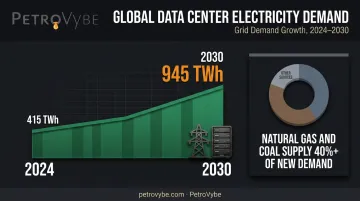
That demand curve is the backdrop for PetroVybe's thesis: developing natural gas assets today to meet electricity needs that are only growing.
Capturing that opportunity requires disciplined execution, not just favorable timing. The structure itself is designed to stay hands-off for investors. PetroVybe's operating team manages drilling, production, and reporting while third-party engineers validate reserves independently.
Investors target a MOIC of roughly 2.2x to 5.8x and an IRR near 26% over a 10-year hold. Accredited investors interested in direct partnership can explore South Texas and Gulf Coast Basin development projects through PetroVybe.
How to Choose the Right High-Income Investment for Your Portfolio
Picking the right vehicle starts with understanding your own income structure, not chasing whichever option has the flashiest headline return.
Assess your income mix. If most of your income is W-2 wages or capital gains, you need a deduction that offsets active income, like IDC deductions from oil and gas. If you have significant passive rental income already, real estate depreciation might do more work.
Balance liquidity against return potential. Municipal bonds and dividend stocks suit near-term goals since you can access capital quickly. Real estate syndications and oil and gas working interests suit long-term compounding, since capital typically locks up for years.
Verify the track record before committing. Look for:
- Audited financials
- Independent engineering reports
- Verified investor reviews
PetroVybe, for example, holds a Texas Railroad Commission operator license and carries verified ratings on Invest Clearly.
Skipping that third step is how investors end up in offerings that look great on a pitch deck and fall apart in year two.
Conclusion
A maxed-out 401(k) and IRA were never designed to carry the full weight of a high earner's tax strategy. Municipal bonds, real estate syndications, mega backdoor Roth contributions, dividend stocks, and direct oil and gas investments each address a different constraint: liquidity, deduction size, or how long you're willing to lock up capital.
The "best" choice isn't universal. It depends on your tax bracket, how much liquidity you need, and how much illiquidity you can tolerate in exchange for a bigger deduction or higher target return. Evaluate tax efficiency and passive income potential together, not returns in isolation.
For investors comfortable trading liquidity for a larger upfront deduction, direct oil and gas investment is where that trade-off is most pronounced. If offsetting active income through natural gas development sounds like it fits your situation, accredited investors can connect with PetroVybe to explore current South Texas and Gulf Coast Basin opportunities.
Frequently Asked Questions
How do I turn $100,000 into $1 million in 5 years?
A 10x return in five years requires taking on outsized risk that most investors shouldn't accept. Realistic wealth-building combines tax-efficient compounding with disciplined reinvestment over a longer horizon, though high-deduction vehicles can accelerate net returns.
What income level counts as "high-income" for investing purposes?
Top marginal tax brackets start around $250,000+ for individuals, though there's no single cutoff. Accredited investor status requires income above $200,000 (or $300,000 jointly) for two years, or net worth over $1 million excluding your home.
What's the best tax shelter for W-2 employees?
Municipal bonds and after-tax 401(k) contributions help, but neither offsets your actual W-2 income directly. IDC deductions from oil and gas working interests are one of the few strategies that reduce active wage income dollar for dollar.
Do I need to be an accredited investor to invest in oil and gas development?
Most private working interest offerings, including PetroVybe's, are limited to accredited investors under SEC Regulation D 506(c) rules. Verification typically requires documentation from a CPA, tax attorney, or licensed financial advisor.
How much of my income can I deduct through a natural gas investment?
PetroVybe partners achieved a 94% deduction against active income in 2024 and 91% in 2025. These deductions come from Intangible Drilling Costs and can apply against W-2 wages and capital gains.
Are high-income investments riskier than traditional stocks and bonds?
Alternative assets often carry illiquidity or operational risk that public markets don't have. In exchange, they can offer diversification and tax benefits that aren't available through stocks and bonds alone.