

This article is general education, not investment, tax, or legal advice.
Introduction
The traditional 60/40 portfolio — 60% stocks, 40% bonds — served investors well for decades. Then 2022 happened. A US 60/40 portfolio returned -16.1% that year, as stocks and bonds declined simultaneously for the first time in a generation. The diversification logic that underpinned the strategy broke down exactly when investors needed it most.
This wasn't a fluke. BlackRock reports that since 2020, bonds have lost money in 17 of 19 months when equities declined at least 2% — a pattern tied to supply-driven inflation shocks that push both asset classes down together.
More accredited investors are responding by rethinking their portfolio structure entirely. Alternative investments — once the domain of large endowments and pension funds — are now accessible to a broader range of high-net-worth individuals, and the structural case for adding them is backed by a decade of correlation data that traditional models didn't anticipate.
This guide covers what alternative investments are, the four allocation frameworks, why alternatives belong in a modern portfolio, the major categories, how much to allocate, and what accredited investors should evaluate before committing capital.
Key Takeaways
- A 60/40 portfolio returned -16.1% in 2022 as stocks and bonds fell together — alternatives offer real diversification when correlations converge
- Private equity projects 10.2% annual returns vs. 6.7% for US large-cap equity (J.P. Morgan 2026 LTCMA forecasts)
- A minimum 5% allocation to private alternatives is needed before benefits outweigh friction costs
- Oil and gas IDC deductions can offset active income, including W2 earnings and capital gains
- Accredited investors now have growing access to private markets with minimums starting around $100,000
What Are Alternative Investments?
Alternative investments are any assets outside publicly traded stocks, bonds, and cash. The CFA Institute defines the category as including private capital, real assets, hedge funds, commodities, and other nontraditional structures, though no single universal definition exists.
The term "alternative" once implied niche or supplemental. That framing no longer fits.
Yale's endowment FY2021 targets placed 78.5% combined in absolute return, venture capital, leveraged buyouts, real estate, and natural resources. Developed-market pension funds increased average alternative allocations from 7.2% in 2008 to 11.8% in 2017. US public pensions moved from roughly 15% in 2007 to more than 30% in alternatives by 2023.
What Distinguishes Alternatives from Traditional Assets
Alternatives share several characteristics that set them apart — for better and worse:
- Lower correlation to public markets — they don't move in lockstep with stocks or bonds
- Potential illiquidity — many lock up capital for years (private equity funds typically require 10+ year horizons)
- Limited historical data — fewer decades of return series compared to public markets
- Higher due diligence requirements — manager selection and deal analysis require more work
- Different fee structures — management fees, carried interest, and overhead costs are common
These tradeoffs are the price of admission. For accredited investors willing to accept illiquidity and complexity, alternatives offer a different return and diversification profile than public markets — which is why the institutional shift toward them has been consistent, not cyclical.
The Four Types of Asset Allocation Strategies
Portfolio construction typically follows one of four frameworks. Each assigns a different role to alternatives.
| Framework | Definition | How Alternatives Fit |
|---|---|---|
| Strategic | Long-term target weights tied to goals and risk tolerance | Permanent allocation with defined rebalancing ranges |
| Tactical | Short-term deviations from strategic mix to exploit market opportunities | Temporary overweight or underweight in specific categories |
| Dynamic | Continuous adjustment as markets or investor circumstances change | Alternative weights evolve rather than returning to fixed targets |
| Core-Satellite | Broad diversified core plus specialist satellite positions | Private equity, credit, or real assets serve as satellites |
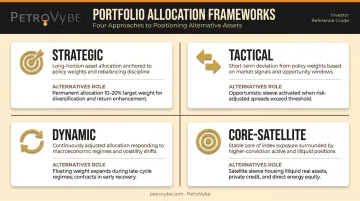
Most modern financial frameworks now treat alternatives as a dedicated sleeve alongside equities and fixed income. J.P. Morgan explicitly models this sleeve divided among private equity, direct lending, and private real estate. Cambridge Associates reports that many endowments have maintained alternatives allocations above 20% for more than two decades.
Which framework you choose shapes which alternatives make sense:
- Strategic allocations favor real assets as long-term inflation hedges
- Core-satellite models are better suited to private equity or direct lending as satellite positions
- Tactical or dynamic frameworks allow shorter-term tilts toward energy, commodities, or credit depending on market conditions
Why Investors Are Turning to Alternatives
The 60/40 Diversification Problem
Post-2022 volatility exposed a structural weakness in relying solely on stocks and bonds. The issue isn't that 60/40 is permanently broken — J.P. Morgan's 2026 LTCMA still projects 6.4% for a global 60/40 portfolio. The issue is that inflation environments push stock-bond correlations positive, reducing diversification exactly when protection is most needed.
Vanguard's modeled high-inflation scenario raised median 60/40 volatility from 9.60% to 10.30% and expected maximum drawdown from -11.70% to -13.10%. Alternatives address this by providing exposures with different return drivers.
Return Enhancement
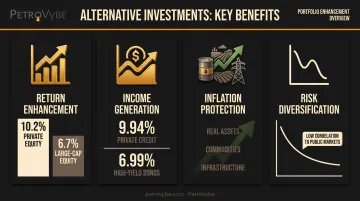
J.P. Morgan's 2026 Long-Term Capital Market Assumptions project 10.2% annual compound returns for private equity, versus 6.7% for US large-cap equity — a 3.5 percentage-point premium. This illiquidity premium is real, but it requires investors to commit capital over long horizons and accept that returns vary significantly by vintage and manager.
Cambridge Associates' US PE Index outperformed the S&P 500 over periods longer than three years through December 31, 2024, consistent with the long-run case for private equity, though past performance is no guarantee of future results.
Income Generation
Private credit and real assets generate stable, often inflation-linked cash flows. The Cliffwater Direct Lending Index reported a current yield of 9.94% versus 6.99% for high-yield bonds as of December 31, 2025 — a spread of nearly 300 basis points for investors willing to accept illiquidity and private market complexity.
Inflation Protection
Real assets — commodities, energy, farmland, timber, infrastructure — tend to retain or increase value during inflationary periods because their revenues are tied to physical output or replacement costs. Bonds, by contrast, lose real value as inflation rises.
CAIA research notes that inflation behavior varies across real asset categories: commodities respond quickly to short-run inflation surprises, while farmland and timber correlations have evolved over time. Not all real assets protect equally — category selection matters.
Risk Diversification
Low correlation means alternatives don't move with public equity markets in predictable ways. In practice, this means:
- Adding alternatives can reduce overall portfolio volatility
- Improved risk-adjusted returns (Sharpe ratio) become achievable without requiring higher equity concentration
- Drawdown severity during market dislocations is reduced when return drivers are genuinely uncorrelated
Alternatives aren't risk-free. Their risks are simply different — and for a diversified portfolio, that difference is exactly what creates resilience.
Major Categories of Alternative Investments
Private Equity
Private equity invests in non-publicly traded companies through buyouts and growth equity. Its primary role is return enhancement — accessing growth and operational improvement opportunities unavailable in public markets. The main tradeoff: lock-up periods of 7-10 years and minimum investment thresholds that have historically favored institutional capital.
Real Assets and Energy
Real assets include infrastructure, commodities, farmland, timber, and energy — physical assets serving two portfolio functions at once: income generation and inflation hedging.
Energy investments, specifically oil and natural gas development, occupy a distinctive position within this category. Investors who hold working interests or royalty positions own rights to commodity production that is inherently correlated with inflation factors. They also benefit from unique tax treatment under the US tax code.
Under IRC 263(c) and Treasury Regulation 1.612-4, Intangible Drilling Costs (IDCs) qualify for current expensing rather than capitalization. IDCs cover expenses like survey work, drilling services, geology, and engineering.
For qualifying working interests, this creates three potential advantages, depending on the investor's circumstances:
- Losses are excluded from IRC 469's passive activity rules
- Deductions can offset active income, including W2 earnings and capital gains
- Real estate deductions typically cannot match this treatment against earned income
This treatment requires the investor to elect general partner status in the Subscription Agreement and may be limited in a given year by the excess business loss limitation under IRC §461(l).
PetroVybe, a Texas-based natural gas development company, offers accredited investors participation through Class C limited partnership units, minimum $100,000. Its current PetroVybe ONE project is focused on East Texas and the Gulf Coast Basins. PetroVybe ONE partners received a 94% tax deduction against active income in 2025 — a prior-program result, not a promise of any future deduction. The project models a ~26% IRR in its base case, with conservative and optimistic cases at ~13% and ~36%; all cases use the 10-year NYMEX strip average of $3.58 gas and $65.53 oil. Modeled returns are not guaranteed. The project is backed by a $48MM proved reserves valuation (PV-09) prepared by Lee Keeling & Associates, Tulsa, March 2026.

Note: IDC deductions are subject to basis, at-risk rules, ownership structure, and individual tax circumstances. Consult a qualified tax professional before making investment decisions based on tax benefits.
Private Credit and Direct Lending
Private credit involves lending to companies outside traditional bank channels through direct loans that offer meaningfully higher yields than public high-yield bonds, as the Cliffwater data shows. These investments provide:
- Steady income with floating-rate protection
- Collateral protection from negotiated lender terms
- Relatively low correlation to equity markets
For income-seeking investors, private credit fills a gap that traditional fixed income increasingly struggles to address in a higher-rate environment.
Hedge Funds
Hedge funds use a range of strategies (long/short equity, global macro, arbitrage, event-driven) aimed at producing returns with lower correlation to market direction. Their primary portfolio role is often risk reduction and smoothing rather than maximum return generation. Results vary significantly by strategy and manager, making selection critical.
Private Real Estate
Real estate spans a wide strategy spectrum:
- Core — stable income from high-quality properties, with lower risk
- Value-add — modest repositioning to improve cash flow
- Opportunistic — capital appreciation and development-driven returns
Private real estate typically offers low correlation to stocks and bonds, inflation protection through rent escalations, and reliable income — attributes that have made it a core allocation for both institutional and high-net-worth portfolios. NCREIF's NPI data (beginning Q4 1977) provides one of the longest return histories in the alternatives universe, though appraisal-based valuations can smooth observed volatility.
How Much of Your Portfolio Should Be in Alternatives?
There is no universal right answer — but there is a meaningful floor.
J.P. Morgan's 2025 optimization analysis found that approximately 5% in private alternatives is the minimum needed to justify the added complexity and cost. Below this threshold, friction costs — due diligence time, management fees, illiquidity premiums, and early-year capital drag — tend to outweigh the diversification gain. Many institutional investors hold 10-30%+ in alternatives.
That 5% floor exists precisely because of friction. Two types of costs affect small alternative allocations:
- Fixed costs — due diligence time, manager selection complexity, overhead
- Variable costs — management fees, illiquidity premiums, J-curve drag (negative returns in early years before distributions ramp up)
These costs become justified as the allocation grows meaningfully. A 2% alternatives sleeve rarely delivers enough benefit to compensate for the overhead. A 10-15% sleeve often does.
Matching Alternatives to Your Primary Goal
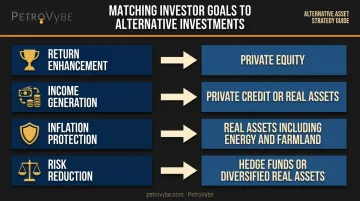
Rather than lumping all alternatives together, size allocations based on what you're trying to accomplish:
- Return enhancement → Private equity (accept long lock-ups)
- Income generation → Private credit or real assets (infrastructure, energy)
- Inflation protection → Real assets including commodities, energy, farmland
- Risk reduction → Hedge funds or diversified real assets
Liquidity Planning
Private alternatives have multi-year lock-up periods. Before allocating:
- Ensure remaining portfolio retains sufficient liquid assets for near-term needs
- Size the illiquid portion relative to your investment horizon
- Investors with horizons shorter than 15 years should approach private real estate, private equity, and private energy funds cautiously, or focus on categories with shorter lock-up structures
Getting forced out of an illiquid position early — at a discount — can erase years of compounding. Know your horizon before you commit capital.
Frequently Asked Questions
What is Warren Buffett's recommended asset allocation?
In Berkshire Hathaway's 2013 shareholder letter, Buffett instructed his wife's estate trustee to hold 90% in a low-cost S&P 500 index fund and 10% in short-term government bonds. That was a specific estate instruction — not guidance for accredited investors with longer time horizons, private market access, or active-income tax optimization needs that alternatives can address.
What are the four types of asset allocation?
The four main frameworks are strategic (long-term target weights), tactical (short-term market-driven tilts), dynamic (continuous rebalancing as conditions evolve), and core-satellite (stable core plus higher-conviction satellite positions). All four frameworks increasingly incorporate a dedicated alternatives sleeve alongside equities and fixed income.
Are alternative investments only for the wealthy?
Private alternatives historically required institutional capital or very high minimums. That's changed. Accredited investors now have access to private equity, private credit, real estate, and energy development — typically with minimums in the $100,000–$250,000 range — opening these asset classes to a broader set of high-income and high-net-worth individuals. PetroVybe's own minimum is $100,000, at one Class C limited partnership unit, with add-on subscriptions from $25,000.
What percentage of my portfolio should be in alternative investments?
A minimum of 5% is widely cited as the threshold where benefits begin to outweigh friction costs, with many institutional investors holding 10-30%+. Individual allocations should be guided by your primary goal (return, income, inflation protection, or risk reduction), time horizon, liquidity needs, and access to specific asset classes.
How do alternative investments help reduce my tax burden?
Direct oil and gas development offers Intangible Drilling Cost (IDC) deductions that can offset active income — including W2 earnings and capital gains — in the year of investment. Unlike real estate deductions, oil and gas working interest losses are excluded from passive activity rules under IRC 469, making them usable against ordinary income. This treatment requires the investor to elect general partner status in the Subscription Agreement and may be limited in a given year by the excess business loss limitation under IRC §461(l). Individual outcomes depend on ownership structure, basis, and tax circumstances.
What is the difference between liquid and illiquid alternative investments?
Liquid alternatives (such as liquid alt mutual funds or hedge fund replication strategies) offer daily or frequent redemption with alternative-style strategies. Illiquid alternatives — private equity, direct real estate, oil and gas development, private credit — lock up capital for years but typically offer an illiquidity premium: higher potential returns in exchange for that commitment.
Informational requests only. PetroVybe projects are offered solely to verified accredited investors. Submitting a contact form does not create an investment or advisory relationship.
Disclosure: PetroVybe and its team members are not licensed financial advisors, and nothing on this website constitutes financial or investment advice or a recommendation to buy, sell, or hold any investment. PetroVybe and its team members are not tax advisors, accountants, or tax strategists, and nothing on this website constitutes tax advice or a tax strategy. PetroVybe and its team members are not attorneys, and nothing on this website constitutes legal advice. All content is provided for general informational purposes only. You should consult your own independent financial advisor, tax professional, and legal counsel before making any decision.