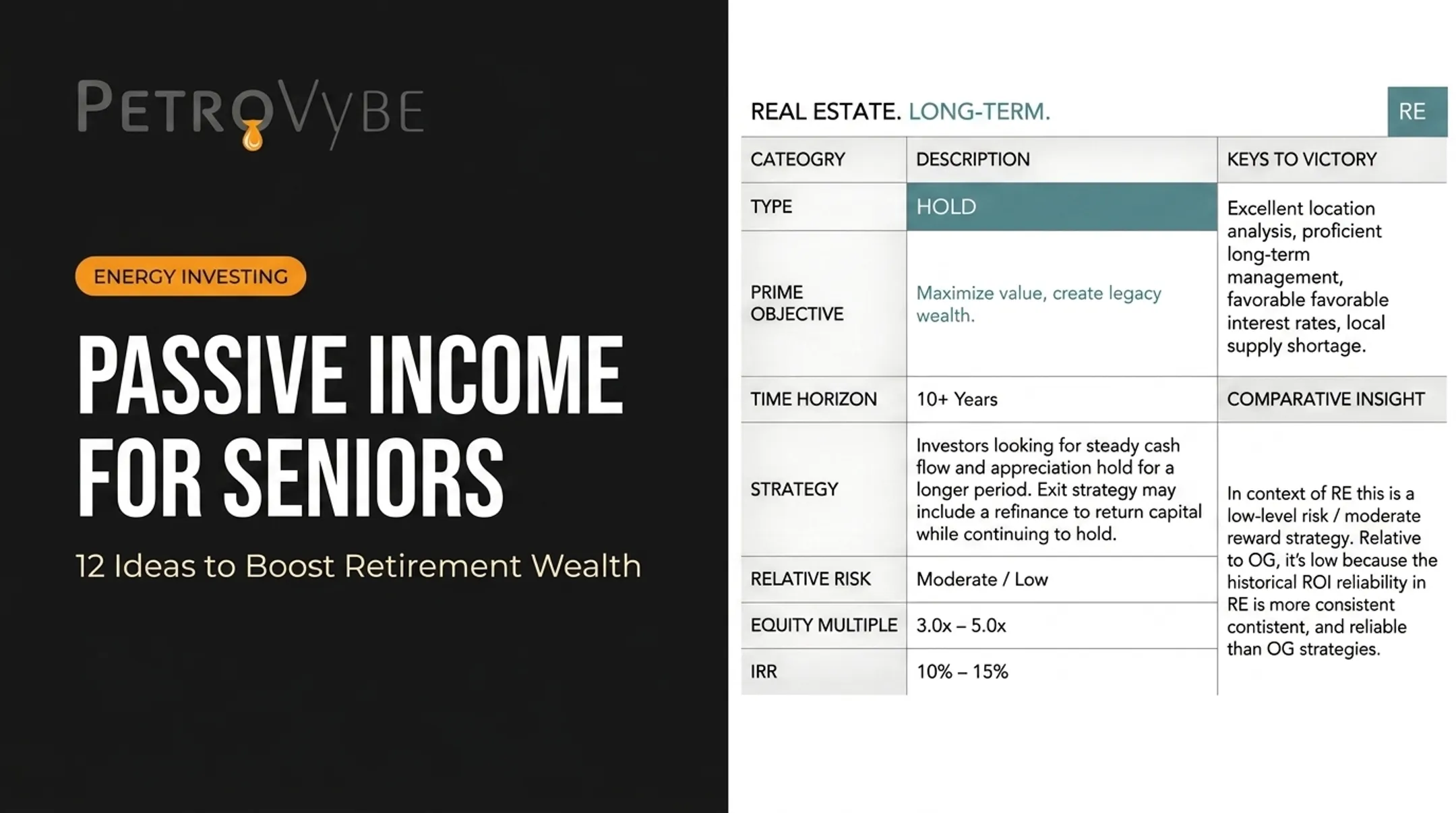

It's no surprise that retirees are leaning on more than one income stream. The Federal Reserve found that 81% of retirees report at least one source of private income beyond Social Security, with half reporting interest, dividends, or rental income specifically.
This guide walks through 12 passive income sources retirees can mix and match based on their capital, risk tolerance, and appetite for involvement.
Key Takeaways
- Passive income reduces reliance on portfolio withdrawals and softens sequence-of-returns risk
- Choose sources that fit your capital, risk tolerance, and desired hands-off level
- Sources range from fully passive (dividends, annuities) to semi-passive (rentals, licensing)
- Tax treatment varies by source and can materially change your after-tax income
- Diversification protects against inflation, market swings, and outliving your money
Why Diversifying Passive Income Matters in Retirement
Relying on one income source concentrates risk in ways that can backfire. A retiree who depends only on Social Security faces benefit caps and taxation thresholds. A retiree who depends only on a stock portfolio is exposed to market downturns at the worst possible time.
Blending three income types reduces the impact of any single setback:
- Guaranteed sources (Social Security, pensions, annuities) keep cash flowing when stocks dip
- Market-linked income (dividends, bond ladders) participates in portfolio growth
- Alternatives such as real estate or energy investments can offset inflation’s effect on fixed payments
Below are 12 sources, ordered roughly from most traditional and liquid to more specialized, higher-yield alternatives. Each includes the effort level, capital needed, and risk profile.

12 Key Sources of Passive Income in Retirement
Dividend Stocks and Dividend ETFs
Dividend-paying companies distribute a portion of profits to shareholders, typically quarterly. The broad S&P 500 yields relatively little today, while dedicated high-dividend funds pay more. Vanguard's High Dividend Yield ETF (VYM), for example, yielded 2.29% as of July 2026.
The catch: Dividends aren't guaranteed. Companies cut or suspend payouts during downturns, and share prices still fluctuate with the market.
Bond Ladders and Fixed Income
A bond ladder staggers maturities across several years, so you're not locked into one interest rate and you get predictable cash flow as each rung matures. Treasury yields recently ranged from roughly 3.9% on short-term bills to 4.8% on 10-year notes, per Treasury data.
The risk here is inflation, not default. Fixed payments lose purchasing power over a 20-year retirement if inflation outpaces your rate.
Annuities (Immediate and Deferred)
Annuities convert a lump sum into guaranteed lifetime income. Payout rates rise with age since the insurer expects to pay for fewer years. On a $100,000 premium, a 65-year-old male might see roughly $630-$679/month. An 80-year-old male could see $993-$1,062/month, according to ImmediateAnnuities.com.
Tradeoffs to weigh:
- Money is largely locked up once committed
- Surrender charges apply for early withdrawals
- Fees vary significantly by product and insurer
High-Yield Savings, Money Market Funds, and CDs
These carry no market exposure and near-zero risk to principal. Top national savings accounts were paying up to 4.10% APY in September 2026, per Bankrate, though the national average sat closer to 0.63%.
This bucket works best for near-term cash reserves, not long-term income growth. Don't expect it to outpace inflation over a decade.
REITs (Real Estate Investment Trusts)
REITs let you collect real estate-linked income without managing tenants or property. The FTSE Nareit All Equity REIT index yielded 4.07% as of the end of 2025. Compared to buying property directly, REITs require far less capital and zero maintenance.
The catch: REIT prices still move with interest rates and equity markets, so the yield can hold while principal swings.
Direct Rental Property Ownership
Owning rental property directly offers income plus appreciation potential, but it's genuinely active work: tenant screening, maintenance calls, vacancies, and property taxes. Single-family rentals were seeing cap rates around 7.1% recently, though that's a return on the property, not your leveraged cash-on-cash yield.
Real estate crowdfunding platforms offer a lower-effort alternative if you want real estate exposure without the landlord duties.
Whole Life Insurance Cash Value
A whole life policy builds cash value over time that you can borrow against or withdraw. It's a long-term commitment, though. Unpaid loans accrue interest and reduce your death benefit, and a policy can lapse if the loan balance ever exceeds the cash value.
Oil and Gas / Natural Gas Development Investments
Direct participation in natural gas development projects can generate royalty-style passive income tied to actual production. This is alternative-asset territory, generally limited to accredited investors.
What makes this category distinct from most on this list is the tax treatment. Intangible drilling cost (IDC) deductions let investors write off a large share of their investment against active income, including W-2 earnings and capital gains, not just passive income.
How PetroVybe approaches this: Partners received a 91% deduction against active income in 2024 and 94% in 2025, driven by IDC and depletion deductions on development projects across East Texas and Gulf Coast Basin acreage, including a 58,000-acre position in Lavaca County.

Projected partner outcomes include:
- Monthly distributions exceeding $10,000 during peak production
- Targeted 4.5x return over a 10-year hold
This is best suited for accredited investors with $100,000+ in liquidity who are comfortable with illiquidity and the risks inherent to energy development.
Royalties and Licensing (Books, Music, Patents)
If you've written a book, composed music, or hold a patent, royalties can keep paying you long after the initial work is done. Trade book royalties typically run 10-12% of sales, according to the Authors Guild.
Income here tends to be lumpy and unpredictable, and usually requires upfront time, legal setup, or both before the checks start arriving.
Silent/Passive Business Ownership
Buying an equity stake in a business you don't operate day-to-day can produce regular profit distributions. It's a real path to passive income, but concentration risk is significant. Private placements are also notoriously illiquid compared to publicly traded investments, per the SEC's Investor.gov guidance.
Home Sharing and Asset Rentals (Airbnb, Parking, Vehicles)
Underused assets can generate real monthly income:
- Airbnb hosting: median $2,408/month in U.S. host revenue in 2025
- Parking space rental: roughly $50-$300/month
- Vehicle sharing (Turo): average $634/month to the car owner
This lands in semi-passive territory. Guest coordination, cleaning, and upkeep require ongoing attention, even if it's not a full-time job.
Peer-to-Peer Lending
P2P platforms let you lend directly to individuals or small businesses and collect interest. Prosper reported a 5.5% average historical return net of fees and losses as of mid-2024. Higher yields come paired with real default risk, so this works best as a small slice of a broader portfolio, not a core holding.
How to Choose the Right Mix for Your Retirement Plan
Think in layers:
- Floor layer: guaranteed income you can't outlive — Social Security, annuities
- Discretionary layer: market-linked income that can grow — dividends, REITs, bonds
- Flexible layer: semi-passive or alternative sources — rentals, royalties, energy investments

Weight each layer by three factors:
- Available capital
- How hands-on you want to be
- Your time horizon
Someone in their early 60s with a longer runway can usually hold more market-linked and illiquid exposure than someone already drawing down assets at 80.
Before you commit capital to any single source:
- Run withdrawal and tax projections across a 20+ year span
- Stress-test a 4% (or custom) withdrawal rate — small errors compound badly
- Review the mix with a financial or tax professional when the dollars are material
Tax Considerations for Passive Retirement Income
Tax treatment varies enormously across these sources:
- Qualified dividends and long-term capital gains get preferential rates versus ordinary income
- Rental income allows depreciation deductions (27.5 years for residential property, per IRS Publication 527)
- Annuity growth is tax-deferred until withdrawal
- Natural gas development investments can offer substantial first-year deductions against active income, which is unusual for a passive category
PetroVybe's structure, for instance, targets roughly 70% of the investment as a first-year deduction, with up to 100% deductible over the life of the investment.
Sequencing withdrawals and income sources correctly can materially reduce your lifetime tax burden. A tax professional who understands both retirement income and alternative investments is worth the consultation fee.
Conclusion
No single source covers every retirement need. A diversified mix of guaranteed, market-linked, and alternative income protects against inflation, market swings, and the risk of outliving your savings.
Before you allocate, take stock of:
- Liquidity needs
- Risk tolerance
- How hands-on you want to be
If you're an accredited investor looking for tax-advantaged passive income tied to real production assets, explore PetroVybe's natural gas investment opportunities in East Texas and Gulf Coast Basin projects.
Frequently Asked Questions
How can I make $1,000 a month in passive income?
At typical yields, a dividend or bond portfolio of about $250,000–$300,000 can produce $1,000/month. Many retirees hit the same target by stacking smaller sources—rentals, annuities, and alternative investments—rather than relying on one portfolio alone.
How long will $300,000 last in retirement?
Under the 4% rule, $300,000 supports about $12,000 a year and is designed to last roughly 25–30 years. On its own that income is modest, so most retirees pair it with Social Security and other passive sources.
What is the best way to earn passive income in retirement?
The strongest approach combines guaranteed income—Social Security and annuities—with market-linked and alternative sources matched to your risk tolerance and available capital.
Is rental income considered passive income for tax purposes?
Generally, yes. The IRS treats rental income as passive unless you qualify as a real estate professional, which comes with specific hour and activity requirements.
Does passive income affect Social Security benefits?
Dividends, rental income, and annuity payments don't count toward the Social Security earnings test, which applies to wages and self-employment income. However, passive income can affect how much of your Social Security benefit is taxable.
How much capital do I need to live off passive income alone?
Divide your target annual income by your expected yield—for example, $60,000 at 4–5% points to roughly $1.2–$1.5 million. Layering multiple sources usually lowers the total capital required versus relying on one asset class.