
If you're job hunting, investing, or trying to partner with the right energy company, knowing who actually leads the pack matters. Brand recognition isn't the same as market dominance.
This article ranks the top Houston oil and gas companies by production, market capitalization, and industry influence, and explains what makes each one distinct.
TL;DR
- Houston hosts more than 4,200 oil, gas, and advanced-energy firms, including 14 Fortune 500 energy headquarters
- ExxonMobil, Chevron, ConocoPhillips, Phillips 66, and Halliburton represent the city's biggest names
- Leaders stand out on market cap, production scale, and spread across upstream, midstream, and downstream
- The region refines roughly 15.3% of total U.S. oil-refining capacity
- Accredited investors can also tap private natural gas developers for direct-access alternatives beyond public giants
Overview of the Oil and Gas Industry in Houston, Texas
Houston's dominance comes down to geography and infrastructure: deepwater ports, dense pipeline networks, and massive refining capacity all converge here.
According to the Greater Houston Partnership, the region anchors U.S. energy with:
- More than 4,200 oil and gas and advanced-energy firms
- 14 Fortune 500 energy headquarters
- Roughly 15.3% of total U.S. refining capacity
- Four deepwater ports and over 1,000 miles of hydrogen pipeline
That concentration of capital and infrastructure is why the following companies dominate headlines, hiring, and investor attention. Here's how they stack up.
Top Oil and Gas Companies in Houston, Texas
We ranked these companies using market capitalization, production scale, headquarters presence, and industry influence, not just name recognition.
ExxonMobil
ExxonMobil moved its global headquarters to its Houston-area Spring campus in 2023, consolidating operations across upstream, refining, and chemicals under one roof. It's the largest U.S.-based oil major by a wide margin.
What sets it apart:
- Highest market cap among Houston majors at $655.7 billion (Reuters, September 2026)
- Produced 4.7 million oil-equivalent barrels per day in 2025
- Targeting roughly 2.3 million BOED from the Permian by 2030
- Guyana operations hit 900,000 barrels per day in August 2025 after the Yellowtail project came online
| Headquarters Location | Core Segments | Key Differentiator |
|---|---|---|
| Spring/Houston, TX | Upstream, Refining, Chemicals | Largest U.S. oil major; Guyana + Permian scale |

Chevron
Chevron announced its move from San Ramon, California to Houston in August 2024, with leadership relocating that same year. Its deepwater Gulf of Mexico and Permian assets anchor its production.
What sets it apart:
- Second-largest market cap among the five at $412.1 billion
- Completed the Hess acquisition in July 2025, gaining a 30% stake in Guyana's Stabroek Block (11+ billion barrels of discovered recoverable resource)
- Anchor field started production in 2024 with 75,000 gross barrels/day design capacity
- Committed more than $10 billion through 2028, including $2 billion toward lowering carbon intensity
| Headquarters Location | Core Segments | Key Differentiator |
|---|---|---|
| Houston, TX (from San Ramon, CA) | Upstream, Deepwater, Low-Carbon | Hess acquisition; Guyana and Permian growth |
ConocoPhillips
ConocoPhillips is one of the world's largest independent exploration and production companies. It is headquartered in Houston and operates across 14 countries.
What sets it apart:
- Completed its Marathon Oil acquisition in November 2024, converting each Marathon share into 0.255 ConocoPhillips shares
- Expects more than $1 billion in run-rate synergies from that deal
- Reported 2.375 million BOED in 2025 production
- Management has pointed to growth potential of up to 5% annually, per Reuters reporting
| Headquarters Location | Core Segments | Key Differentiator |
|---|---|---|
| Houston, TX | Exploration & Production | Largest independent E&P; Marathon merger |

Phillips 66
Phillips 66 runs an integrated downstream and midstream business from its Houston headquarters, spanning pipelines, NGL fractionation, and refining.
What sets it apart:
- Operates 70,000+ miles of U.S. pipeline systems
- Invested $2.6 billion in midstream capital projects from 2023-2025
- Committed $1.2 billion to renewable fuels, primarily the Rodeo Renewable Energy Complex conversion
- Reuters listed its market cap near $66.6 billion
| Headquarters Location | Core Segments | Key Differentiator |
|---|---|---|
| Houston, TX | Midstream, Downstream, NGLs | Integrated pipeline and fractionation network |
Halliburton
Founded in 1919, Halliburton is one of the world's largest oilfield services companies and remains headquartered in Houston.
What sets it apart:
- Employs more than 48,000 people across 145 nationalities
- Operates in more than 70 countries
- Spent $426 million on R&D in 2024, supporting its Landmark digital platform, including DecisionSpace 365 and cloud-based reservoir tools
- Market cap sits around $30.1 billion, smallest of the five but still a global services leader
| Headquarters Location | Core Segments | Key Differentiator |
|---|---|---|
| Houston, TX | Oilfield Services, Digital Technology | Global scale; century-long operating history |

How We Chose the Top Companies
Ranking oil and gas companies by brand recognition alone is a common mistake that ignores actual production scale and financial performance.
We weighed four factors instead:
- Market capitalization: a snapshot of investor confidence and company size
- Headquarters presence: confirmed Houston-area operations, not just regional offices
- Production and reserves: actual barrels produced, not projected potential
- Segment diversification: upstream, midstream, and downstream exposure
This approach filters out companies that look impressive on paper but lack the operational footprint to match.
Beyond the Corporate Giants: Where Private Investors Fit In
Public majors like ExxonMobil and Chevron dominate headlines, but they're not the only way to get exposure to Texas energy. Accredited investors have another option: private natural gas development companies offering direct access to early-stage projects.
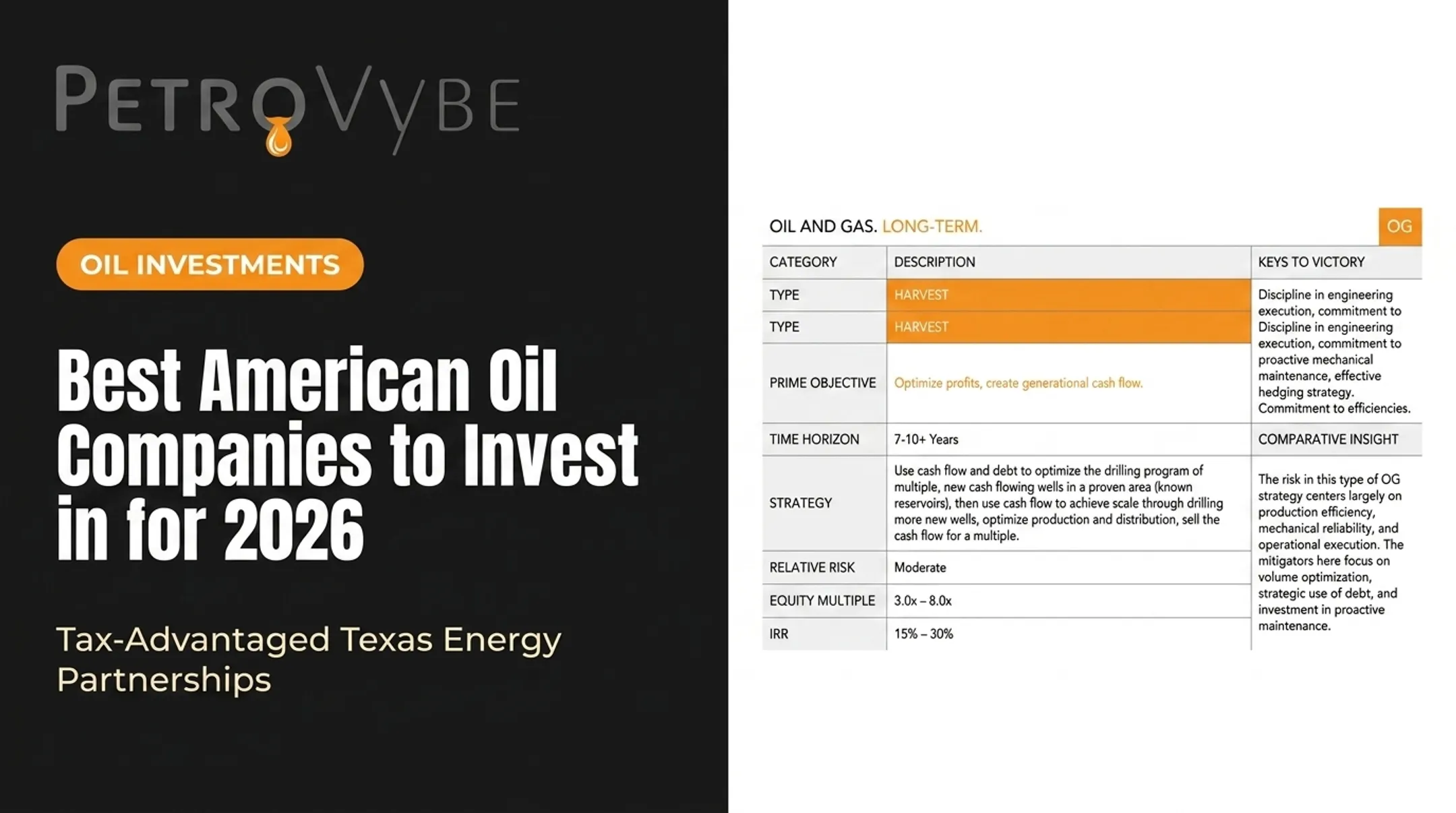
PetroVybe, a Texas-based natural gas developer operating in the Gulf Coast Basin, is one example. Unlike buying shares of a mature public company, PetroVybe offers direct equity participation in development-stage assets: a 58,000-acre position in Lavaca County combining roughly 400 acquired legacy wells with 57+ planned new wells.
What makes this different from public energy stocks:
- Partners have realized 91-94% tax deductions against active income (including W-2 earnings) through intangible drilling cost and depletion allowances
- Backed by a $48 million PV-09 reserves valuation from a licensed engineering firm, plus a clean 2025 independent audit
- Places capital where production value is created, not after the growth phase has already played out
- Open to accredited investors with $1 million net worth (excluding primary residence) or $200,000 individual / $300,000 joint income

Direct participation still sits in a different category from evaluating ExxonMobil or Chevron as a career prospect or public stock holding. One is early-stage project equity; the other is ownership in a mature public company.
Conclusion
Houston's energy dominance comes from the concentration of upstream giants, midstream operators, and oilfield service leaders headquartered in the same metro area. That density makes the city central to U.S. energy.
Whether you're evaluating a career move or an investment, look past the name recognition. Compare operational scale, track record, and, for investors, how a company's structure aligns with your financial goals.
Accredited investors curious about direct participation in natural gas development, rather than public market exposure, can explore PetroVybe's Gulf Coast Basin opportunities to see if it fits their portfolio.
Frequently Asked Questions
What are the biggest oil and gas companies in Houston?
ExxonMobil is the largest by market cap and production, at roughly $655.7 billion and 4.7 million BOED in 2025. Chevron and ConocoPhillips follow as major upstream players with large Houston operations.
How many oil companies are in Houston, Texas?
The Greater Houston Partnership reports more than 4,200 oil, gas, and advanced-energy firms in the metro area. This figure covers the broader energy ecosystem, not just headquarters.
What are the major oil companies in Texas?
The five most prominent Houston-tied names are ExxonMobil, Chevron, ConocoPhillips, Phillips 66, and Halliburton. Each covers a different segment, from upstream production to oilfield services.
What is the best energy company in Houston, Texas?
It depends on your goal. Career seekers usually rank culture, mobility, and project mix; investors tend to compare market cap, dividends, and upstream vs. downstream exposure.
What are the best oil and gas companies to work for in Houston?
Compare total compensation, schedule stability, and whether you want reservoir/production work, field services, or refining. Majors, independents, and service firms each trade pay upside for different risk and travel profiles.
Can accredited investors invest directly in Houston-area oil and gas development?
Yes. Private development companies like PetroVybe offer accredited investors direct access to natural gas projects in Texas basins, including the Gulf Coast Basin, outside the public markets.