

Introduction
Accredited investors are staring down higher ordinary income tax brackets, elevated capital gains exposure, and a shrinking list of legal ways to keep more of what they earn. Limited partnerships have become a go-to answer.
Pass-through taxation and passive loss rules get discussed constantly in financial circles, but usually in the abstract. Their real value shows up in April, when a K-1 either shrinks your tax bill or does nothing at all.
This article breaks down the core tax advantages built into LP structures, then shows how oil and gas development LPs unlock deductions most passive investments simply can't touch.
Key Takeaways
- LPs pass profits and losses directly to partners, avoiding entity-level tax
- Limited partners typically owe no self-employment tax on their distributive share
- Passive losses can offset passive income from other investments, creating sheltered cash flow
- Oil and gas working interests let deductions offset active W-2 and capital gains income
- Maximizing these benefits requires proper structuring, K-1 tracking, and a partnership-savvy CPA
What Is a Limited Partnership (Brief Context)
A limited partnership pairs at least one general partner, who manages the business and carries unlimited liability, with one or more limited partners who contribute capital and cap their liability at that investment.
You'll find this structure powering:
- Real estate syndications
- Private equity and hedge funds
- Oil and gas development projects
The LP structure itself is just a wrapper. The real tax advantage comes from how the IRS treats income and losses inside that wrapper, which the next section explains in detail.
Core Tax Advantages of Limited Partnerships
Everything below gets measured in real tax-dollar terms: effective tax rate, after-tax yield, and cash you actually keep. Not legal theory.
Pass-Through Taxation (No Double Taxation)
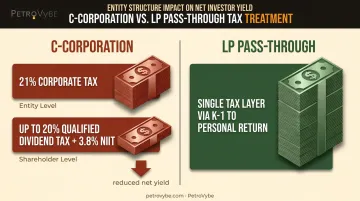
A partnership files Form 1065 as an information return, issues K-1s to each partner, and pays no federal income tax at the entity level. Each partner then reports their share on their personal return and pays tax once.
Compare that to a C-corporation. The entity pays a flat 21% corporate rate, and then shareholders pay again on distributions: up to 20% on qualified dividends, plus a 3.8% Net Investment Income Tax for many high earners.
That's two full layers of tax on the same dollar of income. It's a structure the Tax Foundation describes as double taxation, and while the exact drag varies by investor, it consistently reduces effective returns.
Skip that second layer, and more of the distribution lands in your pocket.
Tax metrics impacted: effective tax rate, net distributable cash, after-tax IRR.
Passive Loss Deductions Offsetting Passive Income
The passive activity loss rules trace back to the Tax Reform Act of 1986, and they still govern how most LP losses behave today. A passive activity is generally one where you don't materially participate — think a syndication where the general partner runs everything and you just cut a check.
Under these rules, losses from depreciation or intangible drilling costs can offset income from other passive sources. Some investors call these offsetting positions "Passive Income Generators," though the IRS never actually defines that term. The controlling category is simply passive activity income under IRS Publication 925.
Here's how this plays out for someone holding multiple syndications:
- Losses from Investment A (often front-loaded through depreciation) offset gains from Investment B
- Disallowed losses carry forward indefinitely
- Suspended losses become fully deductible when you dispose of the interest in a taxable sale
Build a portfolio with this in mind, and you can strategically match losses and gains year over year instead of paying full freight on each investment separately.
Tax metrics impacted: passive income tax liability, suspended and carryforward loss balances.
No Self-Employment Tax on LP Income
Because a limited partner's income is generally passive rather than earned through active labor, it's typically excluded from self-employment tax — a real advantage over general partner income or active business earnings.
The legal basis is IRC Section 1402(a)(13), which excludes a limited partner's distributive share "as such" from net earnings from self-employment. The catch: this exclusion doesn't cover guaranteed payments for services, and courts have scrutinized partners who function more like active operators than passive investors.
For context on what's actually at stake:
- Combined self-employment tax rate: 15.3% (12.4% Social Security + 2.9% Medicare)
- 2025 Social Security wage base cap: $176,100
- The 12.4% portion stops at the wage base; the 2.9% Medicare portion never does
Avoiding this tax entirely on a six-figure distribution is a meaningful difference in net take-home yield compared to earning similar income as an active business owner.
Tax metrics impacted: self-employment tax liability, net investment yield.
Amplified Tax Advantages: Oil & Gas Limited Partnerships
Among LP structures, oil and gas development LPs offer some of the most aggressive deductions available anywhere in the U.S. tax code — and they work differently than the passive rules described above.
The Intangible Drilling Cost Deduction
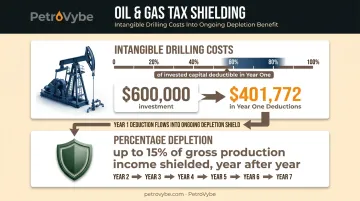
Intangible Drilling Costs (IDCs) cover the non-salvageable expenses of drilling a well: labor, fuel, chemicals, hauling, and site preparation. Under the current-expense election, qualifying IDCs can be deducted in full in the year they're incurred, per 26 CFR § 1.612-4.
In practice, IDCs typically run 60% to 80% of total invested capital in a new-drilling development project, with much of that hitting in year one. That's a substantial write-off against a single tax year's income.
Why Working Interests Break the Passive Loss Rules
This is the part that separates oil and gas LPs from nearly every other passive investment. Section 469(c)(3) explicitly exempts working interests in oil and gas properties from the passive activity definition, provided the investor's liability isn't limited by the ownership structure. That means these deductions can offset:
- W-2 wages
- Capital gains
- Other active income
PetroVybe's own partner data illustrates the scale of this benefit in practice:
- 2024 partners realized a 94% tax deduction against active income, delivered via K-1
- 2025 partners captured 91%, also usable in the same tax year the capital was deployed
- A sample 2025 K-1 on file shows a $600,000 capital contribution generating $401,772 in IDC-driven deductions
PetroVybe structures its natural gas development projects across South Texas and the Gulf Coast Basin, including its Lavaca County acreage, to give accredited investors direct access to this working-interest tax treatment. That access layers on top of long-term passive income and MOIC targets.
Depletion Adds a Second Layer
Once wells enter production, percentage depletion shields a portion of ongoing income, generally up to 15% of gross income from the property for qualifying independent producers, subject to statutory limits under Section 613A. That's tax shielding that compounds well beyond the initial deduction year.
Common Pitfalls and How to Maximize Your LP Tax Benefits
Even a well-structured LP won't deliver these advantages automatically. Execution matters.
What Happens When These Advantages Are Missed or Misused
- Investing outside a qualifying LP structure forfeits these benefits, defaulting instead to standard ordinary-income tax treatment
- Passive loss carryforwards left unpaired with other passive income can sit unused for years, wasting valuable deductions
- Crossing the 500-hour threshold (or other material participation tests) can strip away limited partner tax treatment entirely
How to Get the Most Value From LP Tax Advantages
- Work with a CPA who knows partnership taxation before you invest, not after the K-1 arrives
- Diversify across multiple passive income streams so gains and losses can be matched strategically each year
- Prioritize working-interest structures like oil and gas development LPs when offsetting active income is your primary goal, since they bypass the standard passive loss ceiling entirely
Conclusion
The core tax advantages of a limited partnership come down to three mechanisms:
- Pass-through treatment that avoids double taxation
- Passive loss rules that shelter income from other syndications
- An exemption from self-employment tax on distributive shares
These benefits compound further when paired with a working-interest vehicle. Oil and gas development LPs are one of the few structures where deductions can offset active income directly, not just passive gains.
Accredited investors exploring this path can look to PetroVybe. The company pairs these tax structures with IDC deductions of up to 94% against active income, backed by tangible natural gas assets in South Texas and the Gulf Coast Basin.
Frequently Asked Questions
What are the tax advantages of a limited partnership?
LPs offer pass-through taxation that avoids entity-level tax, the ability to offset passive income with passive losses, and generally no self-employment tax on a limited partner's distributive share.
Do limited partners pay self-employment tax?
Generally no. IRC 1402(a)(13) excludes income received as a limited partner "as such" from self-employment tax, though guaranteed payments for services remain taxable.
Can I use limited partnership losses to offset my W-2 income?
Most LP passive losses cannot offset W-2 income. The major exception is working interests in oil and gas, which IRC 469(c)(3) exempts from passive activity loss limits.
What is the difference between an LP and an LLC for tax purposes?
Both are typically pass-through entities for federal tax purposes. LPs require at least one general partner with unlimited liability, while LLC members can share management duties without losing liability protection.
How does an oil and gas working interest avoid passive activity loss limits?
Because working interest holders typically bear unlimited liability, IRC 469(c)(3) excludes this structure from the passive activity definition. That exclusion lets deductions offset active income sources like wages and capital gains directly.
Is investing in a limited partnership only for accredited investors?
Many private LP offerings, including energy development deals like PetroVybe's, are restricted to accredited investors under SEC Regulation D rules. This typically requires $1 million in net worth or $200,000+ in annual income.