This article is general education, not investment, tax, or legal advice. Stocks and bonds used to be enough. For a lot of investors, they aren't anymore.
Rising interest rates, sticky inflation, and heavy tax bills have pushed high-income earners and accredited investors toward alternative assets. Private equity, real estate, commodities, and direct participation programs like natural gas development now sit alongside traditional portfolios instead of on the sidelines.
This isn't a fad. Preqin projects global alternatives AUM will hit $29.22 trillion by 2029, up 74.1% from $16.78 trillion at the end of 2023. That's real capital moving toward diversification, inflation protection, and tax efficiency.
This guide breaks down what alternative assets are, the main categories, the benefits and risks, and how accredited investors can get started, including direct participation options like natural gas development.
Key Takeaways
- Private equity, real estate, commodities, hedge funds, and natural resources sit outside stocks, bonds, and cash
- Low public-market correlation and inflation resistance make alternatives a real diversification tool
- Accredited investors can use tax-advantaged vehicles, including oil and gas development programs
- Manager track record and due diligence matter more here than with a typical index fund
What Are Alternative Investments?
The CFA Institute defines alternative investments as anything outside public equity, fixed income, and cash. That's a wide net, and it covers two distinct buckets:
- Non-traditional asset classes: real estate, private equity, commodities, natural resources
- Non-traditional strategies: leverage, short-selling, derivatives-based approaches used by hedge funds
These two buckets behave differently. A commercial property and a hedge fund both count as "alternatives," but one is a physical asset and the other is a strategy wrapped around traditional securities. Direct oil and gas partnership units sit in the first bucket: you own a claim on real producing assets, not a trading strategy.
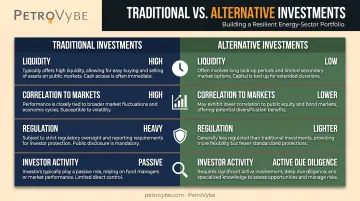
Traditional vs. alternative investments, at a glance:
| Characteristic | Traditional | Alternative |
|---|---|---|
| Liquidity | High (daily trading) | Low (lockups, holding periods) |
| Correlation to markets | High | Often lower, asset-dependent |
| Regulation | Heavy (SEC-registered) | Lighter, often exempt offerings |
| Investor activity | Passive, liquid | Active due diligence required |
Who Can Invest in Alternatives
Many alternative offerings restrict access to accredited investors. Under SEC rules, you qualify if you meet one of these tests:
- Net worth over $1 million, excluding your primary residence
- Income over $200,000 individually (or $300,000 jointly) in each of the prior two years, with the same expected this year
- Hold a Series 7, 65, or 82 license in good standing
That said, access has expanded through evergreen funds, crowdfunding platforms, and specialized development partnerships—including direct energy projects—that were rarely open to individuals a decade ago. Knowing which bucket an offering falls into still matters: it shapes liquidity, tax treatment, and the due diligence you need before you commit capital.
Why Investors Choose Alternative Assets
Diversification That Actually Diversifies
Not all alternatives behave the same way relative to stocks. BlackRock found bitcoin's correlation to the S&P 500 sits around 0.53, while gold's correlation is just 0.19 over the same period. That's a meaningful difference if you're building a portfolio to weather a stock market drawdown.
Gold acts more like a true diversifier here. Bitcoin, less so.
Inflation Protection From Real Assets
Hard assets tend to respond differently to inflation than paper assets do. S&P Dow Jones Indices found average commodity-index returns climbed as inflation rose: when inflation ran above 6%, the Bloomberg Commodity Index averaged 43.2% returns across the periods studied. Much of this history is back-tested, not live performance.
Return Potential, With Patience Required
Private capital and real assets can outperform public markets over a full cycle. But they often follow a J-curve: value dips early as capital gets deployed, then climbs as assets mature. Illiquidity isn't a side effect. It's the trade-off for the return.
The Tax-Efficiency Angle
Certain structures offer something a typical stock or bond holding cannot. Oil and gas development programs allow investors with a working interest to elect to expense qualifying intangible drilling costs (IDCs), things like wages, fuel, and contractor work tied to drilling, rather than capitalizing them.
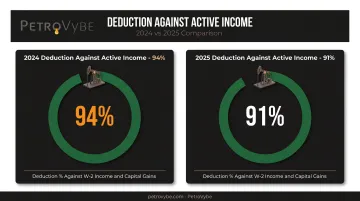
PetroVybe's partners saw this play out directly: 94% deduction against active income in 2025. Prior result; not a promise of any future deduction. That's a deduction applied against W-2 income and capital gains, something a traditional brokerage account simply can't offer. This treatment requires the investor to elect general partner status in the Subscription Agreement and may be limited in a given year by the excess business loss limitation under IRC §461(l).
Types of Alternative Investments
Alternative assets sit outside traditional stocks and bonds. Each category brings different liquidity, fees, risk, and return drivers.
Private Equity and Venture Capital
Ownership stakes in private companies, typically with long lock-ups and high minimums. Returns come from business growth and eventual exits, not daily price movement.
Real Estate and Real Assets
Physical property, REITs, infrastructure, and farmland. Income comes from rent or leases, plus appreciation over time. Non-traded REITs carry hefty upfront fees, often 9-10% in sales commissions and offering costs, so read the fine print.
Hedge Funds
Pooled funds using leverage, short-selling, and derivatives. The SEC notes typical fees run 1-2% of NAV plus 15-20% of profits, with redemptions often limited to four times a year and lockups of a year or more.
Commodities and Precious Metals
Gold, silver, oil, and agricultural products. Exposure can be physical or through futures and index products, and behavior varies significantly by commodity.
Natural Gas and Oil Development
Direct participation programs let investors take a working interest in energy development, pairing IDC deductions with income tied to actual production.
PetroVybe is one example: a 58,000-acre position in Lavaca County, Texas (Gulf Coast Basin) with roughly 400 acquired legacy wells and 57+ planned new wells. Reserves carry a $48 million PV-09 valuation from a licensed third-party engineering firm, prepared by Lee Keeling & Associates, Tulsa, March 2026. Targets include a 10-year MOIC of 2.2x to 5.8x, an IRR near 26%, and an 80/20 investor-favored profit split.

Digital Assets and Collectibles
Cryptocurrency, NFTs, art, and niche collectibles. High volatility, evolving regulatory treatment, and limited price history make this category harder to underwrite than most.
Benefits vs. Risks of Alternative Investments
Key Benefits
- Diversification: lower correlation to public markets can reduce portfolio volatility
- Inflation protection: tangible, hard assets often hold value when prices rise
- Return potential: longer holding periods can support higher expected outcomes
- Niche access: markets and deal types unavailable on public exchanges
- Tax efficiency: structures and deductions not available in traditional accounts
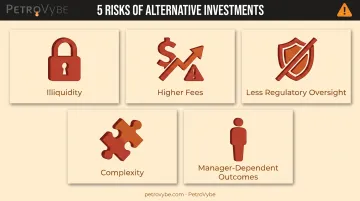
Key Risks
- Illiquidity: capital can be locked up for years with limited exit options
- Higher fees: management and performance fees reduce net returns
- Less regulatory oversight: many alternative investments operate as private, exempt offerings
- Complexity: understanding the structure matters as much as the asset itself
- Manager-dependent outcomes: returns hinge heavily on operator skill and integrity
The SEC has flagged real compliance issues in private funds, including undisclosed fee practices and valuation problems that overcharged investors.
Those risks make diligence non-negotiable. Before allocating capital, weigh your time horizon and liquidity needs, and talk with a financial or tax advisor who understands the specific structure you're considering.
How to Get Started Investing in Alternative Assets
There are generally three ways in:
- Buy the asset directly: a rental property, physical gold, or a working interest in a well
- Invest in a company tied to the asset: a REIT, an energy operator, a mining company
- Invest in a fund or partnership: pooled capital managed by a general partner
Whichever path you choose, vetting the operator matters more than the pitch deck.
What to check before committing capital:
- Track record: Has the team executed similar projects before, and what were the results?
- Third-party validation: Independent engineering reviews, audited financials, verified reserve reports
- Transparency: Regular reporting, accessible documentation, responsive investor relations
PetroVybe, for example, backs its projects with independent engineering reviews and holds a 5.0 rating across 8 verified reviews on Invest Clearly, with 100% five-star feedback. Independent ratings and engineering reviews are useful signals to weigh before you commit capital.
Start small. Many advisers point to a 5-15% allocation as a reasonable range for high-risk alternatives, based on industry surveys rather than a hard rule. Scale up as you get comfortable with the illiquidity and the reporting cadence.
Frequently Asked Questions
What are alternative investments?
Alternative investments are assets outside traditional stocks, bonds, and cash. Examples include real estate, private equity, commodities, and natural resource development programs.
Why should I invest in alternative investments?
They offer diversification through lower correlation to public markets, inflation protection from tangible assets, and in some cases, tax advantages traditional securities don't provide.
What are the best alternative investments?
The better fit depends on your goals: real estate for income, private credit for steadier yield, and energy development programs when tax efficiency is a priority.
What are examples of alternative investments?
They usually fall into private markets (private equity, private credit), real assets (real estate, commodities, energy), and pooled or direct vehicles such as hedge funds and natural gas development programs.
Is a hedge fund an alternative investment?
Yes. Hedge funds pool investor capital and use non-traditional strategies, such as leverage and short-selling, to pursue returns that aren't tied to typical market movement.
What are some alternative ways to invest besides stocks?
You can add real assets, private credit, or direct ownership stakes in projects like natural gas development. These paths often differ from stocks in liquidity, market correlation, and tax treatment.
Informational requests only. PetroVybe projects are offered solely to verified accredited investors. Submitting this form does not create an investment or advisory relationship.