

This article is general education, not investment, tax, or legal advice. Putting a dollar figure on oil and gas reserves before you wire capital is genuinely hard. The rock is underground, the cash flow hasn't happened yet, and every operator has an incentive to paint a rosy picture. So how do you get an apples-to-apples number?
That's where PV-10 comes in. It's the industry's standard yardstick for estimating what proved reserves are worth today, and it shows up everywhere from SEC 10-K filings to private placement decks. If you're an accredited investor evaluating a non-traded oil and gas deal, understanding PV-10 isn't optional homework, it's the baseline for asking smart questions.
This article covers what PV-10 actually is, how it's calculated, why it matters, where it falls short, and how to use it wisely when you're vetting an opportunity.
Key Takeaways
- PV-10 discounts future net cash flow from proved reserves at a fixed 10% rate to estimate present value.
- Public companies commonly disclose PV-10 as a non-GAAP supplement; it's not identical to fair market value.
- Excludes income taxes and does not risk-adjust between reserve categories such as PDP and PUD.
- Independent, third-party engineered reserve reports carry more weight than self-reported figures alone.
What Is PV-10?
PV-10 stands for "present value at a 10% discount rate." It estimates today's value of projected future revenue from proved reserves, after subtracting direct operating and development costs, but before income taxes.
The SEC doesn't mandate a standalone "PV-10" line item. Regulation S-K Item 1202 requires public companies to disclose proved reserve quantities and technical governance, while GAAP's "standardized measure" is the after-tax figure companies must report.
PV-10 is the widely used pre-tax version issuers voluntarily disclose alongside that figure, and most reconcile the two directly in their filings.
Reserve Categories Aren't Created Equal
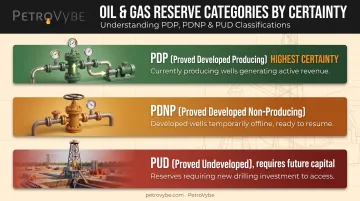
PV-10 treats every barrel the same, but reserves come in three flavors:
- PDP (Proved Developed Producing): Wells already online and producing.
- PDNP (Proved Developed Non-Producing): Infrastructure exists, but the well is shut-in or behind pipe.
- PUD (Proved Undeveloped): Reserves that still require new wells or major capital.
A blended PV-10 number can hide the fact that a chunk of the "value" depends on wells that haven't been drilled yet.
Who Actually Calculates It?
Licensed petroleum or reservoir engineers prepare the underlying reserve reports. Ryder Scott's evaluation for Carrizo was led by a Texas-licensed P.E. with nearly 30 years of experience, and McDaniel's 2024 report for another operator was signed by an Alberta Practicing Professional Engineer.
Third-party engineering firms matter because a self-reported reserve figure from an operator carries an obvious conflict of interest.
For context on scale: Civitas Resources reported a $9.2 billion PV-10 versus an $8.3 billion standardized measure at year-end 2024, a $900 million gap driven entirely by future income taxes. That gap alone shows why the pre-tax versus after-tax distinction matters when comparing numbers across companies.
How Is PV-10 Calculated?
There's no single regulatory formula, but the widely used shorthand is:
PV-10 = Σ [(Reserve Revenue − Production Costs − Development Costs) / (1.10)^t]
Where "t" represents each future year, discounted back to the present.
The key inputs:
- Production decline curve data for each well or lease
- Commodity pricing based on the SEC convention: the unweighted 12-month average of first-day-of-month prices
- Lease operating expenses, workover costs, and development capital
- Ownership interest (working interest and net revenue interest)
A Simplified Example
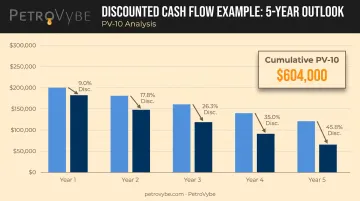
Imagine a well projected to generate $200,000 in net cash flow in Year 1, declining 15% annually for five years. Discounted at 10%, Year 1 becomes roughly $182,000 in present-value terms.
By Year 5, cash flow falls to about $104,000 and discounts to roughly $65,000. Sum all five discounted years and you have the well's PV-10.
Engineers rarely do this by hand at scale. Ryder Scott's SEC-filed reserve report for Carrizo, for instance, used the ARIES petroleum economic evaluation software to calculate $178.3 million in discounted future net income from $407.6 million undiscounted, applying SEC pricing and monthly compounding.
Why PV-10 Matters for Investors
PV-10 gives you a common yardstick. Because every company applies the same discount rate and pricing convention, you can compare reserve disclosures across operators without each one using its own assumptions.
Practical uses include:
- Benchmarking a company's asking price against disclosed reserve value
- Timing asset divestitures or capital raises
- Supporting reserve-based lending decisions
- Screening valuation via the EV/PV-10 ratio (enterprise value divided by PV-10)
That ratio has no universal "cheap" threshold; it's a screening tool, not a verdict
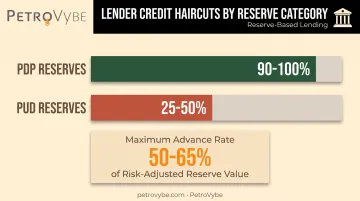
Reserve-based lending offers a useful reality check. Banking guidance from the OCC shows lenders typically apply steep haircuts: roughly 90-100% credit on seasoned PDP reserves, but only 25-50% on PUD, with maximum advance rates of 50-65% of risk-adjusted reserve value. In other words, professional lenders don't take headline PV-10 at face value, and neither should you.
For private, non-traded projects, this matters even more. There's no public stock price to sanity-check an operator's claims, so an independent, third-party reserve report becomes the primary trust signal.
PetroVybe, for example, documents a $48 million proved reserves valuation determined by a licensed third-party engineering firm as part of its investor reporting, alongside a portfolio of three separate reserve reports covering 264 anticipated development locations across two Texas basins. That's the kind of independent verification that protects investor interests when there's no ticker symbol to check.
Limitations of PV-10 and How It Differs From Fair Market Value
PV-10 is useful precisely because it's standardized, but that standardization creates blind spots.
Where PV-10 falls short:
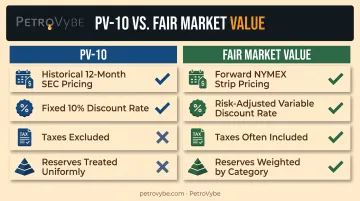
- Applies a fixed 10% discount rate regardless of actual project risk
- Uses historical pricing (a trailing 12-month average) instead of forward market expectations
- Excludes income taxes, asset retirement obligations, and corporate overhead
- Treats PDP, PDNP, and PUD reserves with no risk differentiation
| Factor | PV-10 | Fair Market Value (FMV) |
|---|---|---|
| Pricing basis | Historical 12-month SEC average | Forward NYMEX strip pricing |
| Discount rate | Fixed 10% | Risk-adjusted, varies by asset |
| Taxes | Excluded | Often included |
| Reserve risk | Treated uniformly | Weighted by category |
FASB itself has cautioned that the standardized measure (and by extension PV-10) is neither fair market value nor a precise forecast of actual future cash flow. As Stout's analysis on PV-10 limitations points out, treating PV-10 as an actual transaction value is one of the most common mistakes investors make.
Treat PV-10 as a starting reference point, not a closing number, when evaluating a private placement or acquisition.
How to Use PV-10 When Evaluating an Oil & Gas Investment Opportunity
Before you commit capital, run through this checklist:
- Request the underlying reserve report, not just the summary figure. Confirm which engineering firm prepared it and its independence from the operator.
- Check the effective date and pricing assumptions. A report using two-year-old commodity prices tells a different story than one using current numbers.
- Compare PV-10 to the stated purchase price or investment ask. If the ask is close to (or above) PV-10 with no margin for tax, risk, or development cost, that's worth questioning.
- Ask for category-level breakdowns (PDP vs. PDNP vs. PUD) rather than one blended number.
PetroVybe's process shows the diligence bar accredited investors should expect:
- Licensed third-party engineering firms for reserve valuation
- A reserve-report portfolio across multiple basins
- Investor access to underlying engineering reports and pro forma financials through its DataDrive platform
Whatever operator you evaluate, insist on that full report access. A headline PV-10 alone is not enough to underwrite the deal.
Frequently Asked Questions
What does PV-10 mean in oil and gas?
PV-10 is the present value, discounted at a fixed 10% annual rate, of forecast pre-tax net cash flow from proved oil and gas reserves. It's a standardized way to estimate reserve value.
What does PV mean in finance?
"PV" stands for present value, the current worth of a future sum of cash flow once you apply a specific discount rate. It reflects the idea that money today is worth more than the same amount later.
Is PV-10 the same as fair market value?
No. PV-10 uses historical SEC pricing and a flat 10% discount rate while excluding income taxes. Fair market value uses forward-looking pricing and risk-adjusted assumptions, so the two figures can differ substantially.
Who calculates PV-10 for an oil and gas company?
Licensed petroleum or reservoir engineers, either in-house or from an independent engineering firm, prepare the reserve report used to derive PV-10. Third-party firms add credibility since they have no ownership stake in the outcome.
Why do public oil and gas companies report PV-10?
Public companies disclose PV-10 as a common supplemental figure alongside the GAAP standardized measure, mainly to give investors a comparable, pre-tax reserve benchmark across companies.
What are the main limitations of using PV-10 to value reserves?
PV-10 uses a fixed 10% discount rate, historical rather than forward pricing, and excludes income taxes and reserve-category risk. It's a useful benchmark, not a final valuation.
Informational requests only. PetroVybe projects are offered solely to verified accredited investors. Submitting this form does not create an investment or advisory relationship.