
For high-income W2 earners and investors sitting on capital gains, this tax drag adds up fast. You could earn a solid return on paper and still watch a meaningful chunk disappear before you ever see it. This article walks through which investments belong in taxable accounts, how asset location can boost after-tax returns, and additional strategies — including alternative options — for investors who want to go further.
Key Takeaways
- Broad index funds, ETFs, munis, and long-held stocks fit taxable accounts—they produce mostly long-term gains or tax-exempt income
- Taxable bonds, REITs, and actively managed funds create more tax drag and fit better inside IRAs or 401(k)s
- Tax-loss harvesting, longer holding periods, and smart asset location raise after-tax returns
- High-income earners can use direct-participation investments for upfront deductions against active income or capital gains
What Makes a Taxable Account Different
A taxable brokerage account gets no special treatment from the IRS. Interest, dividends, and realized capital gains are all taxed in the year you receive them. There's no deferral like a traditional IRA and no tax-free growth like a Roth.
The tax rate you pay depends on the type of income:
- Ordinary income rates (up to 37% federally) apply to interest payments and short-term capital gains (assets held one year or less)
- Preferential rates (0%, 15%, or 20%) apply to qualified dividends and long-term capital gains, based on your IRS tax bracket
Higher earners also face the 3.8% Net Investment Income Tax (NIIT) once modified adjusted gross income crosses $200,000 (single) or $250,000 (married filing jointly), according to the IRS's NIIT guidance.
Stack that on a 20% long-term capital gains rate and investment income can approach 24% federally, before state taxes. That drag is why tax-efficient holdings matter more in a taxable account than in tax-advantaged accounts.

Best Tax-Efficient Investments for Taxable Accounts
Not all investments create the same tax bill. Some generate income you can't avoid reporting every year; others let gains compound quietly until you decide to sell.
Individual Stocks Held Long-Term
Buy a stock, hold it more than a year, and you control when the tax event happens. No annual distributions and no surprise capital gains. You pay long-term rates only when you choose to sell.
Broad-Market Index Funds and ETFs
Total market and S&P 500 index funds have low turnover, so fewer taxable events pass through to shareholders. According to Morningstar's fund research, the median tax-cost ratio for large-blend funds sits around 1.26% over a three-year window—lower than most actively managed and bond-heavy alternatives.
Other Tax-Efficient Options
- Tax-managed mutual funds — use built-in loss harvesting and low-turnover strategies to actively suppress distributions
- Municipal bonds and muni bond funds — interest is exempt from federal tax (and often state tax if you buy bonds from your home state), making them attractive for high earners
- I Bonds — interest is deferrable until redemption and exempt from state and local taxes, per TreasuryDirect
- Oil and gas direct participation (IDC) — for accredited investors, intangible drilling costs can offset active W2 and business income in the year incurred, with depletion allowances over the holding period
What to avoid in taxable accounts: actively managed high-turnover funds, taxable bond funds, and REITs. These generate frequent ordinary-income distributions and belong in tax-advantaged accounts instead.

Asset Location: Putting the Right Investments in the Right Accounts
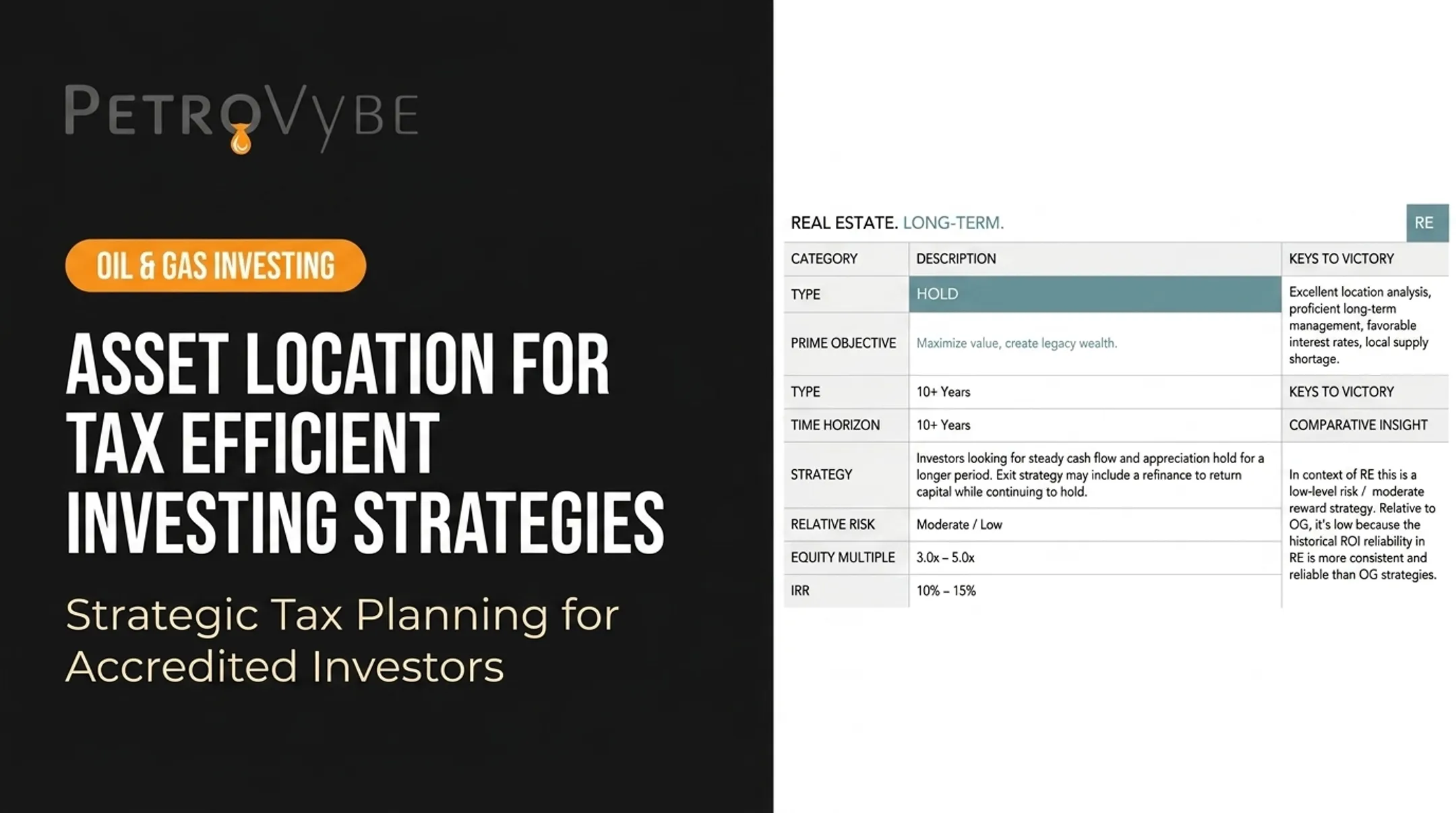
Asset allocation determines what you own. Asset location determines where you hold it. Same portfolio, very different tax outcomes. The basic framework:
- Least tax-efficient assets (taxable bonds, REITs, high-turnover funds) → tax-advantaged accounts
- Most tax-efficient assets (index funds, municipal bonds, growth stocks) → taxable accounts
- Highest-growth-potential assets → Roth IRAs, where qualified withdrawals are entirely tax-free Example: Say you hold a bond fund throwing off 4% annual interest inside a taxable account. Taxed at 32%, that's over 1% of annual drag. Move that same fund into your IRA, and the interest compounds untaxed until withdrawal. Vanguard's research estimates that strategic asset location can add roughly 0.05% to 0.30% annually in after-tax returns. That compounds into real money over a few decades. Even so, Vanguard is clear that allocation, not location, remains the primary driver of long-term returns. Practical limitations to keep in mind:
- Employer 401(k) menus may lack low-cost bond or REIT options
- Tax-advantaged account space is limited by annual contribution caps
- Liquidity needs may require keeping certain assets accessible in taxable accounts

Additional Techniques to Reduce Taxes in Taxable Accounts
Beyond picking the right investments, a few tactical moves can shave real dollars off your tax bill.
Tax-loss harvesting. Sell a losing position to offset realized gains elsewhere in your portfolio. Just watch the wash-sale rule: buying a "substantially identical" security within 30 days before or after the sale disallows the loss, under the IRS wash-sale rule.
Rebalance with new cash, not sales. Instead of selling winners to rebalance, direct new contributions toward underweighted asset classes. You get back to target allocation without triggering a taxable event.
Donate appreciated securities. If you've held a stock for more than a year and it has appreciated significantly, donating it directly to a qualified charity lets you:
- Avoid the capital gains tax entirely
- Deduct the full fair market value (subject to a 30%-of-AGI ceiling)
This works especially well for concentrated stock positions you'd otherwise pay heavily to unwind.

Beyond Traditional Securities: Alternative Tax-Advantaged Strategies
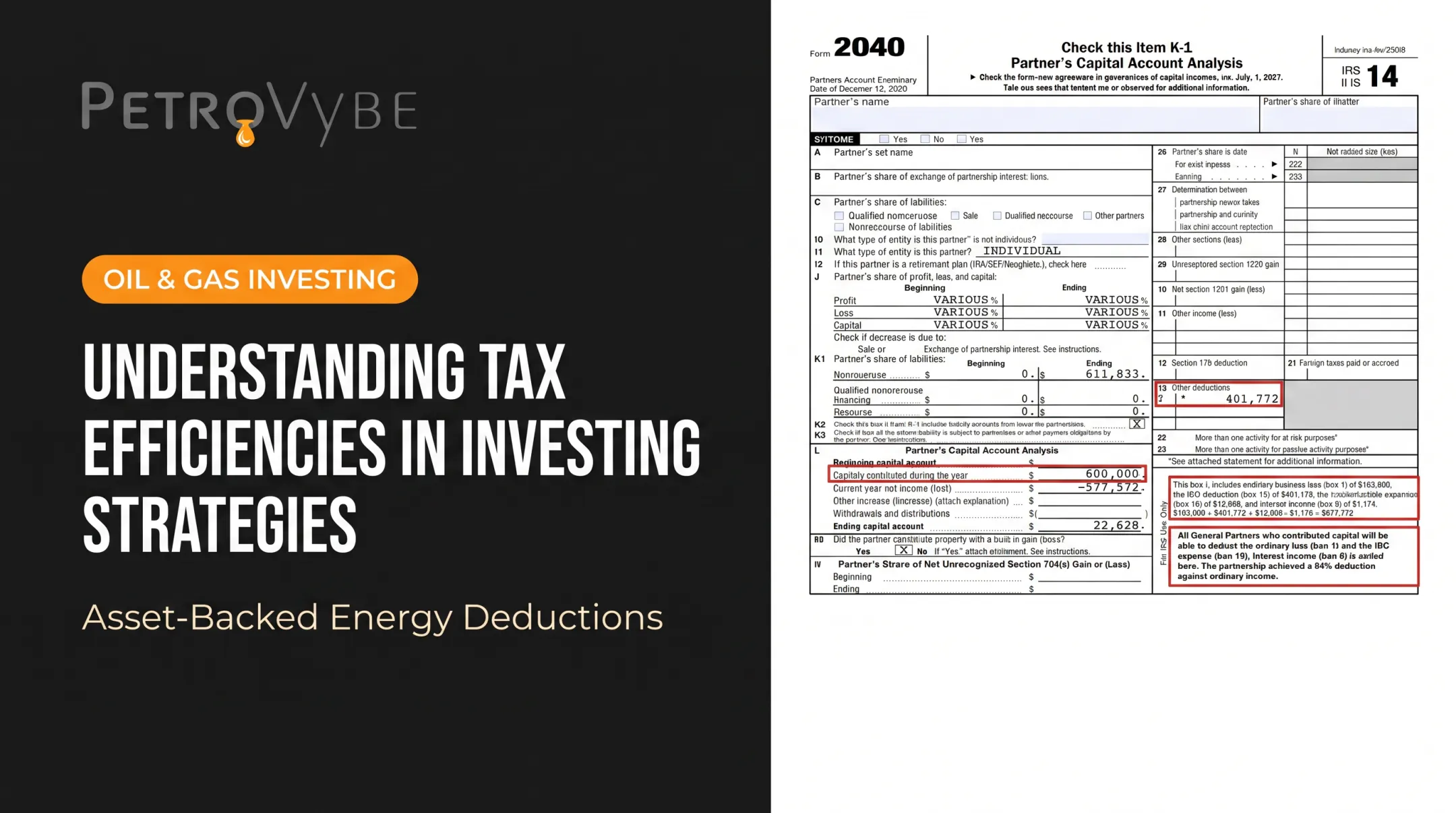
Municipal bonds and index funds help manage tax drag on investment income. But they don't do much for W2 wages or realized capital gains — the income that pushes many high earners into the top brackets in the first place. This is where some accredited investors look toward direct-participation investments structured specifically to offset active income, not just passive investment income. Natural gas and oil development is one example. Under IRC §263(c) and Treasury Regulation §1.612-4, working-interest holders can elect to deduct Intangible Drilling Costs (IDCs)—labor, fuel, and other non-salvageable expenses—in the year incurred. Because a working interest isn't classified as a passive activity under §469(c)(3) for qualifying holders, those deductions can offset active income directly. Most real estate or fund-based deductions can't. One concrete path is a direct working-interest stake with a private developer. PetroVybe, a Texas-based natural gas company, offers accredited investors that structure through projects in Lavaca County's Gulf Coast Basin. Partners in PetroVybe ONE received a 91% deduction against active income in 2024 and 94% in 2025, combining IDC and depletion allowance benefits. Projects span roughly 400 acquired legacy wells and 57+ planned new wells across 58,000 acres, with a third-party PV-09 reserve valuation of $48 million. A few things to know before considering this route:
- Illiquid hold: PetroVybe anticipates at least 2–3 years before first distribution
- Capital minimum: Typically $100,000 in liquidity
- Accreditation required: Mandatory under SEC rules
- Forecasts, not guarantees: Materials target roughly 2.2x–5.8x MOIC and 26% IRR over 10 years—review the Private Placement Memorandum This path suits only a narrow slice of investors. If you carry a heavy W2 or capital-gains tax load and can underwrite illiquid energy risk, treat it as one option to diligence—not a default allocation.
Frequently Asked Questions
What type of investment is best for a taxable account?
Broad-market index funds, ETFs, individual stocks held long-term, and municipal bonds generally work best. They minimize annual distributions and benefit from favorable long-term tax rates.
What is the best investment to reduce taxable income?
Municipal bonds provide tax-exempt interest income at the federal level. High-income earners with active income can also consider alternative investments like natural gas development, which offer deductions against W2 wages and capital gains.
What are the best stocks to hold in a taxable account?
Individual stocks held over one year, especially low-dividend growth stocks, minimize annual tax drag since you control when gains are realized and benefit from long-term capital gains rates.
Should I hold bonds in a taxable account?
Taxable bonds generally belong in tax-advantaged accounts because interest is taxed at ordinary rates. Municipal bonds are the exception, offering tax-exempt income well suited to taxable accounts for high earners.
How does asset location differ from asset allocation?
Asset allocation determines what you own across stocks, bonds, and other assets. Asset location determines which account (taxable, IRA, or Roth) holds each investment to minimize taxes.
Are alternative investments like oil and gas a good fit for taxable accounts?
Oil and gas development deals are usually private placements, not brokerage products, but they are taxable-account investments. For accredited investors, IDC and depletion deductions can offset W2 wages and capital gains—unlike typical IRA or Roth holdings.