This article is general education, not investment, tax, or legal advice.
The difference between a disciplined operator and a mediocre one doesn't show up in a pitch deck — it shows up in production volumes, quarterly distributions, and what an asset is actually worth five years after capital is committed. For accredited investors evaluating upstream energy opportunities, understanding how oil and gas asset management works is not optional background reading. It's the analytical framework that separates informed decisions from expensive guesses.
This guide covers the definition of oil and gas asset management, the types of assets involved, the core components of a well-run system, the threats that quietly destroy value, and what operational excellence actually looks like in practice.
Key Takeaways
- Oil and gas asset management maximizes the value, safety, and productive life of physical assets from exploration through decommissioning
- Assets fall into three segments: upstream (exploration and production), midstream (transportation and storage), and downstream (refining and distribution)
- Effective systems integrate asset inventory, risk management, maintenance strategy, and real-time performance data
- Aging fields, deferred maintenance, and fragmented data are the most common destroyers of asset value
- Operator discipline in asset management directly drives production reliability, cash generation, and return on capital
What Is Oil and Gas Asset Management?
Oil and gas asset management is the strategic, systematic process of acquiring, operating, maintaining, and eventually decommissioning physical assets to maximize their value and productive output over time. That includes individual wells, pipelines, compressor stations, and processing facilities — everything that touches the hydrocarbon from reservoir to sale.
ISO 55000:2024 defines asset management as "coordinated activity of an organization to realize value from assets," balancing costs, risks, opportunities, and performance. In upstream oil and gas, the SPE Petroleum Resources Management System (PRMS) extends this framework across exploration, appraisal, development, production, and abandonment — treating every phase as an interconnected economic decision.
More Than Maintenance
A common misconception frames asset management as a maintenance function. It isn't. It's the integrated discipline that connects:
- Intervening on aging equipment at the right time, before failures compound
- Allocating capital efficiently — cost per barrel, EBITDAX margin, reinvestment thresholds
- Maintaining permit integrity, inspection records, and emissions compliance
- Timing workovers, new drilling, and asset rationalization for maximum return
When these functions operate in alignment, operators compound production and asset value over time. When they run in silos, small problems become expensive failures — and the losses are rarely visible until they've already hit the balance sheet.
So the real question isn't what asset management covers. It's who keeps those functions working together.
Who Drives Asset Management Quality
Effective asset management requires genuine cross-functional collaboration. The operators who outperform consistently align petroleum engineers, operations teams, financial strategists, and geophysicists around a single objective — not separate department goals.
For investors, that organizational alignment is one of the clearest signals of operator quality. PetroVybe is structured around this principle:
- COO scaled a $5 billion asset from zero to 35,000 BOEPD over eight years
- CFO operates as both financial strategist and petroleum engineer
- Chief Geophysicist brings a 48-year career in identifying profitable well locations
- VP of Asset Intelligence & Performance translates operational data into decisions that support production and investor reporting
Results described were achieved at prior companies and are not indicative of PetroVybe results.
Types of Oil and Gas Assets
Upstream: Exploration and Production
Upstream assets are the revenue-generating core of the value chain — the point where hydrocarbons are pulled from the ground and value is first created. For development-stage companies focused on NGL production, upstream asset performance directly drives investor distributions and reserve valuations.
Key upstream asset types include:
- Drilling rigs and wellheads
- Production platforms and artificial lift systems
- Gathering pipelines and separation equipment
- Well completion and stimulation infrastructure
As general industry context on U.S. onshore activity, the EIA reported approximately 5.5 Bcf/d of gas and 1.0 million bbl/d of oil from the Eagle Ford play, with regional gas production projected to grow from 6.8 Bcf/d in 2024 to 7.0 Bcf/d in 2026. These figures describe the Eagle Ford specifically and do not relate to PetroVybe's own acreage or projects.
Midstream: Transportation and Storage
Midstream assets — pipelines, compressor stations, storage tanks, and processing plants — move and condition raw hydrocarbons between the wellhead and the buyer. Midstream reliability shapes the price upstream operators actually receive for their production. A well that produces efficiently but can't move product to market generates no cash flow.
Downstream: Refining and Distribution
Where midstream ends at delivery, downstream assets take over — converting raw hydrocarbons into finished products through refineries, petrochemical facilities, and distribution networks.
For accredited investors evaluating direct-participation opportunities, downstream exposure is uncommon. Most upstream investment structures concentrate participation at the point where hydrocarbons are produced, not processed.
Key Components of an Effective Asset Management System
Asset Inventory and Data Foundation
Every sound asset management system starts with a centralized, accurate database cataloging every physical asset — its location, condition, maintenance history, and performance data. Without it, capital allocation and maintenance prioritization become guesswork. Operators flying blind on asset condition consistently over-maintain low-priority equipment while under-maintaining assets that matter.
Risk Management and Criticality Analysis
Effective operators continuously assess which assets carry the highest consequence of failure — factoring in safety exposure, production impact, regulatory liability, and replacement lead times. The result is a tiered maintenance priority system: resources flow toward assets where failure would most damage production or create compliance exposure, not toward whatever broke most recently.
The Maintenance Strategy Spectrum
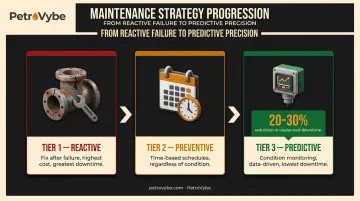
How an operator approaches maintenance has a direct impact on cost structure and production reliability. The progression:
- Reactive — fix it when it breaks; highest per-unit cost, greatest downtime exposure
- Preventive — time-based maintenance schedules regardless of actual condition
- Predictive — condition monitoring and data-driven intervention before failure occurs
McKinsey research documents that condition-based maintenance can reduce unplanned downtime by 20–30%. A nine-platform offshore case achieved 20% lower average downtime and more than 500,000 additional barrels per year in incremental production. These are not guaranteed outcomes — they required two years and significant data infrastructure — but they illustrate the upside available to operators who commit to the transition.
That upside comes with a catch: the same McKinsey analysis found that 70% of oil and gas digitization projects did not progress beyond pilot stage — meaning technology selection is only half the battle. Execution discipline determines whether the investment pays off.
Performance Monitoring and KPIs
A well-run system continuously tracks:
- BOEPD output relative to target
- Production efficiency (actual vs. maximum production potential)
- EBITDAX margin
- Cost per BOE (lifting costs excluding taxes and royalties)
- Production uptime percentage
These metrics give management the visibility to identify underperforming assets early — before small inefficiencies compound into expensive interventions.
Data Integration
Siloed data across spreadsheets, legacy systems, and disconnected field reports is one of the most consistent operational failures in the industry. EY estimates more than $790 billion of upstream value from digital solutions over the decade to 2035 — but that value only materializes when operators centralize operational and financial data and use analytics to connect field performance with capital planning decisions.
Operators who unify this data answer the hard capital questions with confidence: whether to execute a workover, commit to a new well, or cut losses on an underperforming asset.
The Major Challenges That Put Asset Value at Risk
Aging Fields and Deferred Maintenance
The IEA reports that roughly one-quarter of global oil output comes from fields over 50 years old. Older fields require progressively more capital to maintain — and operators who defer maintenance during price downturns often create compounding liabilities. The consequence isn't always visible until a significant failure occurs. By then, an investor's asset may have been quietly losing productive life for years.
IEA data documents average post-peak decline rates of 5.6% for conventional oil and 6.8% for conventional gas — the baseline headwind every operator must actively manage through reinvestment and optimization.
Regulatory and Environmental Compliance Pressure
The oil and gas sector operates under expanding safety mandates, emissions standards, and reporting requirements. Current penalties are real: OSHA maximums reach $165,514 per willful or repeated violation, and Texas Railroad Commission violations can carry penalties assessed per day for each violation, meaning exposure accumulates for as long as a violation continues.
Well-managed operators embed compliance into daily operations rather than treating it as a checkbox exercise. That means:
- Maintaining permit integrity across all active wells
- Keeping inspection documentation current and audit-ready
- Building regulatory monitoring into the asset management framework itself
Operators who handle compliance reactively accumulate liability that surfaces in operating costs — or worse, production curtailments.
Data Fragmentation and Operational Blind Spots
When asset data lives in disconnected systems or manual logs, decision-making becomes reactive. Operators without a unified view of portfolio asset health are:
- Slower to identify problems before they escalate
- Less precise in deploying capital toward highest-return opportunities
- More likely to over-maintain some assets while under-maintaining others
That unevenness compounds over time — assets that needed attention six months ago are now emergency repairs, while capital sat idle elsewhere.
Commodity Price Volatility and Capital Discipline
Oil and gas prices fluctuate — that's not news. What separates strong operators is their behavior during downturns. Operators who defer critical maintenance when prices fall face higher-cost emergency repairs precisely when production ramp-up pressure is greatest. The best operators build asset management plans designed to hold across price cycles — maintaining production continuity rather than trading it for short-term cost relief.
What Good Asset Management Means for Accredited Investors
The Direct Link to Returns
Every production uptime percentage point, every avoided unplanned shutdown, and every successful workover translates into cash flow — which funds investor distributions, supports reserve valuations, and compounds toward the project's modeled MOIC. Modeled returns are projections, not promises, and are not guaranteed. Operational execution is what separates investments that perform from those that disappoint.
What to Look for When Evaluating an Operator
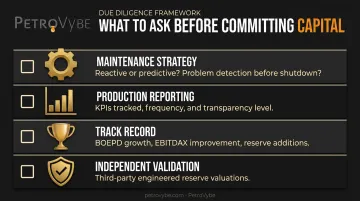
Before committing capital, investors should probe:
- Maintenance strategy — reactive or predictive? How do they detect problems before they become shutdowns?
- Production reporting — what KPIs do they track, how frequently, and how transparently?
- Prior performance — BOEPD growth, EBITDAX improvement, reserve additions on prior assets
- Independent validation — are reserve valuations third-party engineered, or internal projections?
PetroVybe's project data illustrates what this looks like in practice: $48MM in proved reserves valuation (PV-09), prepared by Lee Keeling & Associates, Tulsa, March 2026. The team behind those numbers brings individually verified credentials:
- CFO Clayton Riddle led a 9x year-over-year EBITDAX increase at a prior oil and gas development company
- COO Blaine Yeary scaled a $5 billion asset from zero to 35,000 BOEPD over eight years
- VP of Asset Intelligence & Performance Luke McIntosh translates operational data directly into strategic decisions
Results described were achieved at prior companies and are not indicative of PetroVybe results.
Why Natural Gas Demand Strengthens the Case
Asset management quality compounds in value when the underlying commodity demand is strengthening. Goldman Sachs projects 3.3 Bcf/d of incremental U.S. natural gas demand by 2030, assuming natural gas supplies 60% of new data-center power capacity.
Investors participating in well-managed natural gas assets aren't just capturing current production cash flow. They're positioned for appreciation as demand fundamentals strengthen over the decade ahead.
Frequently Asked Questions
What is oil and gas asset management?
Oil and gas asset management is the systematic process of managing physical assets — wells, pipelines, facilities, and equipment — across their full lifecycle to maximize value, ensure safety, and generate reliable production output. Maintenance, financial planning, and operational decisions are all managed under a single discipline.
What are the three types of oil and gas assets?
Upstream assets cover exploration and production, including wells and drilling equipment. Midstream assets include transportation and storage infrastructure. Downstream assets encompass refining and distribution facilities. Direct-participation investment opportunities for accredited investors are typically concentrated in the upstream segment.
What is the difference between reactive and predictive maintenance in oil and gas?
Reactive maintenance means repairing assets after they fail — the most expensive approach, with the highest downtime exposure. Predictive maintenance uses condition monitoring to catch problems early, cutting costs and keeping production on schedule.
How does oil and gas asset management affect investor returns?
Production reliability drives cash distributions directly. Well-managed assets maintain higher output rates and lower maintenance costs over time. Operators with strong asset management records are better positioned to perform against projected returns, though no operator can guarantee them.
What should accredited investors look for in an operator's asset management capabilities?
Evaluate the operator's record on prior asset performance, their maintenance strategy, the quality and frequency of production reporting, and whether reserve valuations are validated by a third-party engineering firm. Verified operational milestones carry more weight than projected ones.
Why is natural gas asset management particularly important right now?
Rising electricity demand from AI data centers is creating durable, long-term demand for natural gas. Operators who control costs, maintain output, and reinvest systematically are positioned to build durable value as that demand grows through the decade ahead.
Informational requests only. PetroVybe projects are offered solely to verified accredited investors. Submitting a contact form does not create an investment or advisory relationship.
Disclosure: PetroVybe and its team members are not licensed financial advisors, and nothing on this website constitutes financial or investment advice or a recommendation to buy, sell, or hold any investment. PetroVybe and its team members are not tax advisors, accountants, or tax strategists, and nothing on this website constitutes tax advice or a tax strategy. PetroVybe and its team members are not attorneys, and nothing on this website constitutes legal advice. All content is provided for general informational purposes only. You should consult your own independent financial advisor, tax professional, and legal counsel before making any decision.