The SEC's own investor education platform, Investor.gov, teaches compound interest and the Rule of 72 as foundational financial literacy, calling compound interest simply "interest you earn on interest." That's how central this concept is to every portfolio, from a teenager's first savings account to a family office's alternative asset allocation.
Here's the problem: most people know compounding is "good," but few understand the mechanics. How do rate, frequency, and time horizon actually interact to produce exponential growth? This guide breaks down what compounding is, how it works step-by-step, and where it shows up across savings, markets, and real asset investments.
Key Takeaways
- Compounding grows returns on both your principal and previously earned interest.
- The formula A = P(1 + r/n)^(nt) shows frequency and time as the top growth levers.
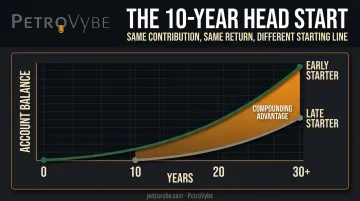
- A 10-year head start often outperforms bigger contributions made later.
- Reinvested oil and gas production cash flow compounds just like savings interest.
- Unpaid credit card interest compounds too, growing balances faster than expected.
What Is Compounding?
Compounding is the process where investment earnings (interest, dividends, or capital gains) get reinvested to generate their own additional earnings over time. Your principal doesn't just sit there. It grows, and then the growth itself starts growing.
Think of it as a snowball rolling downhill. Each rotation picks up more snow than the last, not because the hill got steeper, but because the snowball itself got bigger. That's the mechanic: a static starting number converts into an expanding base that produces increasingly larger returns each period.
What Compounding Is Not
A few clarifications matter here:
- It's not a fixed rate of return. Market-based compounding fluctuates year to year, unlike a guaranteed savings rate.
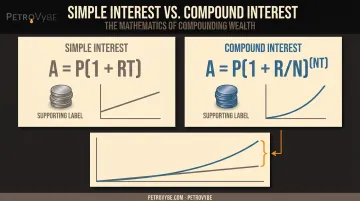
- Simple interest works differently. It calculates returns only on the original principal, using A = P(1 + rt), while compound interest recalculates on principal plus all prior earnings.
- Reinvestment isn't automatic. It has to happen; withdrawn gains stop compounding immediately.
Why It Still Matters in a High-Speed Market
Algorithmic trading and instant liquidity products dominate headlines, but exponential growth over time still outperforms most short-term strategies for the average investor. Two types show up constantly: compound interest (savings accounts, CDs, bonds) and compound returns (stocks, mutual funds, dividends, capital gains).
The vehicles differ. The underlying mechanic doesn't.
How Does Compounding Work?
Compounding unfolds through a consistent sequence: a principal is set, it generates returns, those returns get reinvested, and the cycle repeats. Frequency and time determine how dramatic the final outcome becomes.
Initiation: The Principal and Starting Point
Compounding begins the moment a principal (an initial deposit or investment) starts earning a return. That could be a bank automatically posting monthly interest, or an investor electing to reinvest dividends instead of cashing them out.
Initiation can take two forms: a one-time lump sum (a $10,000 deposit, for example) or recurring contributions (monthly $500 deposits into a 401(k)).
Here's the common bottleneck: many investors delay starting because early-stage growth looks negligible. A first-year gain of $50 on $1,000 doesn't feel exciting. But this is exactly when time is doing its most valuable, if invisible, work.
Core Operation: Reinvestment of Earnings
Each period's earnings get added back to the principal, so future returns calculate on a growing base rather than a fixed one. Fidelity's standard example illustrates this clearly: $6,000 at 3.5% annual interest produces $6,427.35 after two years with compounding, versus $6,420 under simple interest. The gap looks small at first.
Extend that same $6,000 to 30 years, and compounding produces roughly $16,840 versus just $12,300 under simple interest, a gap of nearly $4,500 in additional growth from reinvestment alone.
The rate of return and consistency of reinvestment (versus withdrawing gains) directly determine how fast that base compounds. Skip a reinvestment cycle, and you reset part of the snowball.
Regulation: Frequency and Rate Effects
Compounding frequency changes outcomes. The more often interest or returns are calculated and added back, the higher the effective yield.
At a 5% nominal annual rate, here's how frequency shifts the actual annual percentage yield (APY):
| Frequency | Calculated APY | $1,000 After 1 Year |
|---|---|---|
| Annual | 5.000% | $1,050.00 |
| Monthly | 5.116% | $1,051.16 |
| Daily | 5.127% | $1,051.27 |
The Rule of 72 offers a fast way to estimate doubling time: divide 72 by the annual rate. At 8%, that's 72/8 = 9 years. At 9%, it's 72/9 = 8 years, the exact example Investor.gov uses to teach the concept.
It's an estimate, not a guarantee. The precise math produces 9.006 years at 8% and 8.043 years at 9%.
Underestimating compounding frequency is a common reason investors misjudge long-term projections or unknowingly pick a lower-yield product.
Output: The Exponential Growth Curve
The end result is a curve that starts flat and accelerates sharply in later years. That's why compounding is often called "back-loaded" growth: the majority of total growth often happens in the final third of the time horizon.
Consider two savers, each contributing the same amount monthly, but starting 10 years apart. The one who started earlier doesn't just end up ahead by 10 years of contributions. They end up ahead by 10 years of contributions plus every dollar of growth those contributions generated in the meantime. That compounding gap widens every single year it's left alone.
This is precisely why long-hold investment structures, like a 10-year development partnership that reinvests cash flow into new production, are built to compound value in the back half of the term rather than the front.
Where Compounding Is Used
Compounding isn't confined to one product type. It shows up, for better or worse, across nearly every corner of personal finance.
Interest-bearing accounts. Savings accounts, CDs, and money market accounts compound daily, monthly, or annually depending on the bank and product. Always check the disclosed APY rather than assuming a schedule.
Stock market and retirement accounts. Inside 401(k)s and IRAs, reinvested dividends and capital gains compound returns over decades. Retained distributions buy more shares, which can generate their own future distributions, creating a feedback loop.
Credit card debt. It works the same mechanic against consumers: as of the Federal Reserve's most recent G.19 consumer credit release, average card rates sit at 20.94% across all accounts and 22.15% for accounts assessed interest. Unpaid balances compound daily in many cases, meaning:
- Interest gets added to the balance
- Next month's interest calculates on that larger balance
- The cycle repeats, often faster than borrowers expect
Compounding doesn't care whether it's growing your wealth or your debt; it just follows the math.
Compounding Beyond Wall Street: Real Asset & Cash Flow Reinvestment
Compounding isn't limited to interest-bearing accounts or public markets. Businesses apply the same logic to operating cash flow, reinvesting it to scale production and asset value rather than letting gains sit idle.
At PetroVybe, this shows up directly in what the company calls its two-part formula:
- PROTECT — Acquire legacy production assets and execute targeted workovers and optimization projects to stabilize the cash-flowing foundation
- SCALE — Identify new drilling opportunities through geological and production data, then reinvest cash flow to compound output over time
PetroVybe describes this internally as "stacking wells," comparing it directly to compounding interest: each producing well generates cash flow that funds the next well, systematically expanding the production base.
The company's current scale (roughly 1,300 BOEPD across 400 producing wells and 58,000 acres in South Texas and the Gulf Coast Basin) represents the starting principal in that equation, not the end goal.
This reinvestment discipline underpins PetroVybe's 10-year targets for accredited investor partners: a MOIC range of roughly 2.2x to 5.8x and an IRR of approximately 26%. Both figures are tied explicitly to operational compounding rather than a single drilling outcome or exit event.

Unlike traditional compound interest, this model compounds tangible reserves and production volume instead of a paper rate. That changes the risk/return profile:
| Dimension | Traditional Compound Interest/Stocks | Reinvested Production Cash Flow |
|---|---|---|
| What compounds | A financial rate on a paper asset | Physical output and proved reserves |
| Liquidity | Typically high | Low — multi-year hold periods |
| Risk type | Market or interest rate risk | Commodity, operational, geological |
It's a different risk category entirely, built for accredited investors with a longer time horizon and specific tax considerations rather than a replacement for a diversified portfolio.
Conclusion
Compounding is a mechanical, time-driven process. Rate, frequency, and reinvestment discipline determine how fast a principal turns into something meaningfully larger. Patience applied consistently, not shortcuts, makes the math work in an investor's favor.
Understanding where and how compounding actually works, whether in a savings account, a retirement portfolio, or a reinvested cash flow model like PetroVybe's, helps investors evaluate growth opportunities clearly. That perspective matters when assessing any structure that promises returns over time.
Frequently Asked Questions
What is compounding with examples?
Compounding means earning returns on both your original amount and previously accumulated gains. For example, $1,000 growing at 5% annually becomes $1,050 after year one and $1,102.50 after year two, since interest calculates on the larger balance each time.
What does 5% compounded annually mean?
It means 5% interest is calculated once per year and added to the principal. The following year's 5% then applies to that new, larger balance rather than the original amount.
Is compound interest really that good?
Yes, but it requires patience. Compound interest is genuinely powerful over long time horizons, though it needs consistent reinvestment and years, not months, to produce dramatically larger results.
What's the difference between simple and compound interest?
Simple interest calculates returns only on the original principal. Compound interest calculates returns on the principal plus all previously accumulated interest, which is why the growth curve accelerates over time.
How often should interest compound to maximize growth?
More frequent compounding (daily or monthly instead of annually) produces a slightly higher effective yield. The difference is modest in year one but becomes more meaningful the longer money stays invested.
Can compounding work outside of a bank account or stock portfolio?
Yes. The same principle applies to reinvested business cash flow, such as scaling production and reserves in real asset investments like natural gas development, where growth comes from tangible output rather than a stated interest rate.