
This article is general education, not investment, tax, or legal advice. Most accredited investors researching oil and gas deals focus on production numbers and reserve estimates. They often skip past the single biggest tax lever available in the industry: Intangible Drilling Costs.
That's a mistake. IDCs typically make up a first-year deduction target of approximately 70–80% of invested capital of a new well's development cost, and independent producers and direct investors can often deduct up to 100% of that amount in the year it's incurred—against active income, including W-2 wages and capital gains. This treatment requires the investor to elect general partner status in the Subscription Agreement and may be limited in a given year by the excess business loss limitation under IRC §461(l).
One quick note before going further: "IDC" also shows up in university and grant administration circles, referring to "Indirect Costs" tied to federally negotiated overhead rates. That's a completely different concept. This article is about oil and gas Intangible Drilling Costs only.
Here's what this guide covers: what IDCs actually are, how the deduction works, how investors access it through direct participation, and who qualifies.
Key Takeaways
- IDCs generally cover a first-year deduction target of approximately 70–80% of invested capital of a well's development cost and are deductible in the year they're incurred
- Non-integrated operators and direct working interest holders can often deduct up to 100% of qualifying IDCs
- Section 469's working interest exception lets these deductions offset active income, not just passive income
- Investors get this treatment by holding a working interest personally—not by buying stock. This treatment requires the investor to elect general partner status in the Subscription Agreement and may be limited in a given year by the excess business loss limitation under IRC §461(l).
What Are Intangible Drilling Costs (IDCs)?
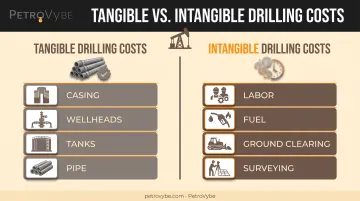
IDCs are the non-salvageable costs of preparing and drilling a well: expenses you can't resell or repurpose once the well is done. Under 26 CFR § 1.612-4, qualifying costs include:
- Wages, fuel, repairs, and hauling
- Contractor and turnkey drilling work
- Ground clearing, draining, and road building
- Surveying and necessary geological work
- Construction of derricks, tanks, and pipelines (excluding salvageable materials)
Intangible vs. Tangible: The Real Distinction
Salvage value draws the line, not whether something sounds "physical." Tangible Drilling Costs cover items with resale value: casing, wellheads, tanks, pipe. These get capitalized and depreciated under the applicable MACRS asset class rather than expensed immediately.
IDCs, by contrast, have no salvage value. The labor is spent, the fuel is burned, the ground is cleared. There's nothing left to sell.
A Deduction With Deep Roots
The administrative treatment of IDCs as deductible dates back to 1913, according to the Independent Petroleum Association of America. Congress later codified it in the 1954 tax code. The purpose was straightforward: drilling is risky, and Congress wanted to encourage domestic exploration by softening the financial blow of a dry hole.
That's still the operative logic. The IDC deduction applies whether or not the well ever produces a drop of oil or cubic foot of gas. It rewards the act of drilling, not the outcome.
IDC Tax Treatment: Deduct Now or Amortize Later
Taxpayers have a choice under IRC 263(c) and IRC 59(e): expense qualifying IDCs immediately, or elect to capitalize and recover them ratably over 60 months.
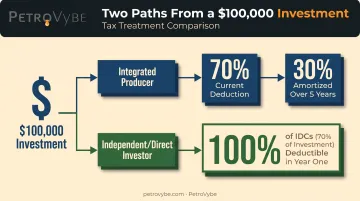
The 70%/30% Rule for Integrated Companies
IRC 291(b) reduces the current-year IDC deduction for integrated oil companies by 30%, with that portion amortized over five years.
Independent producers and direct investors aren't subject to that haircut. They can expense 100% of qualifying IDCs in the current year—but that is 100% of the IDC bucket, not 100% of the total investment.
Example: if IDCs are 70% of a $100,000 investment, a non-integrated taxpayer can deduct $70,000 in year one. Electing under 59(e) instead means a smaller current deduction plus five years of amortization. This treatment requires the investor to elect general partner status in the Subscription Agreement and may be limited in a given year by the excess business loss limitation under IRC §461(l).
Active Income Offset—With Caveats
A working interest held without limited liability is treated as nonpassive under Publication 925, regardless of whether the holder materially participates. That's why direct working interest holders can potentially offset W-2 income and capital gains, not just passive income. This treatment requires the investor to elect general partner status in the Subscription Agreement and may be limited in a given year by the excess business loss limitation under IRC §461(l).
That said, this isn't an automatic dollar-for-dollar guarantee. These limits still apply in sequence before the deduction lands on your 1040:
- Basis limits
- At-risk rules
- Excess-business-loss limits
- Capital-loss rules
AMT: More Nuanced Than a Flat Percentage
The "excess IDC" preference under IRC 57 compares excess IDCs to 65% of oil-and-gas net income. Non-integrated taxpayers also face a separate 40% benefit limitation under current Form 6251 rules. Don't assume 65% automatically triggers AMT exposure. Model Form 6251 line 2t directly.
Documentation matters. Retain:
- Invoices and drilling reports
- K-1s
- Any Section 59(e) election statements
A 2018 IRS private letter ruling shows the cost of a missed election deadline: the taxpayer had to petition for 120 days of late-election relief. Calendar the 59(e) deadline with your CPA before year-end.
How Investors Recover IDCs Through Direct Participation
Accredited investors don't need to buy stock in a major producer to access IDC treatment. Holding a direct working interest in a development project, rather than a passive royalty position, is what typically opens the door to personal IDC deductions.
The general mechanics:
- IDCs are incurred during the drilling and completion phase of the well
- The deduction is generally claimed on the partner’s K-1 for that same tax year
- Investors may expense the full amount upfront or amortize it evenly over 60 months
This is where the deduction stacks with long-term upside. You hold a working interest that can generate production revenue for years after the wells come online.

How PetroVybe Structures This
PetroVybe offers accredited investors direct partnership units in natural gas development projects through PetroVybe ONE. Participation begins at one unit of $100,000, with add-on subscriptions from $25,000. Partners who joined in 2025 saw first-year deductions against active income of 94%, reported through K-1 tax documents. Prior result; not a promise of any future deduction. This treatment requires the investor to elect general partner status in the Subscription Agreement and may be limited in a given year by the excess business loss limitation under IRC §461(l).
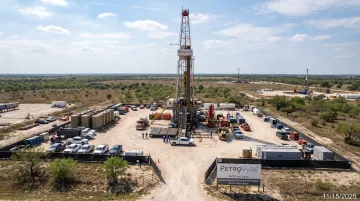
PetroVybe's Lavaca County, Texas project combines roughly 400 existing wells with 57+ planned new wells across a 58,000-acre position in the Gulf Coast Basin. The IDC deduction applies only to qualifying new-drilling costs—not to legacy-well acquisition or workover expenses.
The company also backs its projects with a third-party engineered reserve valuation of $48 million (PV-09, prepared by Lee Keeling & Associates, Tulsa, March 2026), reviewed by a licensed engineering firm, giving investors an independent check on the numbers behind the deal.
Who Qualifies to Claim IDC Deductions?
Eligibility hinges on the nature of the interest you hold, not on your investor accreditation status.
| Interest Type | IDC Eligibility | Passive Loss Treatment |
|---|---|---|
| Direct working interest, unlimited liability | Can elect IDC deduction personally | Nonpassive: can offset active income |
| Limited partner/limited liability structure | May still receive allocation; needs review | Not automatically nonpassive |
| Royalty interest only | No independent IDC eligibility | Not applicable This treatment requires the investor to elect general partner status in the Subscription Agreement and may be limited in a given year by the excess business loss limitation under IRC §461(l). |
A few practical notes:
- Accredited investor status meets SEC deal requirements; it does not determine IDC eligibility
- Review your Private Placement Memorandum, Limited Partnership Agreement, and Subscription Agreement to confirm how your interest is classified
- Talk to a CPA or tax attorney experienced in oil and gas taxation before you fund the investment, not after year-end
Misclassifying your interest can cost you the deduction entirely.
Frequently Asked Questions
What does "IDC costs" mean?
In oil and gas, IDC stands for Intangible Drilling Costs—the non-salvageable expenses of drilling and preparing a well. The same acronym also means unrelated "Indirect Costs" in university and grant administration.
How do I get a federally negotiated indirect cost rate?
That term is unrelated to oil and gas IDCs. It refers to F&A rates research institutions negotiate with a cognizant federal agency such as HHS or NSF. Contact the relevant agency for that process.
Can IDC deductions offset W-2 income?
Direct working interest holders without limited liability are generally treated as nonpassive. That status can let IDC deductions offset active income, including W-2 wages and capital gains. Basis and at-risk limits still apply. This treatment requires the investor to elect general partner status in the Subscription Agreement and may be limited in a given year by the excess business loss limitation under IRC §461(l).
Do I need a successful well to claim the IDC deduction?
No. The deduction applies to qualifying costs incurred during drilling, whether or not the well produces. It rewards the cost of drilling itself, not the outcome.
Should I deduct IDCs immediately or amortize them?
It depends on your current versus projected tax bracket and cash flow needs. Immediate expensing accelerates savings; the 60-month election spreads them out. Talk to a tax professional before electing either approach.
Informational requests only. PetroVybe projects are offered solely to verified accredited investors. Submitting this form does not create an investment or advisory relationship.