"Investing in oil and gas" doesn't mean one thing. It can mean buying a single ETF share on your phone during lunch, or it can mean taking a direct ownership stake in a producing well in South Texas. The right approach depends on your capital, your risk tolerance, and your tax situation — not on which method sounds the most exciting.
This guide breaks down every major way to invest in oil and gas: who each method suits, what it takes to get started, the forces that drive returns, and the mistakes that trip up even experienced investors.
Key Takeaways
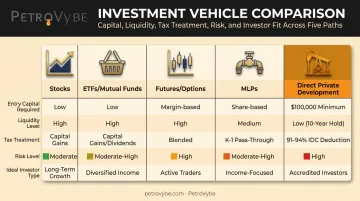
- Public markets need just a brokerage account; private deals require accredited status and six-figure capital
- Tax treatment varies: capital gains on ETFs, K-1 income on MLPs, deductions on working interests
- Rising AI and data center power demand is adding a measurable tailwind to natural gas
- Match the vehicle to your liquidity needs and time horizon, not the "best" single option
Ways to Invest in Oil and Gas
Every method below gives you exposure to the same underlying commodity, but the mechanics, risk profile, and tax outcome differ dramatically depending on which door you walk through.
Oil and Gas Stocks
Buying shares of producers, refiners, and service companies gives you direct company exposure. Think integrated majors, independent shale producers, or oilfield service firms.
Here's the catch: stock performance depends on management decisions, debt loads, and earnings execution just as much as it depends on crude prices. Two companies can hold identical acreage and post wildly different returns based on how well they're run.
- Best for: Long-term investors seeking dividends and liquidity
- Watch for: Stock prices don't always track oil prices in lockstep: a company can fall even when crude rallies if its balance sheet is shaky
Oil and Gas ETFs and Mutual Funds
This category splits into two very different animals:
- Equity ETFs hold baskets of energy stocks (producers, refiners, pipeline companies), spreading company-specific risk across dozens of holdings
- Futures-based commodity ETFs use oil futures contracts to try to track the spot price of crude directly
The equity version diversifies away single-stock risk. The futures version carries a hidden cost most retail investors miss: contango. When futures prices for later-dated contracts sit above near-term prices, a fund must sell expiring contracts and buy pricier ones, quietly eating into returns.
The gap can be enormous. Morningstar reported that the United States Oil Fund (USO) returned roughly 14% in 2009, while spot WTI crude rose 78% that same year — a 64-percentage-point shortfall driven almost entirely by roll costs. USO's own 2024 regulatory filing confirms that prolonged contango can materially reduce fund returns relative to holding crude directly.
That's not a knock on ETFs generally. It's a warning specific to futures-based commodity funds held long term.
Oil and Gas Futures and Options
Futures and options offer the most direct price exposure available in public markets, but they come with real friction: margin approval, broker suitability review, and a working understanding of contract expiration dates.
This route suits experienced, active traders, not long-term investors. Leverage cuts both ways, and a contract that moves against you overnight can wipe out a position fast. If you've never traded derivatives before, this isn't the place to start.
Master Limited Partnerships (MLPs)
Pipeline and midstream MLPs don't drill for oil. They move it, store it, and process it, generating income from energy infrastructure rather than commodity price swings. That's why MLP performance tracks throughput volumes more than crude prices.
The appeal is income. The Alerian MLP Infrastructure Index yielded 7.53% as of August 2025, close to its three-year average of 7.43%.
The trade-off is paperwork:
- MLPs issue Schedule K-1 forms, not 1099s
- Partners report their share of partnership income whether or not cash was actually distributed
- Passive losses can get suspended against future income from that same partnership
If you don't want to deal with K-1 complexity every tax season, factor that in before chasing the yield.
Direct and Private Oil & Gas Development Investment
Accredited investors can skip public securities entirely and take a working interest (direct ownership) in a development project alongside an operator. This is a fundamentally different animal than buying shares.
The biggest draw is tax treatment. Intangible Drilling Cost (IDC) deductions can be applied against active income, including W-2 earnings and capital gains, something no ETF, stock, or MLP can offer.
PetroVybe uses this model, giving accredited investors direct access to early-stage natural gas development in South Texas and the Gulf Coast Basin. Its flagship project, PetroVybe ONE, sits on a 58,000-acre basin in Lavaca County with roughly 400 acquired wells already producing and 57-plus new wells planned.
Partners who joined in 2024 and 2025 received tax deductions of 94% and 91% against active income, respectively. The project targets a 10-year MOIC of roughly 2.2x to 5.8x, with an IRR near 26%.
The trade-off is liquidity. You're locking up capital for years, not trading in and out. In exchange, you're getting tangible asset ownership and tax treatment public markets simply don't provide.
Is Investing in Oil and Gas a Good Idea?
It depends on the investor, not the commodity. Oil and gas can diversify a portfolio and provide an inflation-sensitive hedge, but whether it's a good idea for you hinges on your goals, risk tolerance, and tax bracket.
On the inflation question: energy stocks have historically shown the highest sensitivity to inflation changes of any equity sector, according to S&P Global Market Intelligence. That's meaningfully different from claiming oil and gas move in a fixed, predictable pattern against stocks and bonds. The honest answer is that energy tends to respond to inflation, not that it's a perfect inflation hedge.
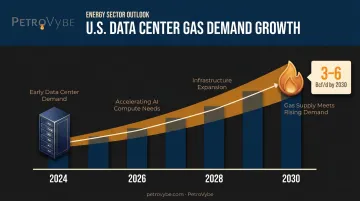
There's also a demand story unfolding right now that didn't exist five years ago. S&P Global Ratings projects U.S. data centers will add 3 to 6 Bcf/d of natural gas demand by 2030, up from almost none at the time of that October 2024 report. That's a scenario range, not a locked-in guarantee, but it's a real and measurable tailwind specific to natural gas.
Weigh that against the risks that apply across every method:
- Price volatility — crude and gas prices swing on inventory reports, weather, and demand shifts
- Geopolitical shocks — conflicts and sanctions can move prices within a single trading session
- Regulatory and environmental scrutiny — policy shifts can change project economics overnight
Your decision comes down to choosing the right vehicle: a public security or a direct development project, based on your liquidity needs and tax profile.
What You Need Before Investing in Oil and Gas
Entry requirements range from "just open a brokerage account" to formal income and net-worth verification, depending entirely on which method you choose.
Capital and Account Requirements
- Stocks and ETFs: Start with the price of a single share — often under $100
- Futures and options: Require margin approval and broker sign-off before you can trade
- Private development partnerships: Typically require six-figure liquidity; PetroVybe's threshold, for example, sits at $100,000
Investor Status and Documentation
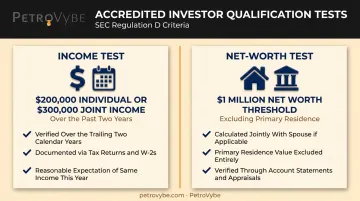
Direct working-interest partnerships require SEC accredited investor status. That means meeting one of two tests:
- Income test: More than $200,000 individually (or $300,000 jointly) in each of the two preceding years, with a reasonable expectation of the same going forward
- Net-worth test: More than $1 million, excluding your primary residence
Issuers using general solicitation must verify this status through documents like W-2s, tax returns, brokerage statements, or written confirmation from a CPA, attorney, or registered broker-dealer. This isn't a formality: it exists to protect investors in less-liquid deals where you can't simply sell your position tomorrow.
Risk Tolerance and Time Horizon
Match your liquidity needs to your vehicle:
- Need to access cash within a year or two? Stick to public securities.
- Comfortable locking up capital for 5 to 10 years in exchange for tax advantages and compounding? Direct development positions may fit.
Key Factors That Affect Oil and Gas Investment Returns
The same macro forces move underlying value across every method described above. What changes is how each vehicle transmits those forces into your actual returns.
Supply and Demand Balance
Why it matters: OPEC+ production discipline and U.S. shale output set the price floors and ceilings that everything else responds to.
Impact: The IEA projected global oil demand would rise by just 830 kb/d in 2025, while global supply grew by roughly 3 mb/d, creating a meaningful surplus. Observed inventories reached a four-year high of 8,030 million barrels in October 2025. Oversupply conditions like these tend to pressure prices, regardless of which vehicle you hold.
Geopolitical and Regulatory Events
Why it matters: Wars, sanctions, and sudden policy shifts can disrupt supply lines overnight, and markets react in real time.
Impact: When the Israel-Iran conflict escalated in June 2025, Brent crude jumped $2.15, or 2.8%, to $78.85 per barrel in a single session. That's a snapshot of how fast geopolitical risk can move prices, and how quickly it can reverse once tensions ease.
Tax Treatment of the Investment Vehicle
Why it matters: ETFs face annual capital gains treatment. MLPs issue K-1s with their own reporting quirks. Direct working interests can qualify for IDC deductions against active income.
Impact: For high-income investors, tax efficiency can be as significant a return driver as price appreciation itself. A partner in a direct development deal offsetting six figures of W-2 income through IDCs may come out ahead even in a flat-price environment.
Operator and Team Execution
Why it matters: For both stocks and direct development deals, the skill of the management and geology team determines whether reserves actually convert into profitable production.
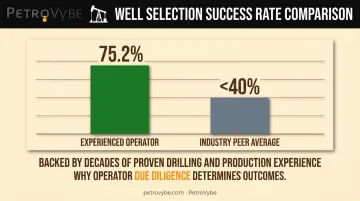
Impact: This is where operator selection matters most in private deals. PetroVybe, for instance, cites a 75.2% well-selection success rate for its Chief Geophysicist, based on a 48-year track record — well above a general industry peer average that hovers below 40%. Whether you're buying a stock or entering a working interest, the team's execution history deserves as much scrutiny as the acreage itself.
Common Mistakes to Avoid When Investing in Oil and Gas
Even seasoned investors trip on the same handful of errors:
- Treating futures-based ETFs as buy-and-hold positions. These products are built for short-term trading, not multi-year exposure. Contango drag compounds against you over time.
- Ignoring tax and liquidity differences before committing capital. A K-1 headache or a locked-up position for a decade shouldn't be a surprise you discover after you've wired funds.
- Skipping due diligence on operator track record. Before entering a direct working-interest deal, verify third-party reserve validation and the operator's actual drilling history, not just their pitch deck.
- Over-concentrating in a single company or vehicle. Spreading exposure across the risk spectrum (some public, some private) protects you better than betting everything on one stock or one deal.
Frequently Asked Questions
Is it a good idea to invest in oil?
It can diversify a portfolio and offer some inflation sensitivity, but suitability depends on your risk tolerance, time horizon, and which vehicle you choose.
How do I invest in oil?
Main routes include stocks, ETFs and mutual funds, futures and options, MLPs, and direct private development partnerships for accredited investors. Each requires different capital, documentation, and holding periods.
What is the safest way to invest in oil and gas?
Diversified equity ETFs and large integrated oil companies typically carry lower risk than futures contracts, leveraged ETFs, or single small-cap stocks. Diversification reduces company-specific and roll-cost risk.
How much money do I need to start investing in oil and gas?
Public securities can start with the cost of one share, often under $100. Private development deals typically require accredited investor status and $100,000 or more in liquidity.
Are oil and gas investments considered passive income?
Dividends, MLP distributions, and direct working-interest royalties can all generate passive cash flow. Tax treatment and reporting complexity vary widely between these structures.
What tax benefits come with oil and gas investing?
Direct working interests can offer Intangible Drilling Cost deductions applied against active income, including W-2 earnings — a benefit standard ETFs and stocks don't provide. PetroVybe partners, for example, received deductions of 91-94% against active income in 2024 and 2025.