That growing role is exactly why investors are paying closer attention to the sector again. But "investing in natural gas" isn't one action. Buying a stock, trading a futures contract, and committing capital to a direct development partnership are three very different experiences, each with its own risk, tax, and return profile.
This guide walks through the step-by-step process for investing in natural gas, when the timing makes sense, the market factors driving returns, common mistakes to avoid, and a side-by-side comparison of every major investment vehicle, from ETFs you can buy in minutes to private development partnerships built for accredited investors.
Key Takeaways
- Public markets and private partnerships carry sharply different risk, liquidity, and tax profiles.
- Natural gas supplies ~41% of U.S. electricity, with LNG export capacity expanding through 2029.
- Accredited investors can claim upfront IDC tax deductions against active income through direct working-interest positions.
- Weather, storage data, geopolitics, and AI-driven demand drive most gas price swings.
- Misusing leverage and skipping diversification are gas investing's costliest mistakes.
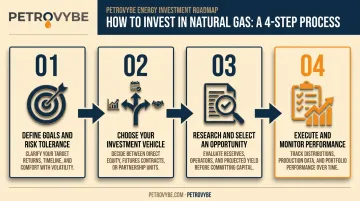
How to Invest in Natural Gas: A Step-by-Step Approach
Step 1: Define Your Investment Goals and Risk Tolerance
Before picking a ticker or signing subscription documents, get clear on why you're investing:
- Short-term trading gains from price swings
- Long-term passive income from production
- Tax efficiency against W-2 or capital gains income
- Diversification away from stocks, bonds, and real estate
Risk tolerance matters just as much as goals. Leveraged instruments like futures and CFDs can erode capital fast. European regulators found that 74%-89% of retail CFD accounts typically lost money. That statistic alone should shape your choice of vehicle in Step 2.
Step 2: Choose Your Investment Vehicle
Three broad categories exist:
- Public equities: natural gas stocks and ETFs, bought through any standard brokerage account
- Derivatives: futures and CFDs, requiring a margin-enabled trading account
- Private direct development partnerships: working-interest positions in actual wells, available only to accredited investors
Eligibility differs sharply. A brokerage account and a few hundred dollars get you into an ETF. Direct development partnerships typically require accredited investor status and minimums starting around $100,000. PetroVybe's partnerships, for example, set their minimum at that $100,000 figure, consistent with SEC accredited investor requirements.
Step 3: Research and Select a Specific Opportunity
For stocks and ETFs, look at:
- Dividend history and payout consistency
- Debt-to-EBITDA ratios and free cash flow
- Where the company sits in the value chain: upstream producer, midstream pipeline operator, or downstream processor
For direct development partnerships, due diligence looks different:
- Vet the operator's track record. Has the team delivered promised production and tax outcomes before?
- Review geological due diligence, including how forecasted decline curves compare against nearby producing wells
- Confirm independent third-party reserve valuations exist, such as PetroVybe ONE's $48 million PV-09 valuation backed by a clean 2025 audit
Step 4: Execute the Investment and Monitor Performance
Public instruments are simple: open a brokerage account, fund it, place the trade. Private placements move slower. Investors confirm accredited status through a CPA or tax attorney, review the private placement memorandum, and sign subscription documents before wiring funds.
Monitoring differs too:
| Investor Type | What to Track |
|---|---|
| Public holders | Weekly EIA storage reports, rig counts, and price action |
| Direct partnership investors | Quarterly production and distribution reports, K-1 tax documents, and operator updates |
Is Natural Gas Investing Right for You? Timing and Prerequisites
Natural gas investing fits investors seeking energy-sector exposure, an inflation hedge, or diversification beyond stocks, bonds, and real estate. It's a poor fit if you need high liquidity on short notice or can't tolerate sharp commodity swings.
Best Timing Considerations
Seasonal demand cycles create predictable patterns: winter heating and summer cooling both push consumption higher. Layered on top is structural, long-term demand growth from AI data centers and electrification, a trend that doesn't reverse with the seasons.
These structural trends don't guarantee good entry timing, though. Be cautious about chasing short-term price spikes tied to geopolitical headlines, like the 2021 Winter Storm Uri freeze-off that sent Texas gas prices soaring before crashing back within weeks. A sudden supply scare can send prices up fast, then erase those gains just as quickly once the headline fades, creating a misleading entry point for anyone reacting in real time.
What You Need Before You Start
Capital minimums vary enormously by vehicle:
- A few hundred dollars for a single ETF share
- A standard brokerage account for stocks or ETFs
- $100,000 or more in liquidity for accredited investor private placements, such as direct natural gas development positions
If you're considering a private placement, get documentation ready early:
- Income or net worth verification for accredited investor status
- A relationship with a CPA or tax attorney who can issue a third-party verification letter
- Time to review offering documents (PPM, LPA, subscription agreement) before committing capital
Firms like PetroVybe require this verification process before accepting any commitment, since offerings are structured under SEC Regulation D, Rule 506(c).
Key Factors That Affect Natural Gas Investment Returns
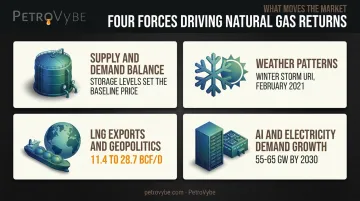
Natural gas returns hinge on physical market fundamentals and bigger macro trends. Four factors matter most.
Supply and Demand Balance
Production levels, weekly EIA storage inventories, and active rig counts move spot and futures prices directly. When storage draws down faster than expected, undersupply conditions can trigger sharp rallies, rewarding long positions and producers holding assets in the ground.
Weather Patterns
Extreme cold or heat can spike heating and cooling demand almost overnight. Winter Storm Uri is the textbook case: Henry Hub natural gas averaged about $3.00/MMBtu in early February 2021, then spiked to $23.86/MMBtu on February 17 as the storm froze wells and gathering lines across Texas.
The storm cut U.S. production by roughly 7% that month. That's the kind of volatility investors need to respect, in both directions.
LNG Exports and Geopolitics
Expanding U.S. LNG export capacity ties domestic gas prices more tightly to European and Asian demand every year. According to EIA projections, North American LNG export capacity is set to more than double, rising from 11.4 Bcf/d at the start of 2024 to 28.7 Bcf/d by 2029. As that capacity comes online, overseas price swings increasingly ripple back into the Henry Hub market.
AI and Electricity Demand Growth
Data centers and AI infrastructure are accelerating demand for new natural gas-fired power generation. S&P Global expects 55-65 GW of new U.S. grid-based gas capacity to come online between 2025 and 2030, roughly double its pre-data-center-boom forecast. That's the demand PetroVybe's Lavaca County, Texas project is built to serve, with production designed to feed directly into the grid powering AI infrastructure.
Common Mistakes to Avoid When Investing in Natural Gas
Even experienced investors misstep with natural gas because it behaves differently than most assets in a portfolio. Watch for these four traps:
- Treating equities and commodity-price exposure as interchangeable. Natural gas stocks and price-tracking ETFs aren't the same bet: a stock's price reflects management decisions, debt load, and hedging strategy on top of the commodity price.
- Using high leverage without understanding margin calls. Futures and CFDs multiply gains and losses alike; margin calls, swap costs, and daily settlement can erode a position before the commodity even moves.
- Overlooking tax and structural differences. Public market gains face ordinary capital gains tax, while direct development investments can generate IDC deductions against active income, a benefit stocks and ETFs don't offer.
- Concentrating exposure in one value-chain segment. Sticking only to upstream, midstream, or downstream plays leaves a portfolio exposed to segment-specific risk. Diversifying across the chain, or pairing public holdings with a direct production stake, spreads that risk more evenly.
Comparing Your Investment Options: Stocks, ETFs, Futures, and Direct Development Partnerships
Every vehicle offers a different mix of liquidity, risk, control, and tax treatment. The right choice comes back to the goals you defined in Step 1.
| Vehicle | Best For | Key Trade-Offs |
|---|---|---|
| Natural gas stocks | Liquidity and dividend income from established producers or midstream companies | Company-specific management and debt risk stacked on top of commodity price risk |
| ETFs and mutual funds | Hands-off, diversified exposure across many companies, or direct price-tracking | Less control over individual holdings, diluted upside versus a concentrated position |
| Futures and CFDs | Active traders comfortable managing leverage and daily price swings | High risk of rapid capital loss, margin and swap costs, unsuitable for passive investors |
| Direct development partnerships | Accredited investors seeking direct ownership, upfront tax deductions, and passive income | Illiquid, restricted to accredited investors, typically $100,000+ minimums |
Why Direct Development Partnerships Work Differently
Direct development partnerships deserve a closer look since they operate differently from anything traded on an exchange. Instead of buying a claim on a company's stock price, investors own a working interest in the wells themselves, at the point where value is actually created.
PetroVybe structures its partnerships this way, pairing independent third-party engineering validation with an experienced operating team. That team includes a Chief Geophysicist with a documented 75.2% career hit rate on profitable well locations, well above the sub-40% industry average.
The firm targets a 10-year MOIC in the range of roughly 2.2x to 5.8x, an outcome tied directly to production performance rather than daily price speculation.
That combination of tax treatment, illiquidity, and long hold periods makes direct development a fundamentally different commitment than clicking "buy" on an ETF. It's built for investors who prioritize after-tax income over trading flexibility.
Frequently Asked Questions
Is natural gas a good investment?
Natural gas's growing role in LNG exports and AI-driven electricity demand makes it a compelling long-term theme, but the commodity carries real price volatility. Whether it's "good" for you depends heavily on which vehicle you choose.
How much money do I need to start investing in natural gas?
You can purchase stocks and ETFs for the price of a single share, often under $100. Accredited investor private placements, such as direct development partnerships, typically require $100,000 or more in liquidity.
What's the difference between natural gas and natural gas liquids (NGLs)?
Processing separates NGLs, including ethane, propane, butane, and natural gasoline, from raw natural gas. Pricing varies by component: ethane tracks close to dry gas, while heavier liquids trend closer to crude oil.
Can I invest in natural gas through my retirement account?
Investors commonly hold natural gas stocks through standard or self-directed brokerage IRAs. Self-directed IRA custodians can also hold certain private placements, though eligibility depends on the specific custodian and offering structure.
What tax benefits are available for natural gas investments?
Direct working-interest investments can generate intangible drilling cost (IDC) deductions against active income, including W-2 wages and capital gains, a benefit public stocks and ETFs don't offer. PetroVybe partners, for example, received deductions of 91%-94% against active income in 2024 and 2025.
Is investing in natural gas riskier than investing in oil?
Both commodities carry extraction and geopolitical risk, and natural gas has shown periods of extreme volatility, such as during Winter Storm Uri. Actual risk depends less on the commodity itself and more on the investment vehicle you choose.