That's real money walking out the door every April.
LLCs offer more tax flexibility than almost any other entity type. You can choose how you're taxed, stack deductions strategically, and even look beyond your core business for additional tax relief. This guide walks through the deduction strategies, entity elections, and lesser-known tactics — including direct investment in natural gas development — that experienced LLC owners use to keep more of what they earn.
Key Takeaways
- LLCs default to pass-through taxation, but S-Corp or C-Corp elections can cut self-employment tax and boost take-home pay
- Stacking common deductions (home office, retirement, vehicle, health insurance) cuts taxable income in the same year
- PTE elections and Section 179/bonus depreciation deliver large, often underused write-offs
- High-income earners can pair LLC strategies with oil and gas investments to offset active income
- Have a qualified tax professional review any strategy before you implement it
Understanding How LLCs Are Taxed
By default, the IRS doesn't treat your LLC as a separate tax entity. Income and losses pass through directly to you.
- Single-member LLC: Treated as a disregarded entity (sole proprietorship). Income flows to Schedule C on your personal return.
- Multi-member LLC: Treated as a partnership. Each member reports their share via Schedule K-1.
- Community-property spouses: In some states, a jointly owned LLC can be treated as a disregarded entity, which simplifies filing.
None of this is permanent. LLCs can elect corporate taxation by filing Form 8832 for C-Corp treatment or Form 2553 for S-Corp treatment.
Default pass-through income is subject to self-employment tax at 15.3% (Social Security plus Medicare) on net earnings up to the Social Security wage base, plus Medicare on amounts above it, according to the IRS. That cost hits before income tax is calculated.
Why Entity Election Matters for Tax Liability
An S-Corp or C-Corp election changes how profits are taxed:
- S-Corp: Pay yourself a reasonable salary (subject to payroll tax); remaining profits can be taken as distributions that are not subject to self-employment tax
- C-Corp: Profits are taxed at a flat 21% federal corporate rate under IRC §11, regardless of earnings level
- Tradeoff: C-Corp dividends can face double taxation, which may offset SE tax savings depending on profit level and salary needs
The better election depends on your profit level, the salary you'd need to justify, and whether dividend double-tax risk outweighs self-employment tax savings.

Top LLC Deductions to Maximize Tax Savings
Most LLC tax savings come from deductions owners never claim, or claim without enough documentation to survive review.
Qualified Business Income (QBI) deduction. Pass-through owners can deduct up to 20% of qualified business income, according to the IRS. Above certain income thresholds, restrictions kick in for specified service businesses, so high earners need a strategy session with their CPA to preserve this deduction.
Section 179 and bonus depreciation. Buying equipment, technology, or qualifying property? You can often expense the full cost immediately rather than depreciating it over years. Current bonus depreciation rules restore 100% first-year expensing for qualifying property.
Retirement contributions cut taxable income and build wealth at the same time:
- SEP IRA: employer contributions up to 25% of compensation
- Solo 401(k): high combined employee/employer contribution limits, plus catch-up amounts for those 50+
- SIMPLE IRA: lower limits, but easier to administer for small teams

Everyday deductions people forget:
- Home office (simplified method: $5/square foot, up to 300 sq ft)
- Business vehicle mileage or actual expense method
- Self-employed health insurance premiums (100% deductible above the line)
- Business-related education, subscriptions, and software
- Charitable contributions made by the business
- Reasonable wages to family members that shift income into a lower bracket
None of these hold up in an audit without paper trails. Separate business and personal accounts, keep receipts, and log mileage. Every deduction you claim should have a document that proves it.
Advanced Tax Strategies: Entity Elections and Timing
Entity elections and timing give LLC owners more control over when income is taxed and how state tax is deducted.
Pass-Through Entity (PTE) tax election. In states that allow it, your LLC (taxed as a partnership or S-Corp) can pay state income tax at the entity level. That payment becomes a full federal deduction for the business, sidestepping the $10,000 SALT cap that would otherwise limit your personal deduction, per IRS Notice 2020-75.
More than 35 states now offer this election. Check whether yours is one of them.
Income and expense timing. Cash-basis LLCs can defer invoicing into January or prepay deductible expenses in December. That shifts taxable income between years based on where you expect to land in the bracket structure.
Multi-entity structures. Separating real estate, intellectual property, or higher-risk operations into distinct LLCs (often under a holding company) isolates liability and can optimize tax treatment across different income streams.
Estimated tax planning. Paying at least 90% of current-year tax or 100-110% of prior-year tax (depending on income) avoids underpayment penalties while keeping cash flow flexible for reinvestment.

Alternative Investment Tax Strategies: Reducing Liability Beyond Deductions
Here's where most LLC owners stop looking, and where high-income earners miss an entire category of tax relief.
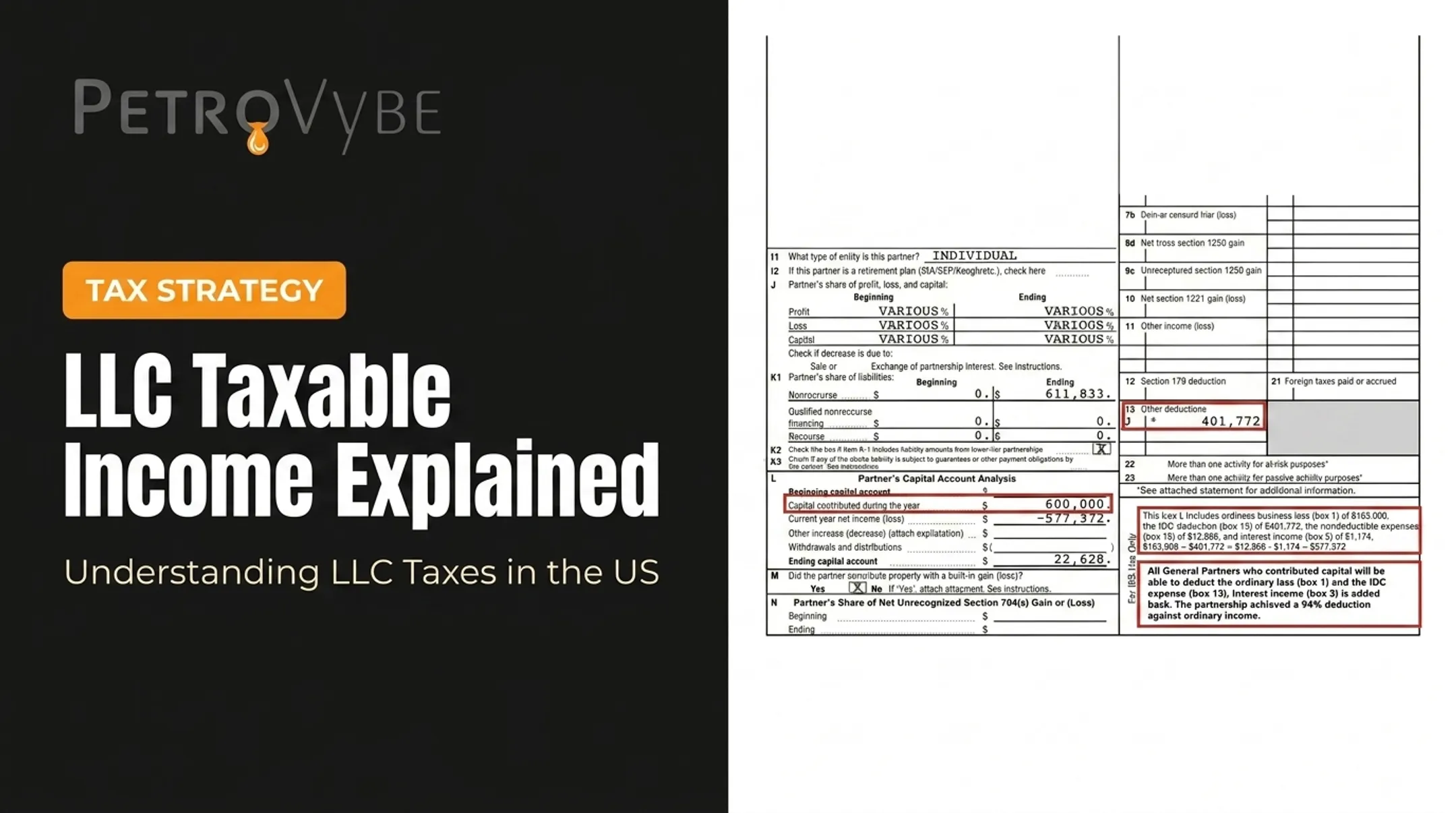
Standard business deductions only go so far. For accredited investors with substantial W-2 income or capital gains, direct participation in oil and gas development can deliver a distinct outcome: Intangible Drilling Cost (IDC) deductions that apply against active income, not just passive gains.
Under Treasury Regulation §1.612-4, IDCs (labor, fuel, supplies, and other drilling costs) can typically be deducted in the year incurred rather than capitalized. Industry data suggests IDCs commonly represent 60% to 80% of a well's total development cost.
IRC §469(c)(3) excludes direct working interests in oil and gas properties from the passive activity rules that trap most tax shelters. That is why this deduction can offset W-2 wages and capital gains, not just other passive income.
PetroVybe, a Texas-based natural gas development company, gives accredited investors direct access to this structure. Partners in the company's projects received a 94% deduction against active income in 2024 and 91% in 2025, according to internal company data.
The investment centers on roughly 400 acquired legacy wells and 58,000 acres in Lavaca County, within the Gulf Coast Basin, with 57+ additional wells planned. Reserves are backed by a $48 million PV-09 valuation from a licensed third-party engineering firm.

Used alongside LLC deduction planning, this structure can extend tax relief in four practical ways:
- Applies against active income (W-2, capital gains), not just passive income
- Uses a 10-year hold with monthly distributions projected to peak above $10,000/month during production
- Requires accredited investor status and a $100,000 minimum investment
- Should be reviewed with a CPA or tax attorney before committing capital
Minimizing Liabilities and Staying Compliant
Aggressive tax planning only works if it holds up under scrutiny.
Keep business and personal finances separate. Commingling funds risks disallowed deductions in an audit. It can also pierce your liability shield entirely, exposing personal assets to business creditors.
Watch reasonable compensation rules. If you've elected S-Corp status, the IRS pays close attention to the ratio of salary versus distributions. Key factors include:
- Your training, experience, and role
- Time actually devoted to the business
- What comparable employees earn in similar roles
- Your distribution history

Recharacterizing distributions as wages after an audit means back payroll taxes, penalties, and interest.
Review your structure annually. Revenue grows, tax law changes, and what made sense at $80,000 in profit may not make sense at $400,000. An annual check-in with a CPA keeps your entity election and deduction strategy aligned with where your business actually is.
Frequently Asked Questions
What are the best LLC tax strategies to maximize deductions and credits?
The strongest combination is entity election (S-Corp when profits justify it), the QBI deduction, retirement plan contributions, and Section 179 expensing. Work with a tax advisor to model which combination fits your income level.
Can an LLC deduct 100% of business expenses?
Only ordinary and necessary business expenses are fully deductible. Some, like business meals, are limited to 50% under IRC §274(n), while entertainment expenses remain nondeductible entirely.
Should my LLC elect S-Corp status to save on taxes?
It depends on your profit level and the self-employment tax savings versus added payroll complexity and costs. A CPA can calculate your specific breakeven point.
How can LLC owners reduce taxable income without new deductions?
Timing strategies help: defer income into the next tax year, accelerate deductible expenses into the current year, and max out retirement plan contributions before the filing deadline.
Are there tax benefits to investing outside my LLC's core business?
Yes. Alternative investments like oil and gas development offer IDC deductions that apply against active income for accredited investors, a benefit most business deductions can't match.
What records should an LLC keep to support its tax deductions?
Keep receipts, mileage logs, and bank statements, and reconcile them regularly. Separating personal and business finances is the single most important habit for surviving an audit intact.