

For high-income investors, this isn't a distant abstraction. A wealth tax targets what you own, not what you earn, which creates an entirely different kind of tax exposure than most investors have planned around.
This article covers the definition of a wealth tax, how it differs from income and capital gains taxes, what global experience tells us, the U.S. policy landscape, and what it means for accredited investors managing significant asset bases.
Key Takeaways
- A wealth tax is an annual levy on total net worth (assets minus liabilities), not on income earned or assets sold
- Most OECD countries that adopted wealth taxes have repealed them — primarily due to capital flight, valuation problems, and high administrative costs
- The U.S. has no federal wealth tax, but state-level proposals are active in California, Washington, and elsewhere
- A federal wealth tax faces real constitutional challenges — and legal scholars remain split on whether it would survive
- Investors holding illiquid assets like private businesses and energy partnerships face the sharpest exposure under any wealth tax framework
What Is a Wealth Tax and How Does It Work?
A wealth tax is a levy applied annually to an individual's total net worth — meaning all assets minus all liabilities — rather than to income earned during the year or gains realized from selling an asset. Some proposals also call it a capital tax, equity tax, or net wealth tax.
What Gets Included
The asset base under most wealth tax proposals is deliberately broad. The OECD defines a net wealth tax as a recurrent levy on movable and immovable assets net of debt — assessed periodically on holdings rather than on income flows or completed transactions. Typical inclusions:
- Cash and bank deposits
- Publicly traded stocks and securities
- Real estate (primary and investment properties)
- Privately held business interests and partnership stakes
- Trusts and pension funds
- Vehicles, jewelry, and art
Most people think of "wealth" as stocks and savings accounts. But wealth tax proposals also reach the closely held business you built, the rental property you've held for 20 years, and the oil and gas partnership generating your monthly distributions.
How the Math Works
The calculation is straightforward in principle: total asset value minus outstanding debts equals taxable net worth. A percentage rate applies to the amount exceeding a set threshold.
Example: If a proposal sets a 2% rate on net worth above $50 million, someone with $60 million in assets and $5 million in debts has $55 million in taxable net worth — and owes 2% on the $5 million above the threshold, or $100,000 annually.
The Liquidity Problem
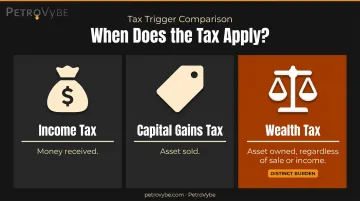
What makes a wealth tax distinctly burdensome compared to income or capital gains taxes is the liquidity mismatch. Each tax type applies at a different trigger point:
- Income tax: applies to money you received
- Capital gains tax: applies when you sell an asset
- Wealth tax: applies to what you own — regardless of income received or assets sold
If your wealth is concentrated in a privately held business, proved energy reserves, or real estate, you may owe an annual tax bill on assets that generated no liquid cash that year. Paying that bill requires selling something — which may not be possible, desirable, or timed well.
How Wealth Taxes Have Been Used Around the World
The numbers tell the story plainly. According to OECD data, approximately 12 OECD member countries had broad individual wealth taxes in 1990. By 2017, that number had dropped to four — and a 2024 classification still counts only four broad net wealth tax systems.
Active Wealth Tax Countries
| Country | How It Works |
|---|---|
| Switzerland | Cantonal and municipal recurrent tax on worldwide net assets of residents; schedules vary by canton |
| Norway | Combined national and municipal rate on net wealth above a threshold; valuation discounts apply to certain assets |
| Spain | Progressive tax on net property and economic rights; autonomous communities can modify exemptions and rates |
| Colombia | Progressive rates on net assets above a threshold, applicable to both individuals and legal entities |
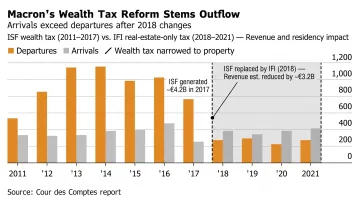
Notable reform: France replaced its broad wealth tax (ISF) in 2018 with a real-estate-only tax (IFI) on net property above €1.3M — removing it from the broad wealth tax count entirely.
Why Most Countries Walked Away
The reasons for repeal are consistent across jurisdictions:
- Administrative complexity: Valuing illiquid assets annually is expensive and contentious
- Revenue disappointment: Revenue collected rarely justified the compliance and enforcement costs
- Capital flight: Wealthy individuals and businesses relocated to lower-tax jurisdictions
That last point — capital flight — is what ultimately forced France's hand. The ISF generated approximately €4.2 billion in 2017, but documented outflows of wealthy residents and capital made the revenue figure increasingly difficult to defend. When France replaced the ISF with the real-estate-only IFI, the estimated annual budget cost was roughly €3.2 billion — a substantial reduction in receipts accepted as a tradeoff for stopping the exodus.
The Case For — and Against — a Wealth Tax
Arguments For
Wealth concentration is real. The Federal Reserve's 2022 Survey of Consumer Finances reports that the top 1% of U.S. families held approximately 30% of family net worth. Proponents argue that income taxes alone are insufficient to address this concentration, since much wealth accumulates through appreciation that is never taxed.
The stepped-up basis gap. Under current U.S. law (IRC §1014), heirs receive inherited property at its fair market value at the date of death — effectively erasing all unrealized appreciation from the tax base permanently. A wealth tax would assess that appreciation annually, closing what critics call a significant loophole.
Revenue potential. Senator Warren's original 2020 proposal — 2% on net worth above $50 million, with a top rate of 6% above $1 billion in the later version — was estimated by the Tax Foundation to raise $2.6 trillion conventionally over 10 years ($2.2 trillion after macroeconomic feedback).
Arguments Against
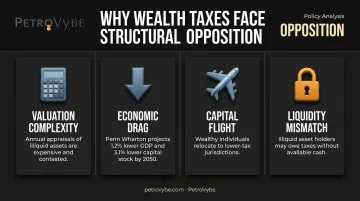
Critics raise four objections that have so far blocked passage in the U.S.:
- Valuation complexity: A large share of high-net-worth wealth sits in private businesses, real estate, partnership interests, and direct investments — assets without a daily market price. Annual appraisals are expensive, subjective, and contestable, creating persistent disputes with the IRS.
- Economic drag: The Penn Wharton Budget Model's analysis of a 2%/3% wealth tax structure projected that by 2050, GDP would be 1.2% lower, the capital stock 3.1% lower, and average hourly wages 1.2% lower — assuming revenues reduced the deficit rather than funded new investment.
- Capital flight: France's experience showed that even a modest wealth tax can trigger behavioral responses that offset much of the anticipated revenue.
- Liquidity mismatch: Wealthy individuals with illiquid holdings — farmland, private equity, closely held businesses — may owe taxes they can't easily pay without selling assets, a structural problem no U.S. proposal has fully resolved.
The result is a standoff: the theoretical case for taxing unrealized wealth accumulation is strong, but the practical obstacles have proven equally durable. For high-income earners, that unresolved debate makes tax-advantaged structuring within the current system — not speculation about future policy — the more actionable focus.
Wealth Tax in the United States: Current Status and Policy Debates
The U.S. currently has no federal wealth tax. Taxes that resemble it in limited ways — property taxes, estate and gift taxes, capital gains taxes — exist, but none imposes an annual levy on total net worth at the federal level.
The Constitutional Question
A significant legal hurdle exists. Article I, Section 9 of the U.S. Constitution bars "direct taxes" unless apportioned by state population — a requirement no modern federal tax satisfies. The 1895 Pollock v. Farmers' Loan & Trust Co. decision treated taxes on property income as direct taxes requiring apportionment; the Sixteenth Amendment later addressed income taxes but not wealth taxes expressly.
Scholars are divided. Some argue a wealth tax could qualify as an excise and avoid the apportionment requirement. Others contend it is unambiguously a direct tax and would be unconstitutional without a constitutional amendment. The Supreme Court's 2024 Moore v. United States decision — which upheld a tax on realized entity income — expressly declined to resolve wealth tax constitutionality.
Federal Proposals
Several bills have been introduced at the federal level, none successfully enacted:
- Ultra-Millionaire Tax Act (S. 510): Introduced by Senator Warren in 2021; remained at "Introduced" status throughout the legislative session
- OLIGARCH Act (118th Congress): A separate wealth-targeting proposal that similarly did not advance out of committee
- Current status: As of 2025, no federal wealth tax has been enacted — and no active bill is on a clear path to passage
State-Level Developments
State activity is more advanced, though equally unresolved:
- California: A 2023-24 annual wealth tax bill (AB 259, 1% over $50M) failed. A separate 2025 initiative (25-0024A1) proposed a one-time tax of up to 5% on covered assets above $1 billion; it was filed in November 2025 and had not been enacted as of year-end.
- Washington: SB 5797 proposed a 1% property tax on stocks, bonds, and specified financial intangibles above $1 billion. It remained in committee in 2025 and did not pass. The state did advance a separate income-based "millionaires tax" — a different instrument.
- Illinois: HB 3039 proposed a mark-to-market tax on unrealized gains for residents with $1B+ in net assets. It was introduced in 2023 and not enacted before the 103rd General Assembly ended.
- Texas: Voters approved Proposition 3 in November 2023 by approximately 68% to 32%, constitutionally prohibiting any state wealth or net worth tax — a direct counterpoint to the legislative trend in states like California and Washington.
What a Potential Wealth Tax Means for Accredited Investors
No wealth tax has been enacted at the federal level or in any U.S. state. But the policy trajectory matters for how sophisticated investors think about asset allocation and tax exposure today — before legislation passes.
Why the Threat Is Different from Income Tax Risk
Income taxes apply to money flowing in. A wealth tax applies to what you've already built. That distinction matters most for investors who have accumulated significant asset bases — stocks, real estate, private equity stakes, partnership interests — that may generate limited liquid income relative to their appraised value.
Under proposals like H.R. 7749, the tax base covers all real, personal, tangible, and intangible property, with Treasury directed to develop valuation rules for nontraded assets. For investors holding private partnership interests, proved energy reserves, or directly owned real assets, this creates both a valuation exposure and a potential cash-flow problem.
The Case for Proactive Income Tax Reduction
One of the most effective strategies available now — before accumulated wealth becomes a policy target — is reducing taxable income while building long-term tangible asset value.
Oil and gas development investments offer a specific mechanism through the Intangible Drilling Costs (IDC) deduction under 26 CFR 1.612-4. For qualifying working interests structured appropriately, IDC deductions can be applied against active income — including W-2 earnings and capital gains — not just passive income.
This is a meaningful distinction from real estate. Passive loss limitations in real estate typically restrict deductibility to passive income only; IDC deductions don't carry that restriction.
PetroVybe structures its accredited investor partnerships specifically around this deduction advantage. Key terms for the current offering:
- First-year deduction: 91% (2024 partners) and 94% (2025 partners) against active income
- Minimum investment: $100,000 per unit
- Eligibility: Accredited investors only — net worth over $1 million (excluding primary residence), or income over $200,000 individually / $300,000 jointly

The underlying assets — proved reserves with a third-party-verified $48MM PV-09 valuation, producing wells in Lavaca County, and multi-well field infrastructure — are the kind of tangible, independently appraised holdings that would fall within most wealth tax proposals.
That's not a reason to avoid them. It's a reason to understand the full tax picture, consult a qualified CPA or tax attorney, and reduce income tax exposure now, before accumulated wealth grows further.
Frequently Asked Questions
What is considered a wealth tax?
A wealth tax is any levy applied annually to an individual's total net worth — assets minus liabilities — rather than to income earned or transactions completed. Property taxes function as a partial analog: assessed annually on asset value, but limited to one asset class rather than net worth overall.
How much tax will you pay on $1,000,000?
The U.S. has no federal wealth tax, so $1 million in net worth carries no annual net worth levy. Tax on $1 million in income depends on income type, filing status, and applicable deductions — a tax advisor can provide figures specific to your situation.
Does the United States currently have a wealth tax?
No federal wealth tax exists in the U.S. Property taxes and estate taxes function as partial proxies, and several states have active proposals, but no state has enacted a comprehensive annual tax on total net worth as of 2025.
What is the difference between a wealth tax and an income tax?
An income tax applies to money earned during the year — wages, dividends, realized capital gains. A wealth tax applies annually to the total value of everything a person owns, regardless of whether any income was received or any asset was sold that year.
Why did most European countries repeal their wealth taxes?
Three consistent reasons: high administrative costs relative to revenue collected, documented capital flight as wealthy individuals relocated to lower-tax jurisdictions, and the inherent difficulty of accurately valuing illiquid assets — particularly private businesses — on an annual basis.
How can investors protect their wealth from potential new tax policies?
Acting before legislation passes gives investors the most options. Direct participation programs — such as oil and gas investments that generate Intangible Drilling Cost deductions against active income — real asset diversification, and qualified tax and estate planning counsel are among the concrete strategies worth evaluating now, not after a bill clears committee.
Disclosure: PetroVybe and its team members are not licensed financial advisors, and nothing on this website constitutes financial or investment advice or a recommendation to buy, sell, or hold any investment. PetroVybe and its team members are not tax advisors, accountants, or tax strategists, and nothing on this website constitutes tax advice or a tax strategy. PetroVybe and its team members are not attorneys, and nothing on this website constitutes legal advice. All content is provided for general informational purposes only. You should consult your own independent financial advisor, tax professional, and legal counsel before making any decision.