

The distinction matters because it determines four things: your tax treatment, your cost obligations, your level of control, and your share of a well's revenue. A royalty check and a working interest distribution can come from the exact same well and look completely different on paper.
This guide breaks down both structures side by side, covers real use cases, and gives you a decision framework. If you're an accredited investor or high-income earner weighing where to put capital in energy, you'll want to understand the mechanics before you wire a dollar.
Key Takeaways
- Royalty interest pays cost-free revenue but skips major tax deductions like IDCs.
- Working interest requires cost-sharing but unlocks full profit participation and tax deductions.
- Net Revenue Interest (NRI) determines a working interest owner's actual take-home pay.
- Choose based on your goals: royalty for stability, working interest for tax efficiency and upside.
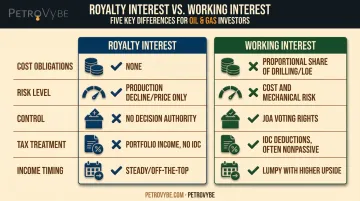
Royalty Interest vs Working Interest: Quick Comparison
Cost, Risk & Control
Royalty owners never write a check for drilling, completion, or operating costs. Their income arrives "off the top" of gross revenue, before anyone else gets paid.
Working interest owners pay a proportional share of every dollar spent developing and operating the well, including drilling, completion, and lease operating expenses (LOE). Some structures also carry capital calls if a project needs more funding down the road.
Royalty interest carries zero operational risk. There's no liability for cost overruns, no mechanical risk, and no decision-making authority. The only real exposure is production decline and commodity price swings.
Working interest owners take on execution risk. They either operate the well directly or hold a non-operated stake with contractual rights under a joint operating agreement (JOA), but either way, they're exposed to cost and mechanical risk.
Tax Treatment
| Factor | Royalty Interest | Working Interest |
|---|---|---|
| IDC deductions | Not eligible (no drilling costs paid) | Eligible |
| Depletion allowance | Percentage or cost depletion | Percentage or cost depletion |
| Passive activity treatment | Royalty income is generally portfolio income | Often qualifies as nonpassive under IRC Section 469(c)(3) |
| Reporting | Schedule E | K-1 / Schedule C (self-employment tax may apply) |
Income Potential & Timing
Royalty income tends to be smaller as a percentage of gross revenue, but it's steady and simple to track. Working interest income has higher upside net of costs, but cash flow is often lumpy, front-loaded with deductions, and affected by workovers or maintenance downtime.
What is Royalty Interest?
Royalty interest is a passive, cost-free right to a percentage of gross production revenue. It's typically held by the mineral rights owner who leased their land to an operator in exchange for that ongoing cut.
Royalty owners get paid before working interest owners, and that payment priority is exactly why royalty interest is considered lower-risk, lower-upside. The money comes off the top, regardless of whether the well is barely profitable for the operator.
There are a few common variations:
- Lease (ownership) royalty: the standard royalty retained when a mineral owner signs a lease.
- Non-Participating Royalty Interest (NPRI): carved from the mineral fee itself; the holder shares in production revenue but has no right to negotiate leases or collect bonuses.
- Overriding Royalty Interest (ORRI): carved from the working interest, not the mineral fee, and it typically ends when the underlying lease does.
Use Cases of Royalty Interest
Royalty interest fits investors and landowners who want a hands-off income stream with zero operational involvement. No JOA to review, no capital calls, no drilling decisions.
Typical holders include landowners, heirs who inherited mineral rights, and retirees who want predictable income without managing anything. Payments are calculated as a fraction of net mineral acres within a drilling unit, multiplied by the negotiated royalty rate.
Royalty rates commonly negotiated in U.S. leases fall in the 12.5% to 25% range, according to a 2025 lease-negotiation guide from The Jones Law Firm, though this is a negotiating benchmark rather than a measured national average. A landowner with a 20% royalty on a well generating $50,000 in gross monthly revenue would see roughly $10,000 before any operating costs touch that number. None of those costs are theirs to pay.
What is Working Interest?
Working interest is an active, cost-bearing ownership stake in a lease or well. It entitles the holder to a proportional share of revenue after royalties are deducted, in exchange for paying a proportional share of drilling and operating costs.
The operational side matters as much as the financial side. Working interest owners can participate in decisions through a joint operating agreement. This active status also unlocks major tax advantages, including IDC deductions and depletion allowances that royalty owners simply can't access.
There are a few structural variants worth knowing:
- Operated working interest — held by the party managing daily field operations.
- Non-operated working interest — no daily control, but often retains voting, consent, and audit rights under the JOA.
- Carried working interest — a joint-venture structure where one party advances another's development costs, recovering them from future production before the carried party resumes paying its own share.
The IDC Tax Advantage
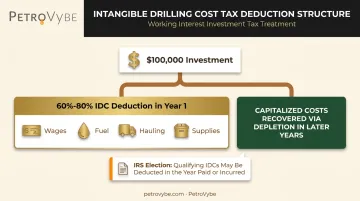
This is where working interest earns its reputation among high-income investors. Intangible drilling costs, meaning wages, fuel, hauling, and supplies tied to drilling and preparing a well, can typically be deducted as current expenses rather than capitalized.
According to the IRS oil and gas audit technique guide, taxpayers with a working interest may elect to deduct qualifying IDCs in the year they're paid or incurred.
PetroVybe structures its natural gas development opportunities specifically around working interest positions for this reason. Its partners have realized IDC deductions in the 60% to 80% range of invested capital in year one. These deductions apply against active income, including W-2 earnings and capital gains, not just passive income the way real estate depreciation typically works.
Use Cases of Working Interest
With those deductions in mind, working interest suits accredited investors who want to sit at the entry point of value creation, not just collect a downstream check. It's the structure that lets you participate directly in a well's economics rather than watching from a distance.
The typical investor profile:
- High W-2 earners looking to offset active income
- Business owners or executives with capital gains needing a tax-efficient home
- Investors targeting long-term MOIC alongside meaningful first-year deductions
PetroVybe's own 2024 and 2025 partners achieved 94% and 91% total tax deductions against active income, respectively, with the bulk of that landing in year one through IDCs. On a $100,000 investment, that translates to a first-year deduction in the $60,000 to $80,000 range, before accounting for depletion in later years.
Royalty Interest vs Working Interest: Which Is Right for You?
The right structure depends on five factors: risk tolerance, desired involvement, tax situation, available capital, and income timing preferences. Walk through these honestly before committing capital.
Choose royalty interest if:
- You want simple, cost-free, predictable income
- You have no interest in active tax planning or participation
- You're comfortable with lower upside in exchange for lower risk
Choose working interest if:
- You carry significant active income (W-2 or capital gains) you want to offset
- You want substantial first-year deductions, not just passive-loss carryforwards
- You're comfortable with a multi-year hold in exchange for full upside participation
A Real Example
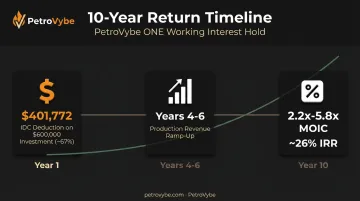
Consider a South Texas natural gas project. One anonymized PetroVybe investor contributed $600,000 in capital. Through IDC deductions and an associated ordinary business loss reported on their K-1, that investment generated a $401,772 deduction in year one, roughly 67% of the invested capital, applied directly against active income.
A royalty interest holder in that same project would forgo that deduction entirely. They'd collect a smaller, steady percentage of gross revenue with no tax offset against W-2 wages or capital gains.
Over a 10-year hold, PetroVybe targets a MOIC of roughly 2.2x to 5.8x and an IRR near 26% for its working interest partners. That return profile is built around combining upfront tax efficiency with long-term production upside.
Ready to see where you might fit? Review PetroVybe's working interest natural gas development opportunities in South Texas and the Gulf Coast Basin, built for accredited investors who want tax efficiency and passive income working together in one structure.
Conclusion
Neither structure wins outright. Royalty interest suits investors who want simplicity and cost-free income with no operational strings attached. Working interest suits those who want deeper economic participation, a voice in decisions, and access to meaningful tax deductions.
Understanding your NRI, cost obligations, and tax treatment before you invest separates satisfied investors from disappointed ones. Working interest structures like PetroVybe's accredited investor partnerships exist specifically to capture IDC deductions against active income—an advantage royalty interest can't match. Know which structure you're actually buying before you sign anything.
Frequently Asked Questions
What is the difference between royalty interest and working interest?
Royalty interest is a cost-free share of revenue with no operating obligations. Working interest is a cost-bearing ownership stake with operational rights, greater upside, and stronger tax benefits.
What is a royalty interest?
A royalty interest is a passive, non-cost-bearing right to a percentage of production revenue, typically held by mineral owners who leased their land to an operator.
What is a working interest?
A working interest is an active, cost-bearing ownership stake in a lease or well. It entitles the holder to revenue after royalties in exchange for paying a proportional share of costs.
Can you own both a working interest and a royalty interest in the same well?
Yes. Different parties, or even the same investor, can hold both interest types on a single well simultaneously, each with distinct rights and payment priority.
Which is better: working interest or royalty interest?
Neither is universally better. The right choice depends on your risk tolerance, tax situation, and preference for passive versus active participation.
How is working interest taxed compared to royalty interest?
Working interest generally qualifies for IDC deductions and depletion, often against active income. Royalty interest generally qualifies only for depletion, with no IDC benefit available.