
This article is general education, not investment, tax, or legal advice. Private placements give accredited investors access to deals public markets never see: early-stage energy projects, direct real estate positions, and niche funds with real upside. But that access comes at a cost. There's no SEC-mandated disclosure package, no analyst coverage, and no regulator reviewing the offering memorandum before it reaches your inbox.
For anyone evaluating oil and gas or other alternative asset private placements, that gap is exactly where due diligence earns its keep. Skip it, and you're investing on faith. Do it right, and you're making an informed bet with your eyes open.
This guide breaks down what due diligence actually means, the main categories to work through, red flags that should stop you cold, and the regulatory rules that shape investor eligibility.
Key Takeaways
- Review the issuer, financials, management, legal structure, and sponsor–investor alignment before you commit capital
- Regulation D skips SEC registration—you still own independent verification of every material claim
- Rule 506(b) allows up to 35 non-accredited investors; Rule 506(c) requires every investor to be accredited
- Require third-party proof (engineering reports, verified reviews) instead of relying on marketing alone
- Treat unverifiable track records or misaligned incentives as stop signs, not minor footnotes
What Is Private Placement Due Diligence?
Due diligence is the process of independently checking what an issuer tells you against what's actually true. In practice, that means verifying financials, checking management's background, reading the offering documents closely, and knowing exactly what you're buying.
Most private placements are offered under Regulation D exemptions, meaning they're not registered with the SEC. That's not a red flag by itself — it's simply how these deals legally operate. But it does mean disclosure isn't standardized the way it is for public offerings.
Keep these points in mind:
- Regulation D exempts issuers from registration, but antifraud liability still applies to misstatements and omissions
- A Private Placement Memorandum (PPM) is not automatically required, and no regulator reviews it before it reaches you
- Due diligence doesn't eliminate risk. It clarifies what you know, what you don't, and what remains genuinely unknowable
Knowing what diligence covers still leaves a practical question: who is actually responsible for doing it.
Whose Job Is It, Really?
Responsibility splits two ways. Broker-dealers recommending a deal must conduct a documented, reasonable investigation under FINRA guidance. FINRA Regulatory Notice 23-08 reinforces that recommending firms can't simply take an issuer's word for it. They need to critically analyze primary documents and assess any third-party diligence provider's independence.
But that obligation doesn't replace yours. If you're the one signing the subscription agreement, the final due diligence call is on you.
Main Types of Due Diligence for Private Placements
Private placement due diligence breaks into four core categories. Skipping any one of them leaves a blind spot.
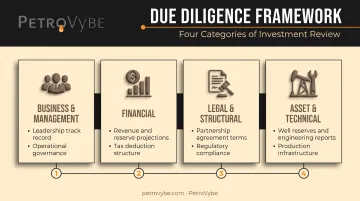
Business and Management Due Diligence
Start with the people running the deal:
- Research the founding team's track record and whether prior results are independently verifiable, not just claimed
- Check regulatory and litigation history for the issuer and its management team
- Confirm compliance with "bad actor" provisions under Rule 506(d)-(e)—disqualifiers include securities fraud, regulatory bars, and specified court orders (typically within a 5–10 year lookback)
Financial Due Diligence
Numbers matter more than narratives here:
- Review revenue history and cash flow projections against realistic assumptions
- Confirm whether financial statements were reviewed (limited assurance) or audited (reasonable assurance) by an independent third party—audits require far more testing and evidence
- Understand fee structures and sponsor compensation, specifically whether management fees are tied to capital committed or capital deployed
Note: Some sponsors don't publish detailed fee schedules upfront. Ask directly, and get the answer in writing before you commit.
Legal and Structural Due Diligence
This is where the paperwork lives:
- Examine the PPM, subscription agreement, entity structure, and any pending litigation or regulatory inquiries
- Confirm exactly what security type you're buying: equity, working interest, or a note—and where it sits in the distribution waterfall
- Understand licensing requirements tied to the specific asset class
Asset and Technical Due Diligence
For oil and gas placements specifically:
- Review reserve reports, third-party engineering valuations, and geological data
- Evaluate well data, production history, and lease acreage claims against what's actually documented
- Confirm whether reserve classifications follow recognized industry frameworks like SPE PRMS
Key Areas to Investigate Before Investing
Beyond the four core categories, a handful of specific questions separate a well-vetted deal from a leap of faith.
Skin in the game. Has management actually funded a meaningful capital contribution alongside investors, or is it all upside for them and all risk for you? Ask for proof of funding, not just a statement of intent.
The distribution waterfall. Map out the preferred return, catch-up provisions, and profit split. Does the structure compensate you fairly for the risk you're taking on?
PetroVybe ONE, for example, is structured around an 80/20 investor-favoring profit split as part of its "Protect and Scale" capital model. Always confirm exact waterfall mechanics—accrual timing and hurdle rates—in the PPM itself.
Affiliated transactions. If the sponsor is buying assets from its own affiliated programs, were those deals priced at market rates with independent appraisals, or just negotiated internally?
Third-party validation. This is the single best defense against taking a sponsor's word at face value. Look for:
- Independent engineering reserve valuations
- Verified investor reviews on third-party platforms
- Regulatory operator licenses confirmed through public sources
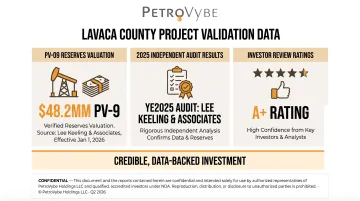
PetroVybe's Lavaca County, Texas project shows what this looks like in practice:
- $48 million PV-09 proved-reserves valuation from a licensed third-party engineering firm. Prepared by Lee Keeling & Associates, Tulsa, March 2026.
- Clean 2025 independent audit from Weaver
- 5.0 rating across 8 verified reviews on Invest Clearly
- One reviewer cited a $30,000 eliminated tax liability—a concrete, checkable claim
Operator licensing for entities like PetroVybe OpCo LLC can be verified directly through the Texas Railroad Commission.
None of this replaces your own homework. But it gives you something to check against, which is the whole point.
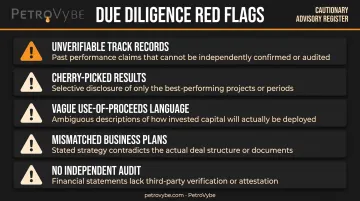
Red Flags That Warrant Further Scrutiny
Certain patterns should slow you down immediately:
- Unverifiable track records: performance claims with no supporting documentation, or numbers that only tell part of the story
- Cherry-picked results: a highlight reel of the best-performing deals while omitting the rest
- Vague use-of-proceeds language: if you can't tell exactly where your money is going, that's a problem
- Mismatched business plans: the pitch says one thing, the actual capital deployment plan says another
- No independent audit or appraisal: missing third-party validation paired with high or opaque sponsor fees
FINRA's own guidance flags guaranteed or unusually consistent returns, secrecy around strategy, and pressure tactics as classic warning signs of a problematic private placement. If a sponsor won't answer specific questions or hesitates on documentation, treat that hesitation as a hard stop.
Regulatory Requirements and Investor Eligibility
Most Reg D private placements require accredited investor status. Under SEC rules, that means:
- Net worth over $1 million, excluding your primary residence, individually or with a spouse
- Income over $200,000 individually (or $300,000 jointly) in each of the prior two years, with a reasonable expectation of the same this year
There are also entity-level and professional-credential paths to accreditation, but income and net worth remain the most common routes.
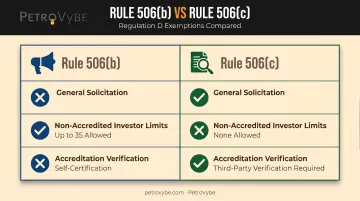
506(b) vs. 506(c): Know the Difference
| Feature | Rule 506(b) | Rule 506(c) |
|---|---|---|
| General solicitation | Prohibited | Permitted |
| Non-accredited investors | Up to 35 allowed | None allowed |
| Accreditation verification | Reasonable belief | Issuer must actively verify |
Both exemptions allow unlimited capital raises. The real distinction is how investors are found and how strictly accreditation gets checked.
Broker-dealers recommending these offerings must comply with Regulation Best Interest and FINRA Rule 2111. That is why you should expect—and request—documented due diligence materials before you sign anything.
Frequently Asked Questions
What are the requirements for a private placement?
Issuers typically file Form D with the SEC, restrict sales to accredited (or a limited number of non-accredited) investors, and avoid general public solicitation, depending on which Reg D exemption applies.
What are the main types of due diligence for private placements?
Due diligence generally covers business and management, financial, legal and structural, and asset-specific investigation, tailored to the offering type.
What is the difference between Rule 144A offerings and private placements?
Rule 144A allows resale of restricted securities to qualified institutional buyers. Traditional Reg D private placements involve direct issuance to accredited investors instead.
What is the investor limit for a private placement — 50 or 200?
Neither number applies universally. Rule 506(b) allows up to 35 non-accredited investors, while 506(c) is limited strictly to accredited investors with no fixed numerical cap.
How can investors verify a sponsor's claimed track record?
Cross-reference public records, independent third-party reviews, and verified reports rather than relying solely on the sponsor's own marketing materials.
Does due diligence guarantee a successful investment?
No. Due diligence reduces uncertainty, but it can't eliminate the risk inherent in illiquid, speculative private placements. It simply ensures you're going in informed.
Informational requests only. PetroVybe projects are offered solely to verified accredited investors. Submitting this form does not create an investment or advisory relationship.