Capital is still flowing into upstream, midstream, and oilfield services deals — just not the way it did a decade ago. PitchBook tracked 172 oil-and-gas PE deals worth $18.7 billion in 2024, and natural gas dealmaking accelerated further into 2025 as AI infrastructure and LNG exports reshaped demand.
What's changed isn't the appetite for hydrocarbons. It's who gets access. Mega-funds still write billion-dollar checks, but accredited investors now have direct paths into the same asset class. This guide covers how O&G PE deals are structured, who the major players are, and where individual investors fit into a market long dominated by institutions.
Key Takeaways
- Oil and gas PE is a smaller niche than tech or healthcare, concentrated in midstream deals backed by stable cash flows
- Full leveraged buyouts are rare in upstream E&P; joint ventures and royalty deals dominate instead
- Carlyle, KKR, Blackstone, and Apollo lead institutional deal flow, alongside specialists like EnCap and Riverstone
- AI data center demand and LNG export growth are pulling fresh capital into natural gas infrastructure
- Direct participation programs offer tax advantages, like Intangible Drilling Cost deductions, that most funds can't match
What Is Oil and Gas Private Equity?
Oil and gas PE firms raise capital from Limited Partners and deploy it across four verticals: upstream (exploration and production), midstream (pipelines and processing), downstream (refining), and oilfield services. The typical playbook is to grow an asset or company, then exit within three to seven years.
Here's the catch: this playbook works far better in some verticals than others.
Traditional leveraged buyouts struggle badly in upstream E&P. A few reasons why:
- Cash flows swing with global commodity prices, not steady contracts
- Capital expenditure needs fluctuate year to year based on drilling programs
- Reserves deplete, which makes weak collateral for lenders who prefer assets that don't shrink
That's why upstream deals lean toward joint ventures and asset acquisitions rather than debt-heavy buyouts common in other sectors.
How Big Is This Market, Really?
Not that big, comparatively. Healthcare technology alone pulled in roughly $15.6 billion in PE and VC deals during 2024 — a figure that's up about 50% year over year and comparable in scale to the entire oil and gas PE market's annual deal value. Oil and gas PE is a niche, not a mega-sector.
One more distinction worth flagging: many firms have rebranded under "energy transition" or "energy" labels while still investing heavily in hydrocarbons. Blackstone's energy unit, now called Blackstone Energy Transition Partners, has invested more than $28 billion across the global energy industry, spanning gas, power, and renewables alike rather than pivoting away from oil and gas.
Investors have two main entry points into this market:
- Institutional fund commitments: LP stakes in blind-pool funds managed by a GP
- Direct participation models: investing directly in specific wells or development projects
The rest of this guide unpacks both.
How Oil and Gas Private Equity Deals Work
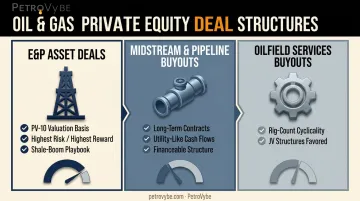
Deal structure varies dramatically depending on which part of the value chain a firm is targeting. Three buckets capture most of the activity.
Bucket 1: E&P Asset Deals
This is the shale-boom legacy playbook. A firm acquires undeveloped or underdeveloped acreage, drills enough wells to prove out reserves, then flips the position to a larger operator. Valuation here often hinges on PV-10, the SEC-standard measure of future net reserve revenue discounted at 10% annually.
Upstream still draws the largest share of overall deal activity, but it's also the riskiest corner of the market given commodity price exposure.
Bucket 2: Midstream and Pipeline Buyouts
Midstream is where traditional buyout economics actually work. Long-term contracts and utility-like cash flows make these assets financeable and predictable. MPLX's 2025 agreement to pay $2.375 billion cash for Northwind Midstream, pricing the deal at roughly 7x forecast 2027 EBITDA, illustrates the pattern: buyers pay for durable distribution yield, not speculative upside.
Downstream, by contrast, sees little deal flow at all. Heavy regulation and a shrinking pool of independent refining targets (some requiring upgrades north of $1 billion) keep buyers on the sidelines.
Bucket 3: Oilfield Services Buyouts
These resemble standard corporate buyouts but carry extra commodity sensitivity. Activity tracks the rig count closely. Baker Hughes reported the U.S. rig count fell about 20% in 2023 and another 5% in 2024, a cyclical pattern service-sector investors need to underwrite around.
Beyond rig-count cyclicality, deal structures are shifting in another way: sponsors increasingly favor joint ventures over full buyouts. Blackstone's $3.5 billion deal for a non-controlling stake in EQT's midstream JV shows the trend, with sponsors taking minority positions alongside operators rather than buying companies outright.
Returns in these structures come mostly from distribution yield and EBITDA growth, not the multiple expansion that drives classic corporate buyouts.
Who's Investing? Top Institutional Players
Two tiers of capital dominate institutional oil and gas PE.
Mega-funds run diversified energy platforms alongside their broader buyout businesses:
- Carlyle : built a natural resources platform including a stake in NGP Energy Capital Management
- KKR : uses Crescent Energy as its primary U.S. upstream vehicle
- Blackstone : paid $3.5 billion for a non-controlling interest in the EQT midstream joint venture
- Apollo : acquired onshore producer EP Energy for roughly $7.15 billion
Dedicated specialists operate at smaller scale but with deeper sector focus:
- EnCap Investments
- Riverstone
- First Reserve
- Lime Rock
- Post Oak Energy Capital
EnCap illustrates the scale specialists can reach even without mega-fund resources. The firm has raised 22 institutional funds totaling roughly $38 billion since 1988, including a $1.2 billion energy transition fund closed in 2021. Specialists like this often have narrower mandates but longer institutional memory of the sector's cycles.
Opportunities and Challenges in Oil and Gas PE
Growth Drivers Fueling New Capital
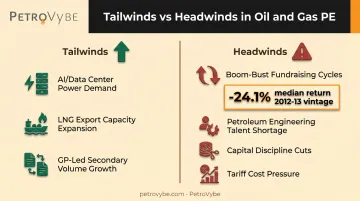
Two forces are pulling fresh money into the sector right now.
AI and data center power demand. U.S. data center grid demand was projected to rise 22% in 2025 alone, nearly tripling by 2030. That surge is driving gas-fired power plant construction and new pipeline buildout. Reuters reported that U.S. natural gas dealmaking surged through 2025, with analysts citing AI power demand and LNG exports as the primary catalysts.
LNG export expansion. The U.S. Gulf Coast is adding serious export capacity. Current U.S. LNG export capacity sits at 15.4 Bcf/d, with 13.9 Bcf/d of additional capacity planned for 2025-2029, nearly doubling throughput over five years. That build-out requires new midstream transport infrastructure, which is exactly where PE capital has concentrated.
A third trend worth watching: GP-led secondaries and continuation vehicles. Global GP-led secondary volume hit $75 billion in 2024, up from $52 billion in 2023, as sponsors look for liquidity on assets they're not ready to sell outright. No verified energy-only breakout exists yet, but the mechanism is increasingly showing up in energy portfolios too.
Risks and Headwinds to Watch
History offers a cautionary tale. North America-focused oil and gas fundraising jumped from an average of $21 billion annually across 2006-2012 to $38 billion annually after 2013. Then it crashed. Funds raised in the 2012-2013 vintage posted a median return of -24.1% after the 2014-2016 price collapse. Boom-era capital formation doesn't guarantee comparable returns.
Other headwinds worth watching:
- Talent pipeline erosion: U.S. petroleum engineering undergraduate enrollment fell from 11,474 in 2014 to just 6,263 in 2017, raising long-term staffing concerns
- Capital discipline: Diamondback cut its 2025 budget by $400 million, and Coterra planned a 30% Permian rig reduction in the back half of the year
- Tariff uncertainty: Baker Hughes estimated tariffs could shave $100-200 million off 2025 EBITDA industry-wide
None of these are dealbreakers, but they're reasons why sponsor selection and deal structure matter more in this sector than in steadier industries.
Beyond Institutional Funds: Direct Access for Accredited Investors
Most institutional O&G PE funds share a familiar structure: large minimum commitments, lockups that can stretch past a decade, and the standard "2 and 20" fee arrangement: a 2% management fee plus 20% carried interest, as the SEC describes the convention. Limited Partners get exposure, but little say in individual asset decisions.
Direct participation models work differently. Instead of committing to a blind pool, an accredited investor with $100,000 or more in liquidity can fund a specific well or development project directly, cutting out the fund-level fees and carry that come with a traditional LP stake.
The Tax Angle Most Funds Can't Offer
This is where direct participation gets genuinely distinct. Under IRC Section 469(c)(3), a working interest held directly (or through an entity that doesn't limit liability) is excluded from passive-activity classification. In plain terms: the Intangible Drilling Cost deduction can offset active W-2 income and capital gains, not just passive income (a benefit real estate passive losses generally can't replicate).
PetroVybe is a Texas-based natural gas development company built around exactly this model. Operating in South Texas and the Gulf Coast Basin, PetroVybe offers direct working interests in its flagship project, PetroVybe ONE, targeting a 10-year MOIC of roughly 2.2x to 5.8x and an IRR near 26%. First-year deductions against active income have run 91-94% for recent partner cohorts, driven primarily by IDC treatment.
What Separates Credible Sponsors From the Rest
Before committing capital to any direct program, look for:
- Independent reserve engineering: PetroVybe's assets carry a $48 million PV-9 valuation from a licensed third-party engineering firm
- Verified operator licensing: confirmable through the Texas Railroad Commission, where PetroVybe OpCo LLC holds its operator license
- Demonstrated technical leadership: PetroVybe's Chief Geophysicist, a 48-year ExxonMobil veteran, carries a 75.2% well-success rate against an industry peer average below 40%
- A clean independent audit: PetroVybe underwent a 2025 audit from Weaver, an independent accounting firm
This direct model complements institutional PE exposure rather than replacing it. The same growth drivers covered above apply directly: PetroVybe's focus on natural gas liquids ties into both AI-driven electricity demand and the premium pricing liquids command over dry gas, positioning direct development as a targeted play on the same trends institutional funds are chasing at scale.
Is Oil and Gas Private Equity Right for Your Portfolio?
This asset class isn't for everyone, and it shouldn't be. The ideal investor profile looks fairly specific:
- Accredited status under SEC definitions, with $100,000 or more in deployable liquidity
- A meaningfully high current tax burden from W-2 income, capital gains, or business profits
- Genuine concern about inflation eroding the value of stocks, bonds, and cash
- Comfort with illiquidity and a 5-10 year time horizon
- Moderate tolerance for commodity price volatility
For context on how institutions think about sizing these positions: FY2024 U.S. endowments held 55.7% in alternatives overall, with 17.1% in private equity and 10.8% in real assets, according to NACUBO data. These are diversified portfolio benchmarks, not a specific oil and gas allocation recommendation, but they show how substantial institutional exposure to alternatives has become.
Whether you're evaluating a $50 million fund commitment or a $100,000 direct working interest, the diligence checklist doesn't change much:
- Review the sponsor's track record: not just marketing claims, but verifiable production and financial history
- Confirm third-party validation: reserve reports, audits, and regulatory licensing should all be independently checkable
- Match the vertical to your risk tolerance: midstream for stability, upstream for higher risk and reward
- Understand the fee and profit-split structure before signing anything
Frequently Asked Questions
What is the 80/20 rule in private equity?
The 80/20 split typically refers to profit allocation after capital return: 80% flows to Limited Partners, while 20% goes to the General Partner as carried interest. The exact structure varies by fund and by waterfall terms, so always check the specific agreement.
What is oil and gas private equity?
It's a segment of private equity where firms raise capital to invest across upstream, midstream, downstream, and oilfield services companies or assets, aiming to grow and exit those positions for a return within a few years.
Who are the biggest private equity firms in oil and gas?
Mega-funds Carlyle, KKR, Blackstone, and Apollo all run active energy platforms. Dedicated specialists like EnCap Investments, Riverstone, First Reserve, and Post Oak Energy Capital focus exclusively on the sector.
Can individual accredited investors invest directly in oil and gas projects outside of PE funds?
Yes. Direct participation, or working interest, programs like PetroVybe allow accredited investors with sufficient liquidity to invest directly in specific development projects, bypassing fund-level fees entirely.
What tax benefits come with oil and gas investments?
Intangible Drilling Cost deductions can offset active income, including W-2 wages and capital gains, not just passive income. This differs from most passive real estate or fund investments.
Is oil and gas private equity a good investment right now?
The sector has a cyclical history, including a painful 2014-2016 bust. That said, AI-driven power demand and LNG export growth are creating real structural tailwinds for natural gas specifically, making sponsor selection more important than ever.