Introduction
Search "unconventional oil and gas" and you'll find a term that trips up even seasoned investors. Many people assume it refers to a different kind of fuel, something exotic or synthetic. It doesn't.
Unconventional oil and gas is chemically the same hydrocarbon pumped from conventional wells. The difference is where it's trapped and how hard you have to work to get it out.
Tight oil supplied about 64% of total U.S. crude oil production in 2023, according to the U.S. Energy Information Administration. Shale and tight formations have become the backbone of American energy output.
This guide breaks down what unconventional oil and gas actually means, the major resource types, and how they compare to conventional reserves. You'll also see why they're central to today's energy security and investment conversations.
Key Takeaways
- Composition matches conventional oil and gas; only the rock formation and extraction method differ
- Major types include tight oil, oil sands, oil shale, shale gas, tight gas, and coalbed methane
- Horizontal drilling and hydraulic fracturing unlocked reserves once considered uneconomical
- Unconventional natural gas now fuels surging U.S. electricity demand, including AI data centers
What Is Unconventional Oil and Gas?
Unconventional oil and gas refers to hydrocarbons trapped in rock formations with low permeability, meaning the oil or gas can't flow naturally and economically to the surface. Getting it out requires specialized technology rather than a simple vertical well.
Here's a misconception worth clearing up: unconventional resources are the same hydrocarbon molecules found in different geological settings, not a separate fuel type. Conventional oil sits in porous "reservoir rock" that lets it migrate and pool.
Unconventional oil is often still locked in the dense "source rock" where it originally formed, or it's held in unusual materials like bitumen-soaked sand.
A Shift Decades in the Making
The industry didn't start here. Early operators drilled the easiest targets first, conventional reservoirs where oil practically wanted to escape. As those fields matured and prices rose, attention turned to formations everyone had previously written off.
Federal research played a real role in that shift. The Department of Energy's Eastern Gas Shales Project, launched in 1976, studied Appalachian Devonian shale. It helped fund a roughly $92 million research push through the 1970s and 80s, including a demonstration 2,000-foot horizontal well drilled in 1986.
That work didn't cause the shale boom alone, but it laid technical groundwork private operators later built on.
There's No Fixed Line
One thing the EIA is upfront about: there's no single, permanent definition of "unconventional." What counts shifts as drilling technology improves, economics change, and production scales up. A formation considered unconventional in 1995 might be treated as routine today.
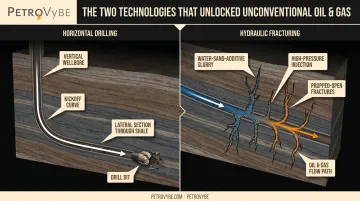
Two technologies made large-scale unconventional development commercially viable:
- Horizontal drilling – wells are drilled down, then curved to run sideways through the producing formation, maximizing contact with the rock
- Hydraulic fracturing – water, sand, and additives are pumped in under high pressure to crack the rock and prop fractures open so hydrocarbons can flow
Types of Unconventional Oil
Unconventional oil generally falls into two buckets: oil trapped in reservoir rock (tight oil, oil sands) and oil found in source rock (oil shale, shale oil).
Tight Oil
Tight oil sits in low-porosity, low-permeability formations like shale or tight sandstone. Without fracturing and horizontal drilling, it simply stays put.
The Permian Basin and Eagle Ford in Texas are the defining U.S. examples. According to U.S. Energy Information Administration data, Permian crude production increased sixfold between 2014 and September 2024, while Eagle Ford production declined 28% over the same window as operators shifted capital toward the Permian's better economics.
North Dakota's Bakken tells a similar story: EIA data shows output there jumped from just over 2,000 barrels per day in 2000 to more than 260,000 barrels per day by 2010, with horizontal wells accounting for nearly 90% of that production.
Oil Sands
Oil sands are a thick mixture of sand, water, and bitumen, a viscous, tar-like form of petroleum too heavy to flow on its own. Extraction requires either:
- Surface mining, used for deposits within roughly 75 meters of the surface
- In-situ recovery, typically steam-assisted gravity drainage, for deeper deposits
Alberta's Athabasca region in Canada remains the world's primary example, and one of the largest bitumen deposits on the planet.
Oil Shale and Shale Oil
These two terms get confused constantly, and the mix-up matters.
- Oil shale contains kerogen, a solid organic material that must be heated (retorted) before it converts into usable oil
- Shale oil is already liquid petroleum sitting in source rock; it just needs fracking to release it, making it technically a subset of tight oil
Shale oil production in Texas and North Dakota drove much of the historic U.S. output boom of the past 15 years.
Types of Unconventional Gas
Unconventional gas follows a similar split: reservoir rock (tight gas), source rock (shale gas, coalbed methane), and one frozen outlier (methane hydrates).
Shale Gas
Shale gas is trapped in fine-grained, clayey source rock. Horizontal drilling paired with hydraulic fracturing creates enough contact with the rock to make extraction economical.
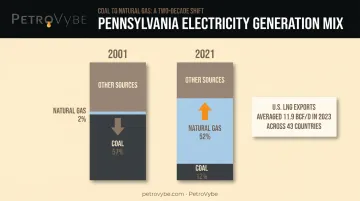
Shale gas has reshaped U.S. energy markets. In Pennsylvania alone, gas-fired power generation rose from 2% of the mix in 2001 to 52% by 2021, while coal fell from 57% to 12% over the same span. This shift happened largely because shale gas made electricity generation cheap and abundant, and the same resource now underpins America's LNG export capacity, which averaged 11.9 Bcf/d in 2023 across 43 countries.
Tight Gas and Coalbed Methane
Tight gas sits in low-permeability sandstone or carbonate reservoirs, held in place by capillary forces. It requires extensive stimulation, similar in principle to shale gas extraction.
Coalbed methane is gas adsorbed onto coal seams. Operators drill into the seam and pump out groundwater to reduce pressure, which releases the trapped methane. It's a smaller piece of the puzzle, supplying about 2% of U.S. dry gas production in 2022.
Methane Hydrates
Methane hydrates are frozen structures of water and gas found in permafrost and deep ocean sediments. Test wells have proven the concept technically feasible, but the Department of Energy has been clear: commercial-scale production remains unproven and likely years away.
Conventional vs. Unconventional Oil and Gas: Key Differences
The distinctions come down to geology, method, and cost, not chemistry.
| Factor | Conventional | Unconventional |
|---|---|---|
| Flow mechanism | Natural buoyancy through permeable rock | Requires artificial stimulation (fracturing, heat, mining) |
| Typical technique | Vertical drilling | Horizontal drilling, hydraulic fracturing, or surface mining |
| Cost & complexity | Lower upfront cost per well | Higher cost, but often higher output per well |
| Production profile | Slower initial decline | High initial output, steeper decline curve |
Conventional and unconventional methods often work together in the same field. Operators apply fracturing and horizontal drilling to revive aging conventional wells once natural reservoir pressure drops off. This extends the life of assets that would otherwise be nearing retirement.
There's also an environmental distinction: conventional extraction relies on the reservoir's own natural energy. Unconventional extraction requires injecting energy, heat, or pressure into the ground, which means more water use and a larger surface land footprint per project.
Why Unconventional Oil and Gas Matters Today
The shale revolution didn't just change domestic supply. It flipped America's position in global energy markets. The EIA confirms the United States remained a net petroleum exporter in 2025, a status that would have seemed implausible twenty years ago when the country was a major importer.
That reversal traces directly back to unconventional development. Shale and tight formations now account for roughly 79% of U.S. dry natural gas production, according to EIA data through 2024.
The New Demand Driver: Data Centers
Energy security isn't the only story anymore. Electricity demand is climbing fast, and AI infrastructure is a major reason why. The International Energy Agency projects U.S. data center electricity use will grow about 240 TWh, or 130%, between 2024 and 2030.
Natural gas already supplies over 40% of that electricity today. The IEA expects gas to add more than 130 TWh of generation capacity to meet the load by 2030.
That makes unconventional natural gas less of a niche energy story and more of a foundational input for the AI buildout happening right now.
Where PetroVybe Fits In
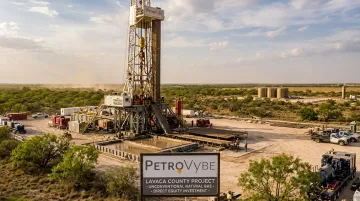
This is the market PetroVybe operates in. As a private, Texas-based natural gas development company, PetroVybe develops unconventional natural gas and NGL assets in South Texas and the Gulf Coast Basin, with its flagship project centered in Lavaca County.
The company gives accredited investors direct equity access to early-stage development, the point where wells are drilled and value gets created, rather than a stake in already-mature, publicly traded energy infrastructure.
That structure also carries a notable financing advantage: Intangible Drilling Cost (IDC) deductions. PetroVybe's model has delivered a first-year deduction of roughly 70% or more against active income, including W2 earnings and capital gains, not just passive income. That's a meaningful distinction from vehicles like real estate, where deductions are typically capped against passive income only.
For accredited investors weighing where unconventional gas fits their portfolio, that combination of direct asset ownership and immediate tax relief is worth understanding before writing a check.
Frequently Asked Questions
What's the difference between conventional and non-conventional oil and gas?
The difference is geological, not chemical. Conventional oil and gas flows naturally from permeable reservoirs, while unconventional resources are trapped in low-permeability rock requiring fracking, horizontal drilling, or mining to extract.
What is non-conventional oil and gas?
It is oil and gas found in unusual reservoir conditions, such as tight formations, source rock, or oil sands, that require specialized extraction technology. The hydrocarbons themselves are no different from conventional oil and gas.
What is an example of non-conventional oil?
Tight oil from the Permian Basin, oil sands from Alberta, Canada, and shale oil from North Dakota's Bakken formation are all common examples.
What is an example of unconventional gas?
Shale gas from the Marcellus or Eagle Ford formations, tight gas, and coalbed methane are the main categories, all typically extracted using fracking and horizontal drilling.
Why has unconventional oil and gas become so important in the U.S. energy market?
Advances in horizontal drilling and hydraulic fracturing unlocked reserves once considered too costly to produce. That shift drove U.S. energy independence and reshaped global supply dynamics.
Can accredited investors participate in unconventional natural gas development?
Yes. Private development companies like PetroVybe give accredited investors direct access to unconventional natural gas projects, often paired with tax deductions of up to 94% against active income and long-term passive income potential.