
Introduction
Inflation erodes cash. Market volatility shakes stock portfolios. And taxes take a larger bite than most high-income earners realize. Yet despite these pressures, the majority of investors operate almost exclusively in financial assets — stocks, bonds, mutual funds — while an entire category of tangible, inflation-resistant investments goes underutilized.
Real assets and financial assets serve fundamentally different roles in a portfolio. That distinction drives real decisions: how wealth holds up under inflation, how income gets generated, and how much of it survives tax season.
This article breaks down what separates these two asset classes, how each behaves across market conditions, and why certain real assets — particularly direct-participation energy investments — offer structural advantages that financial assets can't replicate.
Key Takeaways
- Real assets are tangible investments (real estate, energy, farmland) with value tied to physical utility
- Financial assets are intangible contractual claims (stocks, bonds) whose worth depends on issuer performance
- Real assets preserve purchasing power during inflation; financial assets offer superior liquidity
- Oil and gas development carries IDC tax deductions unavailable through any financial asset structure
- The strongest portfolios hold both: real and financial assets serve different but complementary functions
Real Assets vs. Financial Assets: Quick Comparison
| Attribute | Real Assets | Financial Assets |
|---|---|---|
| Physical Form | Tangible — land, equipment, infrastructure, oil wells | Intangible — paper or digital contracts |
| Source of Value | Intrinsic — physical utility, productive capacity | Extrinsic — contractual rights, dividends, interest |
| Liquidity | Generally illiquid; higher transaction costs | Highly liquid; traded daily with transparent pricing |
| Inflation Sensitivity | Often appreciate during inflationary periods | Fixed-rate instruments lose real value; equities vary |
| Examples | Real estate, oil and gas, farmland, gold, infrastructure | Stocks, bonds, ETFs, mutual funds, derivatives |
What Are Real Assets?
Real assets are tangible, physical investments whose value comes from what they are and what they produce — not from what they contractually promise. A barrel of oil, an acre of farmland, a power grid: these hold value because they serve real economic functions. Financial assets, by contrast, are claims on those underlying things.
The Four Primary Categories
- Real Estate — Residential, commercial, and industrial property. Example: a commercial office building generating monthly rental income
- Infrastructure — Roads, utilities, pipelines, power grids. Example: a natural gas pipeline collecting regulated transmission fees
- Natural Resources & Commodities — Oil, natural gas, precious metals, and extracted hard commodities. Example: a producing natural gas well in South Texas delivering monthly cash distributions
- Productive Land — Farmland and timberland that generate income through harvests. Example: a timber tract in the Pacific Northwest sold for lumber revenue

A key characteristic across all four: supply is physically constrained. You can't print more land or manufacture crude oil. That supply constraint is precisely what gives real assets their inflation resilience.
The Expanding Definition: Digital Infrastructure
That same supply-constraint logic is now drawing institutional capital toward a newer category. Cambridge Associates identifies fiber networks, data centers, and telecom towers as digital infrastructure within the real-asset category — and AI-driven electricity demand is accelerating investment here fast. Goldman Sachs forecasts that data centers alone could drive approximately 3.3 Bcf/d of additional natural gas demand by 2030.
For accredited investors, that demand creates direct entry points into upstream natural gas development — the stage where asset value is created, not acquired at a premium. Companies like PetroVybe focus specifically on this segment, with development projects in South Texas's Lavaca County positioned to supply the energy infrastructure that AI buildout requires.
Who Typically Invests in Real Assets
- Pension funds and endowments — for stable, long-horizon income
- High-net-worth individuals — for diversification beyond public markets
- Accredited investors — for direct participation in natural resources or real estate development, including tax-advantaged structures unavailable through financial instruments
What Are Financial Assets?
Financial assets are intangible claims on value. They don't exist physically: they represent a contractual right to income, ownership, or repayment. Every financial asset has a corresponding liability on someone else's balance sheet: the shares you own are a liability of the issuing company; the bond you hold is a debt obligation of the borrower.
The Four Main Types
- Equity Securities — Stocks representing proportional ownership in a company, with returns tied to earnings and market sentiment
- Fixed Income Securities — Bonds and notes delivering contractual interest payments and return of principal at maturity
- Cash and Cash Equivalents — Money market instruments, bank deposits, and Treasury bills providing liquidity with minimal return
- Derivatives — Futures, options, and swaps whose value derives from an underlying asset's price movements
The Primary Advantage: Liquidity
Financial assets trade daily on regulated exchanges with real-time pricing. You can sell a stock position in seconds. That accessibility makes financial assets the default choice for most retail investors. Lower minimums, broad diversification through ETFs and mutual funds, and instant execution are real structural benefits — particularly for investors who prioritize flexibility over yield.
An Important Clarification
A commodity ETF that tracks oil prices is a financial asset, not a real asset. A REIT that holds physical property is a financial asset, not the underlying real estate. The ETF or REIT structure means you own a contractual claim on the asset, not the asset itself. This distinction matters for tax treatment, inflation behavior, and how risk actually flows through to the investor.
Real Assets vs. Financial Assets: Key Differences
Inflation Performance
The most documented difference between these two asset classes shows up during inflationary periods. When prices rise, real assets — particularly commodities and energy — can appreciate because their underlying goods cost more to produce and consume.
The 2021–2022 period illustrates this clearly. EIA data shows WTI crude oil averaged $67.99/barrel in 2021 and $94.90/barrel in 2022, while CPI inflation ran at 7.0% and 6.5% respectively. Fixed-rate bonds, meanwhile, moved in the opposite direction — the Bloomberg US Aggregate Bond Index fell 12.5% from its high during this period as rising rates crushed bond prices.
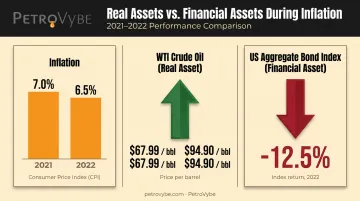
2023 offered a useful counterpoint: oil pulled back to $77.60/barrel even as CPI remained elevated at 3.4%, confirming that energy is a directional hedge against inflation — not a precise one. The asymmetry still favors real assets during inflation spikes, but volatility is part of the trade-off investors accept.
Portfolio Correlation and Diversification
Real assets typically have lower correlation to public equity and bond markets, making them effective diversifiers. The 2022 NACUBO-TIAA study of 678 U.S. and Canadian endowments found that these institutions allocated 12% of their portfolios to real assets — a meaningful commitment specifically to capture diversification benefits unavailable through stocks and bonds alone.
Risk Profiles: Different, Not Simply Greater
| Risk Type | Financial Assets | Real Assets |
|---|---|---|
| Total loss risk | High — a stock can go to zero; a bond can default | Low — physical utility sets a floor value |
| Liquidity risk | Low — sell on exchange any day | High — can take months or years to exit |
| Operational risk | Low | High — wells need maintenance; properties need management |
| Regulatory risk | Moderate | High — especially in energy and natural resources |
Financial assets offer more liquidity but no protection against complete value loss. Real assets retain floor value tied to physical utility but demand patience and operational tolerance.
Why Real Assets Matter for Investors
Inflation Hedging Through Pricing Power
When inflation rises, the goods that real assets produce — energy, food, shelter — cost more. A natural gas well generating 1 million cubic feet per day delivers more dollar value when gas prices are $4/MMBtu than $2/MMBtu. That built-in pricing power is absent from a fixed-rate bond paying 3% regardless of what inflation does.
A savings account or Treasury holding loses real purchasing power when inflation runs hot. A producing energy asset does the opposite — its output is priced at whatever the market commands today, not locked in at rates set years ago.
The Tax Advantage That Financial Assets Can't Match
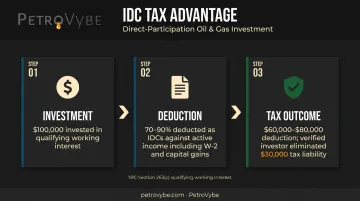
Under IRC Section 263(c), investors holding a qualifying working interest in oil and gas development can elect to deduct Intangible Drilling Costs (IDCs) as a current business expense in the year they arise. IDCs cover labor, survey work, drilling services, and well preparation — costs that typically represent 70–90% of total invested capital.
The critical distinction from real estate or other passive investments: this deduction is not restricted to passive income. For qualifying investors, it can be applied against active income — including W-2 earnings and capital gains.
PetroVybe's direct-participation structure in South Texas has delivered this advantage in verified, concrete terms:
- 2024 partners achieved a 91% first-year deduction against active income including W-2 and capital gains
- 2025 partners achieved a 94% deduction against active income
- One verified investor reported eliminating a $30,000 tax liability entirely through this structure
A $100,000 investment generating a $60,000–$80,000 IDC deduction at a high-income earner's effective tax rate translates to a real, cash-equivalent return before a single barrel of oil or cubic foot of gas is produced.
Accredited investors carrying significant tax liability can access this structure directly through PetroVybe's natural gas development programs in Lavaca County, Texas.
Portfolio Diversification
Adding real assets to a stock-and-bond portfolio reduces overall volatility and improves risk-adjusted returns over time — a strategy institutional investors have employed for decades. Direct-participation structures in oil and gas development give accredited individuals a path into the same asset class — with tax advantages that institutional vehicles typically don't carry.
Conclusion
Most portfolios are built almost entirely on financial assets — stocks, bonds, funds. That works until inflation accelerates, tax burden compounds, or market correlation eliminates the diversification investors thought they had. Real assets solve those specific problems: inflation protection, tangible underlying value, and — in select categories — structural tax advantages that no publicly traded instrument can replicate.
For high-income investors managing tax burden, inflation exposure, and stock market concentration, real assets represent an underutilized layer of the portfolio. Direct-participation energy investments occupy a distinct position within that layer: they offer exposure to a physical asset at the production stage — before it's been packaged, priced into a fund, and marked up for public markets.
The question isn't which asset class to own. It's whether your current allocation is using each one for what it actually does well.
Frequently Asked Questions
What is an example of a financial asset?
Common examples include stocks, bonds, mutual funds, ETFs, and bank deposits. These are intangible instruments — contractual claims or ownership stakes in an issuing entity, not physical items with intrinsic utility.
What is an example of a real asset?
Real assets include land, oil and gas wells, farmland, commercial property, gold, and infrastructure like pipelines. Each derives value from physical properties and productive capacity — not from any contractual claim or issuing entity.
What is the difference between an asset and a financial asset?
Financial assets are a subset of the broader asset category. The term specifically covers intangible contractual claims — stocks, bonds, derivatives. Assets overall also include physical real assets (land, energy) and intangible assets like patents and trademarks.
Are oil and gas considered real assets?
Yes — oil, natural gas, and energy resources are classified as real assets under the natural resources and commodities category. Direct participation in oil and gas development gives investors ownership of the physical asset, which is distinct from buying an energy ETF, a financial claim on commodity prices rather than the resource itself.
Do real assets protect against inflation?
Many do, particularly commodities, energy, and real estate, because their supply is physically constrained and the goods they produce rise in price during high-inflation periods. That said, energy prices can reverse even during elevated CPI periods — real assets are an effective inflation hedge, not a guaranteed one.
Are real assets riskier than financial assets?
They carry different risks rather than simply greater ones. A stock can go to zero; most real assets retain a floor tied to physical utility. The trade-off is illiquidity, operational complexity, and regulatory exposure that financial assets don't carry.
Disclosure: PetroVybe and its team members are not licensed financial advisors, and nothing on this website constitutes financial or investment advice or a recommendation to buy, sell, or hold any investment. PetroVybe and its team members are not tax advisors, accountants, or tax strategists, and nothing on this website constitutes tax advice or a tax strategy. PetroVybe and its team members are not attorneys, and nothing on this website constitutes legal advice. All content is provided for general informational purposes only. You should consult your own independent financial advisor, tax professional, and legal counsel before making any decision.