

The problem? Many investors sign the partnership agreement without understanding what they're actually agreeing to. GP versus LP roles, distribution waterfalls, tax treatment — these details get glossed over, and that's exactly how disputes and unexpected liability show up later.
This guide breaks down what an investment partnership agreement is, the clauses it must contain, and how to write or review one, with particular attention to capital-intensive sectors like natural gas development.
Key Takeaways
- LPs contribute capital passively while the GP actively manages the investment
- State law governs by default when the agreement is silent, not federal law
- Waterfalls, GP authority limits, and exit terms deserve equal scrutiny as returns
- Pass-through taxation and IDC deductions reshape after-tax returns
- A securities attorney and a PPM are typically required alongside the agreement
What Is an Investment Partnership Agreement?
An investment partnership agreement is a legal document governing a partnership formed to pool investor capital toward a defined investment purpose, such as real estate acquisition, oil and gas development, or a private securities offering. That's the key distinction from a general business partnership: the goal isn't to jointly run an ongoing operating business. It's to fund and execute a specific investment strategy.
Structurally, investment partnerships typically separate two roles: passive capital-contributing partners who fund the deal but don't manage it, and an active managing partner who sources, executes, and runs the investment.
When the agreement doesn't address a specific situation, state law fills the gap. The Revised Uniform Partnership Act (RUPA) is a model act for general partnerships, not a universal federal statute governing every limited partnership.
A limited partnership is governed first by the formation state's LP statute, which may then reference general partnership law for anything not addressed. Some provisions in these statutes are nonwaivable, meaning no amount of contract language can override them.
General Partner vs. Limited Partner Roles
The General Partner (GP) manages day-to-day investment decisions, sources deals, and typically carries unlimited liability for partnership obligations under state law. The Limited Partner (LP) contributes capital and receives passive income, with liability generally limited to their investment, though that protection isn't automatic in every situation. Guarantees, personal misconduct, or taking on control functions can pierce that shield depending on the state's LP statute.
In oil and gas development partnerships, this split shows up clearly. Accredited investors take a limited, passive position while an experienced operating team handles drilling, permitting, and production.
PetroVybe's model reflects this structure directly. PetroVybe Partners LP separates the operating team, led by CEO Peter A. Snell alongside the COO, CFO, and Chief Geophysicist, from accredited investor partners who contribute capital and receive K-1 distributions without operational responsibility.

This separation matters most in capital-intensive, higher-risk asset classes like natural gas development, where drilling outcomes, commodity pricing, and regulatory compliance require full-time operational expertise most investors simply don't have.
Key Elements Every Investment Partnership Agreement Should Include
A well-drafted agreement covers six core areas. Skip any of them, and you're negotiating blind.
- Capital contributions and ownership percentage: how cash or asset contributions are valued, how ownership stakes are calculated, and how future capital calls get triggered and enforced
- Profit, loss, and distribution waterfall: the preferred return hurdle, GP promote, and payout order. ILPA's model limited partnership agreement uses an 8% preferred return with 20% carry as a common template, though terms vary by sponsor and asset class
- GP authority and fiduciary duties: which decisions the GP can make unilaterally, which require LP consent, and what reporting obligations protect passive investors from unmanaged risk
- Exit, buyout, and dissolution provisions: valuation methodology, right of first refusal, and what happens if the GP is removed or an LP wants (or needs) to withdraw
- Dispute resolution and governance: mediation or arbitration clauses, plus voting thresholds for major decisions to prevent deadlock
- Reporting and investor communications: frequency of financial statements, K-1 timing, and third-party validation
That last point deserves a real example. PetroVybe backs its reporting with a 2025 independent audit and a $48 million third-party engineered reserve valuation, plus a dedicated Director of Partner Relations who manages quarterly updates and investor questions directly.
Look for that same specificity in any agreement you review: named audits, hard valuation numbers, and a real point of contact, not vague promises of "regular updates."
How to Write an Investment Partnership Agreement: Step-by-Step
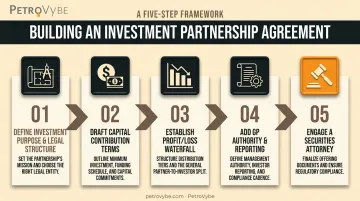
Building an investment partnership agreement isn't a one-afternoon task. Follow these steps in order:
- Define the investment purpose and legal structure. Decide whether an LP, LLC, or joint venture fits the asset class and investor count. Real estate syndications and oil and gas development programs typically use an LP structure.
- Draft capital contribution and ownership terms. Set minimum investment thresholds (accredited investor private placements in oil and gas development commonly start at $100,000 or higher) and specify how additional capital calls will work.
- Establish the profit/loss allocation and distribution waterfall. Set target return metrics benchmarked against the asset's actual risk profile. An oil and gas development deal carries different risk and return assumptions than a stabilized real estate acquisition, and the waterfall should reflect that.
- Add GP authority, investor rights, and reporting cadence. Balance operational flexibility for the GP against meaningful oversight rights for LPs, including audit access and consent thresholds for major decisions.
- Engage a securities attorney. Confirm compliance with SEC Regulation D and applicable state Blue Sky laws. Most capital-raising investment partnerships require a Private Placement Memorandum (PPM) alongside the agreement itself, and Rule 506(c) offerings require verified accredited investor status before any solicitation.
Skipping step five is the most common mistake sponsors make, and often the most expensive one.
Types of Investment Partnerships
Not every investment partnership uses the same legal vehicle. The right choice depends on the asset class and how many investors are involved.
- Limited Partnership (LP): The most common structure for real estate syndications, private equity funds, and oil and gas development programs. One or more GPs manage; LPs contribute capital passively.
- Joint Ventures: Two or more parties co-investing directly in a specific asset or project. Common in oil and gas working interest arrangements where each party holds a direct operating stake.
- Direct Participation Programs (DPPs) / Working Interest Partnerships: Unique to natural resource investing. Investors hold a direct working interest, which enables specialized tax treatment (including Intangible Drilling Cost deductions) unavailable in typical LP or securities structures.
This distinction carries real weight for investors: FINRA (Financial Industry Regulatory Authority) classifies DPPs by their flow-through tax treatment rather than by legal form, which explains why the tax mechanics differ from a standard LP fund.
Tax Considerations and Benefits of Investment Partnerships
Investment partnerships generally use pass-through taxation. The partnership itself doesn't pay federal income tax; profits and losses flow to individual partners via Schedule K-1, and each partner reports their share on their personal return.
For natural resource partnerships specifically, the agreement should spell out exactly how items like depletion and Intangible Drilling Costs (IDCs) get allocated. These special allocations can meaningfully change an investor's after-tax return.
The IRS's Oil and Gas Audit Technique Guide confirms that IDC deductions are governed by specific capitalization elections and eligibility rules, not a blanket deduction available to every investor in every deal.
Here's where the structure matters. A standard LP's passive losses are usually restricted to offsetting passive income only. PetroVybe's natural gas development partnerships pass through IDC deductions that can apply against active income, including W-2 earnings and capital gains, a meaningful distinction for high-income earners.
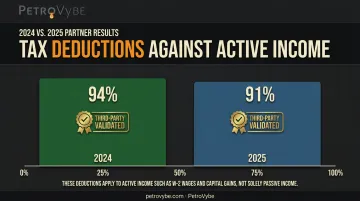
PetroVybe partners received a 94% tax deduction against active income in 2024 and a 91% tax deduction in 2025, with both figures backed by third-party validation rather than internal reporting alone.
Investors considering a similar structure should ask their sponsor how much of the deduction is realized in year one versus spread over subsequent years, then confirm those numbers against the offering's PPM rather than a marketing summary.
Accredited investors curious about how this applies to their own tax situation can explore the structure directly with PetroVybe's team.
Advantages and Disadvantages of Investment Partnerships for Investors
Every structure has trade-offs, so weigh them honestly before signing.
Advantages:
- Passive income potential without day-to-day management responsibility
- Diversification beyond stocks, bonds, and public real estate
- Access to institutional-grade deals typically reserved for insiders
- Tax-advantaged structures in sectors like oil and gas development
Disadvantages:
- Illiquidity from long lock-up periods, often five to ten years
- Heavy reliance on the GP's track record and operational expertise
- Limited investor control over day-to-day decisions
- Returns tied to variables like commodity pricing or market conditions that no agreement can fully control
Before signing anything, vet the GP's actual track record by requesting third-party validation such as engineering reports and audited financials. Confirm the sponsor's reporting cadence matches what they've promised, since a five-minute call rarely reveals what a signed audit opinion or an independent reserve report will.
Frequently Asked Questions
What are 5 things that should be included in a partnership agreement?
Every agreement needs capital contribution and ownership terms, profit/loss distribution rules, partner authority provisions, exit and dissolution terms, and a dispute resolution clause. Skipping any of these leaves room for disagreement later.
Can you invest in a partnership?
Yes. Individuals, particularly accredited investors, can invest as limited partners by contributing capital in exchange for a passive ownership stake and pro-rata returns, without taking on management responsibilities.
What's the difference between a general partner and a limited partner?
The GP actively manages the investment and typically carries unlimited liability for partnership obligations. The LP contributes capital passively and generally has liability limited to their investment amount.
Do investment partnerships file separate business taxes?
No. Partnerships use pass-through taxation, meaning profits and losses flow to individual partners via K-1 forms rather than the entity paying tax directly.
How much capital is typically needed to invest in a private investment partnership?
Minimums vary widely by sponsor and asset class. PetroVybe's oil and gas partnership units, for example, require a $100,000 minimum investment per unit, with exact terms set by the deal's Form D filing and PPM.
What happens if I want to exit an investment partnership early?
Exit terms are governed by the agreement's buyout and withdrawal clause. Early exit may involve valuation discounts, remaining lock-up restrictions, or requiring consent from the GP or other LPs.