

Layer on the 3.8% Net Investment Income Tax above $200,000 (single) or $250,000 (joint) MAGI, the 0.9% Additional Medicare Tax, and phase-outs on Roth contributions and the Qualified Business Income deduction. A six-figure tax bill becomes normal for high earners long before eight figures of net worth.
Most high earners already max out their 401(k) and HSA. They still write enormous checks every April. The real leverage sits in strategies most articles barely mention: real estate loss harvesting, capital gains deferral, and direct-participation investments like oil and gas working interests. This guide covers the foundational moves first, then the advanced plays, including a close look at one of the least-discussed deductions available to accredited investors: Intangible Drilling Costs.
Key Takeaways
- A steep, non-linear tax curve phases out deductions past $200k-$400k+ income
- Retirement and HSA accounts rarely move the needle past $500k income
- Short-term rentals and Real Estate Professional status offset losses against W-2 income
- Oil and gas working interests offer a rare IRS-approved deduction against active income
- The strongest plans stack multiple levers, not a single deduction
Foundational Tax Moves Every High Earner Should Confirm First
Before chasing advanced strategies, confirm these basics are locked in. They won't transform your tax bill alone, but skipping them leaves real money on the table.
| Limit | 2024 | 2025 |
|---|---|---|
| 401(k)/403(b) elective deferral | $23,000 | $23,500 |
| Age-50 catch-up | $7,500 | $7,500 |
| Section 415(c) total contribution cap | $69,000 | $70,000 |
| HSA self-only / family | $4,150 / $8,300 | $4,300 / $8,550 |
Retirement and HSA Moves
- Mega backdoor Roth: if your plan permits after-tax contributions and in-plan conversions, you can fill the gap between your elective deferral and the total 415(c) ceiling
- HSA contributions: triple tax-advantaged (deductible in, tax-free growth, tax-free qualified withdrawals) and, unlike Roth IRAs, not means-tested by income
- Backdoor Roth IRA: works cleanly if you have no existing pretax IRA balances; otherwise the pro-rata rule taxes part of every conversion
Charitable Bunching and Loss Harvesting
Bunching multiple years of planned donations into a donor-advised fund during a single high-income year concentrates the deduction when it's worth the most. Pair this with systematic tax-loss harvesting throughout the year, not just a December scramble.
These moves are table stakes. They should already be in place before you look at anything below.
Real Estate Tax Strategies to Offset High W-2 Income
Real estate remains the most accessible way to generate losses that offset active income, if you structure it correctly.
The Short-Term Rental Loophole
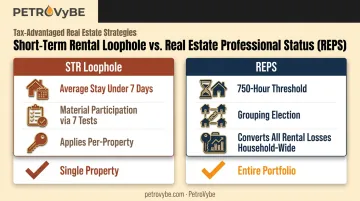
A property with an average guest stay of 7 days or less (or 30 days or less with significant personal services) falls outside the regulatory definition of a rental activity entirely. That distinction matters because it removes the usual passive-loss barrier, but it doesn't automatically make your losses nonpassive.
You still need material participation, satisfied through any of seven tests, including more than 500 hours of involvement or more than 100 hours and more participation than anyone else.
Pair an STR purchase with a cost segregation study and bonus depreciation to front-load deductions. Bonus depreciation ran at 60% for property placed in service in 2024.
Legislation known as the One Big Beautiful Bill restored 100% bonus depreciation for qualified property acquired and placed in service after January 19, 2025, a meaningful reversal of the phase-down schedule.
Real Estate Professional Status (REPS)
If one spouse can log more than 750 hours and more than half their working time in real property trades or businesses, that spouse qualifies as a real estate professional.
This converts all rental losses on the household return from passive to nonpassive, a much bigger lever than the STR loophole alone since it applies across every property, not just short-term stays.
- A grouping election under Treas. Reg. 1.469-9(g) lets a REPS household combine multiple rental properties, including syndications, into one activity to meet material participation
- The election is filed with the original return and generally can't be revoked without a material change in facts
- Without it, each property must independently clear the material participation bar, a steep requirement for larger portfolios
Caution: The IRS has successfully challenged REPS and STR claims where hour logs were thin or after-the-fact. Courts have denied losses in cases like Sezonov and Bailey where taxpayers couldn't substantiate their hours. These strategies require real cash, real time, and documentation that would survive an audit.
Capital Gains and Investment Tax Strategies
If your wealth sits in concentrated stock or you're facing a large capital event, timing and deferral tools matter as much as deductions.
Diversifying Concentrated Positions
- 1031 exchanges defer gain on real property held for investment, provided you identify replacement property within 45 days and close within 180
- 1045 exchanges let you roll gain from Qualified Small Business Stock held over 6 months into new QSBS within 60 days
- Exchange funds pool concentrated stock (think RSUs) with other investors' shares under Section 721, typically requiring a 7-year hold before redemption into a diversified basket
Charitable Trusts and QSBS Exclusions
A Charitable Remainder Trust works well for donors holding highly appreciated assets who want fixed income for life, an immediate partial deduction, and a legacy gift. The payout must fall between 5% and 50% annually, and the remainder to charity must equal at least 10% of the initial contribution.
Section 1202 QSBS remains one of the biggest wins available to founders and early investors. Stock held more than 5 years in a qualifying C-corp can exclude the greater of $10 million or 10 times basis from tax entirely.
Stock acquired after July 4, 2025 gets even more flexible: tiered exclusions of 50%, 75%, and 100% apply after 3, 4, and 5 years, with the asset ceiling raised to $75 million.
Capital gains can also be offset directly. Intangible drilling cost deductions from direct energy investments, the structure PetroVybe uses, can shelter 90%+ of active income, including capital gains, in the same tax year.
Timing and Liquidity Strategies
Borrowing against appreciated stock through a securities-backed line of credit lets you access cash without triggering a sale. Falling collateral values, however, can force a margin call and an unplanned taxable event.
Timing works just as well without any borrowing risk. Deferring a bonus, an ISO exercise, or an asset sale into a lower-income year avoids stacking gains on top of NIIT and AMT thresholds you'd otherwise trigger.
Accredited Investor Strategies: Oil & Gas Working Interests and the IDC Deduction
This is where most high-earner tax planning stops short, and where it shouldn't.
How Intangible Drilling Costs Work
Intangible Drilling Costs (IDCs), meaning labor, fuel, site prep, and other non-salvageable expenses tied to drilling a well, can typically be deducted in the year incurred under IRC Section 263(c). Industry data from IPAA puts IDCs at roughly 60% to 90% of total well development cost, with the higher end common in shale and exploratory drilling.
Separately, IRC Section 469(c)(3) treats a genuine working interest in an oil or gas property as nonpassive. Losses can offset active income, including W-2 wages and capital gains, without a material participation requirement.
The catch: this treatment generally applies only when your liability for that interest isn't capped through an LLC or limited partnership wrapper. Structure matters here, so every deal's documentation should be reviewed by your own CPA against the specific entity terms.
Where PetroVybe Fits
PetroVybe offers accredited investors direct participation in natural gas development projects across South Texas and the Gulf Coast Basin, built around this IDC mechanism. In practice, PetroVybe partners have seen first-year deductions land in the 91% to 94% range against active income across the 2024 and 2025 project vintages, driven by the concentration of IDCs in new drilling budgets.

A $100,000 investment structured this way can generate a deduction well into six figures in year one, taken in full or spread across five tax years depending on the K-1 structure.
Why the Timing Matters Now
Natural gas is becoming the go-to fuel for new electricity generation as AI data centers scale. The International Energy Agency projects data-center electricity demand will more than double, from roughly 415 TWh in 2024 to over 945 TWh by 2030. Natural gas and coal together will cover more than 40% of that added demand. Early-stage natural gas working interests combine a front-loaded tax benefit with a demand tailwind that didn't exist five years ago.
The Risk Side
Working interests carry genuine operational, commodity-price, and dry-hole risk. Before committing capital to any operator, including PetroVybe, request:
- Third-party reserve engineering reports (PetroVybe's flagship project cites a $48 million PV-09 valuation from an independent engineering firm)
- The operator's track record on well location selection and production forecasting
- A clean, current independent audit of the fund's financials
Business Owner and State Residency Tax Strategies
If you own a pass-through business, entity structure and residency planning add another layer of savings on top of everything above.
S-Corp Elections and QBI
Electing S-corp status lets you split income between reasonable W-2 wages and distributions, reducing self-employment tax exposure compared to a sole proprietorship. Layer the Qualified Business Income deduction on top for additional savings:
- Excludes up to 20% of qualifying pass-through income from taxable income
- Phases in for specified service businesses between $191,950 and $241,950 of taxable income (single, 2024)
- Applies in full below those thresholds regardless of business type
The PTET Workaround
State taxes offer a similar opportunity: the Pass-Through Entity Tax election lets S-corps and partnerships pay state income tax at the entity level rather than the individual level, sidestepping the federal $10,000 SALT deduction cap for owners. As of 2025, this election is available in 38 states plus New York City, and it's one of the few ways left to fully deduct state taxes on a federal return.
Residency Planning
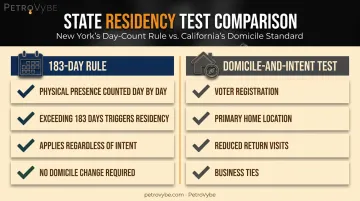
- The 183-day rule is a common trigger for statutory residency in high-tax states like New York
- Moving requires more than a mailing address change: voter registration, a genuine primary home, reduced return visits, and business ties should all shift
- California uses a stricter domicile-and-intent test rather than a simple day count, so documentation needs to be airtight
Frequently Asked Questions
How can high income earners reduce taxes?
High earners combine maximized retirement and HSA contributions with real estate losses, capital gains deferral, and accredited investments like oil and gas working interests to materially lower taxable income. No single move does the job alone.
What is the most overlooked tax break?
The Intangible Drilling Cost deduction and the Short-Term Rental loophole are both underused, largely because most CPAs don't specialize in either and most taxpayers never hear about them.
What is the best tax strategy for high wage earners over $250,000?
There isn't one universal answer. The right approach layers foundational moves with one or two higher-impact levers, such as REPS or an oil and gas working interest, matched to your cash, time, and risk tolerance.
What is the Intangible Drilling Cost (IDC) deduction and who qualifies?
IDCs are drilling-related expenses deductible against active income for those holding a genuine working interest in an oil or gas project. This is typically available to accredited investors in drilling development partnerships.
Is real estate the only way to offset W-2 income?
No. STR and REPS are the best-known levers, but oil and gas working interests are one of the few other IRS-recognized ways to offset active income without a material participation requirement.
How much can accredited investors deduct through oil and gas investments?
Deduction percentages vary by project and operator. PetroVybe's 2024 and 2025 partner results, for example, landed in the 91% to 94% range against active income in the first year.