

That delayed start comes with a silver lining problem: a high tax bracket. Without the right mix of tax-advantaged accounts, diversified funds, and alternative assets, a big chunk of a doctor's income simply evaporates to taxes instead of compounding.
This guide breaks down the best investments and strategies for physicians, built around a compressed timeline, a demanding tax bracket, and a schedule that leaves little room for active portfolio management.
Key Takeaways
- Invest at least 20% of gross income, prioritizing tax-advantaged retirement accounts first.
- Key building blocks: 401(k)/403(b) plans, backdoor Roth IRAs, HSAs, index funds, real estate, and alternative assets.
- Oil and gas development investments enable first-year deductions against active W-2 income, unlike most passive real estate losses.
- Avoid delaying investments or over-relying on commission-based advisors—both cost as much as poor fund picks.
Why Doctors Need a Tailored Investment Approach
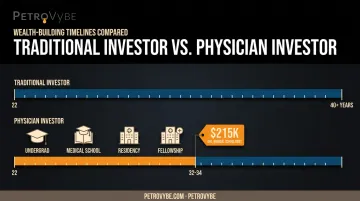
Most financial advice assumes a saver starts contributing in their early 20s and lets compound growth do the heavy lifting over 40-plus years. Physicians don't get that runway.
Between undergrad, medical school, residency, and often a fellowship, doctors typically don't reach full attending income until their early-to-mid 30s. The Association of American Medical Colleges reports median medical school debt of $215,000 for the class of 2025, a balance many carry well into their first attending years.
That combination, a decade-late start plus substantial debt, means the standard "save 15-20% of income" rule needs adjustment. Physicians often need to:
- Invest a higher percentage of income once earnings stabilize, to make up for lost compounding years
- Prioritize tax efficiency aggressively, since a higher bracket makes every deduction worth more
- Automate decisions given limited time for active portfolio management
There's also an education gap worth naming. Many physicians work with a financial advisor, but that isn't the same as having a documented, goal-based investment plan. Many doctors are paying for guidance without a clear strategy behind it.
Best Investments and Strategies for Doctors
The categories below were selected for tax efficiency, liquidity fit, risk-adjusted return potential, and how much ongoing attention they demand from a busy clinical schedule.
Tax-Advantaged Retirement Accounts (401(k), Backdoor Roth IRA, HSA)
These accounts form the foundation of physician investing. They come with decades of tax-deferred or tax-free growth, employer matching (free money), and in many states, creditor protection that shields assets from lawsuits.
What makes them stand out for high earners specifically:
- Employer match is an immediate, guaranteed return no other investment can promise
- Backdoor and Mega Backdoor Roth strategies let physicians who exceed Roth income limits still access tax-free growth
- HSAs offer a rare triple tax advantage: pre-tax contributions, tax-free growth, and tax-free withdrawals for qualified medical expenses
| Feature | Details |
|---|---|
| Tax Treatment | Pre-tax growth (401k/Traditional) or tax-free growth (Roth); HSA offers triple tax advantage |
| Contribution Limits (2026) | $24,500 employee 401(k)/403(b) deferral, $72,000 combined employer+employee cap, $7,500 IRA limit, $4,400/$8,750 HSA (self/family) |
| Liquidity | Locked until retirement age; early withdrawals typically trigger penalties |
Direct Roth contributions phase out between $153,000-$168,000 (single) and $242,000-$252,000 (married filing jointly) in 2026, income levels most attendings exceed quickly. That's exactly why the backdoor Roth workaround matters so much for this profession.
Low-Cost Index Funds & Taxable Brokerage Accounts
Once retirement accounts are maxed out, broad-market index funds become the "set it and forget it" core of a physician's portfolio. These funds track benchmarks like the S&P 500 rather than trying to beat them, and that passive approach keeps costs low.
According to Fidelity's S&P 500 average return data through December 2025, the index averaged 11.0% annually over the past 20 years and 10.4% over 30 years. Past performance doesn't guarantee future results, but the long-term trend is hard to ignore.
| Feature | Details |
|---|---|
| Risk Level | Moderate to high, depending on stock/bond allocation |
| Tax Treatment | Subject to capital gains and dividend taxes; enables tax-loss harvesting |
| Liquidity | Highly liquid; tradable any market day |
Index equity funds also carry dramatically lower fees than actively managed alternatives, an important detail given how much fees compound against you over a 20-30 year career.
Real Estate (Rental Properties & Syndications)
Real estate appeals to doctors because it produces cash flow and appreciation outside the stock market, plus meaningful tax benefits through depreciation. Direct ownership, though, comes with 2 a.m. maintenance calls that don't mix well with clinic hours.
That's where syndications come in. Pooling capital with other investors provides access to institutional-grade properties (apartment complexes, medical office buildings) without landlord duties.
| Feature | Details |
|---|---|
| Risk Level | Moderate; depends on property market and sponsor track record |
| Tax Benefits | Depreciation, cost segregation, potential Section 1031 exchange deferral |
| Liquidity | Low; capital is typically committed for years, and the SEC cautions that private placements can require an indefinite holding period |
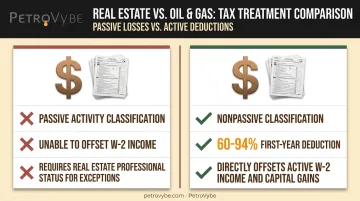
One caveat: rental losses are generally treated as passive under IRS rules, meaning they usually can't offset W-2 income the way some marketing materials imply. Read the fine print before assuming a deduction will hit your active income.
Natural Gas & Oil Development Investments (Alternative Assets)
Energy development remains one of the most underused alternative asset classes among physician-investors, largely because access has historically been reserved for institutions and industry insiders.
Companies like PetroVybe now give accredited investors direct equity participation in early-stage natural gas development projects. PetroVybe's flagship project sits on a 58,000-acre basin in Lavaca County, Texas, combining roughly 400 acquired producing wells with more than 57 planned new wells, backed by a $48 million third-party engineered reserve valuation.
The standout advantage for high-income physicians is the Intangible Drilling Cost (IDC) deduction. Unlike most passive real estate losses, a working interest held without limited liability protection can qualify as nonpassive, meaning the deduction can offset active W-2 income and capital gains in year one.
| Feature | Details |
|---|---|
| Tax Advantage | First-year IDC deductions of 60-94% of invested capital against active income (PetroVybe partners saw 91-94% in 2024-2025) |
| Target Returns | 10-year MOIC target of ~2.2x-5.8x; ~26% targeted IRR |
| Liquidity/Risk | Illiquid; limited to accredited investors; geological risk is mitigated through independent, third-party engineering validation |
This isn't a fit for every physician. It requires accredited status ($200,000+ individual income or $1 million+ net worth excluding primary residence) and a genuine tolerance for illiquidity, since capital is typically committed for a decade.
For a doctor in the top tax bracket with capital gains to offset, though, it can be one of the few investments where the tax mechanics work directly in their favor.
Practice Ownership or Medical Business Equity
Buying into a practice, surgery center, or medical business converts clinical income into ownership equity. It's one of the only investments where a physician's own clinical expertise directly drives the asset's value.
| Feature | Details |
|---|---|
| Risk Level | High; dependent on practice management, patient demographics, partnership terms |
| Capital Required | Substantial upfront buy-in, often financed or structured as a multi-year buyout |
| Liquidity | Very low; tied to tenure and the practice's buy-sell agreement |
A common structure: a fifth partner buying into a practice valued at $2 million might pay $400,000 outright, through reduced compensation over several years, or via a bank-financed installment plan. There's no universal formula: valuation depends on tangible assets, receivables, and goodwill, so an independent appraisal matters before signing.
How to Choose the Right Mix for Your Situation
There's no single "correct" portfolio for every physician. The right allocation depends on four factors:
- Tax bracket - Higher earners benefit disproportionately from deductions like IDC write-offs or maxed-out retirement contributions, since each dollar deducted is worth more at a higher marginal rate.
- Liquidity needs and time horizon - Money you'll need within 5 years shouldn't sit in illiquid syndications or energy development positions.
- Risk tolerance and involvement level - Busy physicians often gravitate toward passive vehicles (index funds, syndications) over hands-on options like rental properties or practice ownership.
- Accredited investor status - Meeting SEC income or net worth thresholds opens doors to private real estate and energy development deals unavailable to the general public.
A reasonable framework follows three steps:
- Max out tax-advantaged accounts first.
- Build a diversified index fund base second.
- Layer in real estate or energy development based on your tax situation and appetite for illiquidity.
Common Investing Mistakes Physicians Should Avoid
Even high earners lose money to avoidable errors. Watch for these:
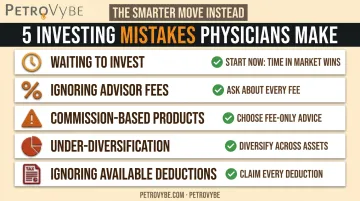
- Waiting until loans are paid off to start investing. Every year on the sidelines costs compound growth that's nearly impossible to recover later in a career.
- Trusting an advisor without understanding fees. A $100,000 portfolio growing 4% annually nets $208,000 after 20 years at a 0.25% fee, compared to $179,000 at 1.00%.
- Scrutinizing commission-based products. Whole life insurance and non-traded REITs often carry 9-10% sales charges that significantly erode returns.
- Under-diversifying. Overweighting real estate or employer stock exposes a portfolio to single-sector downturns; spreading capital across stocks, real estate, and alternatives lowers that risk.
- Ignoring available deductions. The HSA triple tax benefit, backdoor Roth contributions, and IDC deductions on direct energy investments (such as those offered through PetroVybe) all leave real money on the table when skipped.
Conclusion
A strong physician portfolio blends tax-advantaged retirement accounts, diversified index investing, real estate, and alternative assets suited to a high tax bracket. No single vehicle does everything.
Before committing capital anywhere, traditional or alternative, weigh it against three questions: is it tax-efficient for my bracket, does its liquidity match my timeline, and is its risk properly sized?
Natural gas development can check these boxes for many high-income earners. If you're an accredited physician-investor exploring tax-efficient, passive natural gas opportunities, PetroVybe's team can walk through whether it fits your portfolio.
Frequently Asked Questions
What is investing and what is its purpose?
Investing means putting money into assets expected to grow or generate income over time, such as stocks, real estate, or business interests. Its purpose is building wealth beyond what a salary alone can provide.
How much of my income should I invest as a physician?
A common guideline is 20% of gross income, though physicians often need to exceed that given their delayed earnings start. Adjust upward once your income stabilizes to make up for lost years.
What is the best investment for high-income doctors seeking tax deductions?
Start by maximizing retirement accounts (401(k), HSA, backdoor Roth). From there, alternative assets such as PetroVybe's natural gas development partnerships (for accredited investors) can offer deductions of up to 90%+ against active W-2 income.
Are alternative investments like oil and gas development suitable for physicians?
They can suit accredited, high-tax-bracket physicians seeking diversification and tax mitigation, provided they meet minimum investment thresholds (often $100,000+) and are comfortable with illiquidity and operational risk.
Should physicians pay off student loans or invest first?
Low-interest loans can often be paid down gradually while simultaneously investing. Delaying all investing until loans are gone sacrifices early compounding years that are hard to replace.
What accounts should physicians max out before investing elsewhere?
Prioritize your 401(k)/403(b) up to any employer match, then your HSA, then a Backdoor Roth IRA. Only after maxing these should taxable brokerage or alternative investments come into play.