
Many taxpayers struggle to understand why their reported taxable income doesn't match their gross earnings. The gap usually comes down to deductions, adjustments, and pre-tax contributions doing exactly what they're designed to do.
This article breaks down the main reasons taxable income drops, clears up common misconceptions about refunds and audits, and covers strategies high earners use to legally reduce their tax bill.
Key Takeaways
- Taxable income is total earnings minus adjustments, deductions, and exemptions
- Standard or itemized deductions, retirement contributions, and HSAs cut taxable income most often
- High earners and business owners can use investment and business deductions beyond standard retirement accounts
- A low taxable income usually signals effective tax planning, not a financial problem
What Exactly Is Taxable Income (And Why It's Not the Same as Your Salary)
Your paycheck shows gross income. The IRS taxes a different figure entirely.
Here's the calculation flow:
- Gross income — wages, 1099 income, interest, dividends, and more
- Adjustments (Schedule 1) — subtracted to get Adjusted Gross Income (AGI)
- Standard or itemized deduction — subtracted from AGI to get taxable income
Say you earned $90,000 in wages, contributed $8,000 to a 401(k), and claimed the $16,100 standard deduction (single filer, 2026 figures). Your AGI drops to $82,000, and your taxable income lands at $65,900, nearly 27% below your gross pay.

That's not an error. It's how the IRS defines adjusted gross income: gross income minus specific adjustments, then reduced further by your deduction.
A low taxable income doesn't mean you made no money. It usually means your deductions and adjustments worked as intended, lowering the base amount the IRS actually taxes.
Top Reasons Your Taxable Income Is Lower Than Expected
Several common mechanisms shrink taxable income—often more than people expect. These are the usual drivers.
Deductions: Standard vs. Itemized
The standard deduction rose again for 2026: $16,100 for single filers and $32,200 for married filing jointly, per the IRS's 2026 inflation adjustments. Higher standard deductions mean more filers see lower taxable income without doing anything extra.
If you itemize instead, mortgage interest, medical expenses above a threshold, and charitable donations can push your deduction even higher.
Pre-Tax Retirement and Health Accounts
These reduce AGI before your deduction is even applied:
- Traditional 401(k): $24,500 employee deferral limit for 2026 (plus catch-up for age 50+); Roth 401(k) does not reduce AGI
- Traditional IRA: Contributions can reduce AGI up to the annual limit; Roth IRA contributions do not
- HSA: $4,400 self-only, $8,750 family coverage
- FSA: $3,400 salary-reduction limit
Max the pre-tax options and taxable income can drop by tens of thousands of dollars before deductions even enter the picture.

Credits Are Different — and Often Confused
Tax credits (Child Tax Credit, Saver's Credit, education credits) reduce the tax you owe, not your taxable income. This trips up a lot of filers. A $2,000 credit does not lower taxable income by $2,000; it cuts your final bill dollar-for-dollar.
Losses and Life Changes
- Capital losses offset gains, plus up to $3,000 of ordinary income annually (excess carries forward)
- Business losses from self-employment can offset other income
- Job loss or reduced hours directly shrink the income you report
New dependents mainly affect credits and filing status, not the income figure itself.
Investment-Related Write-Offs
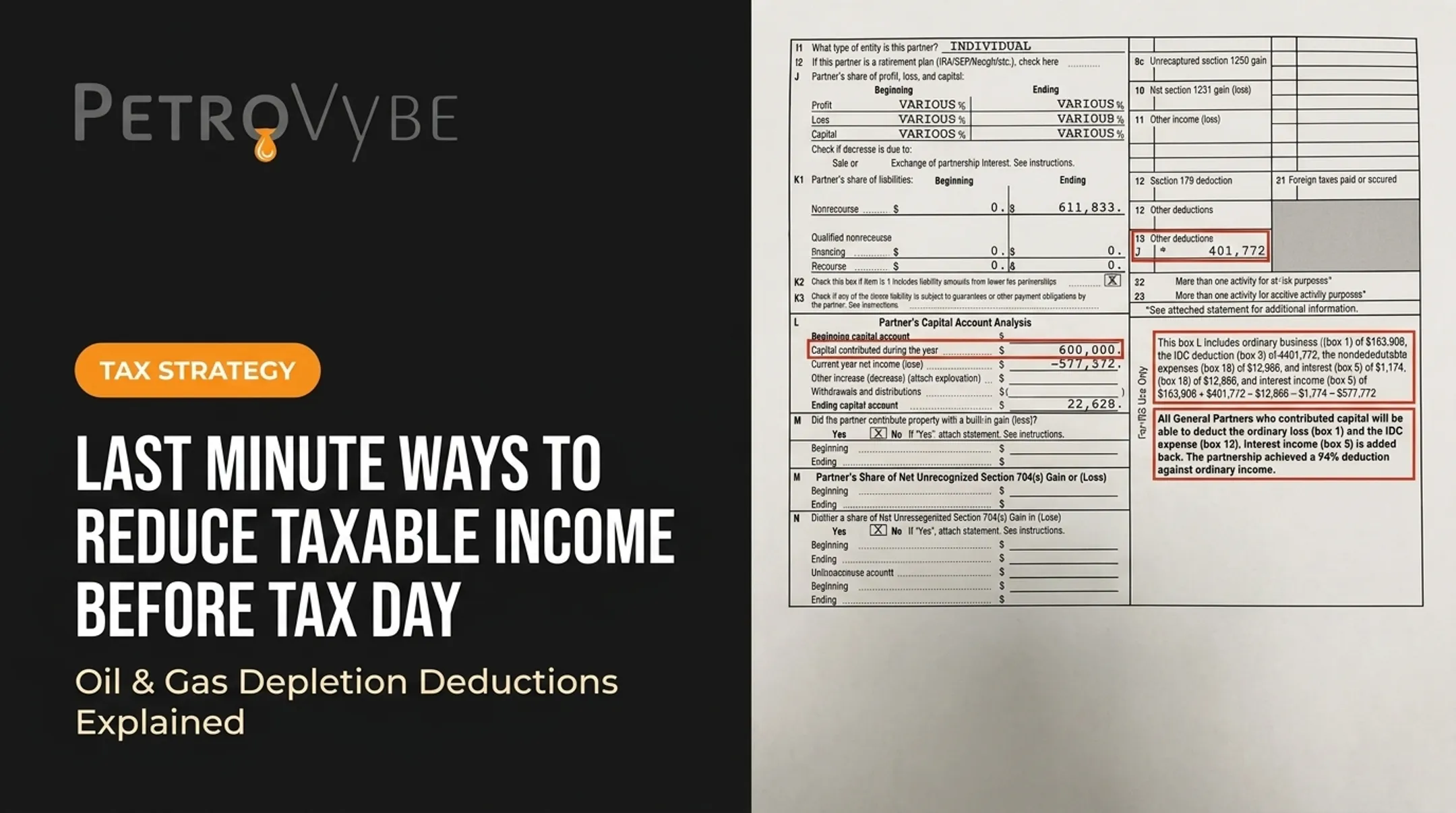
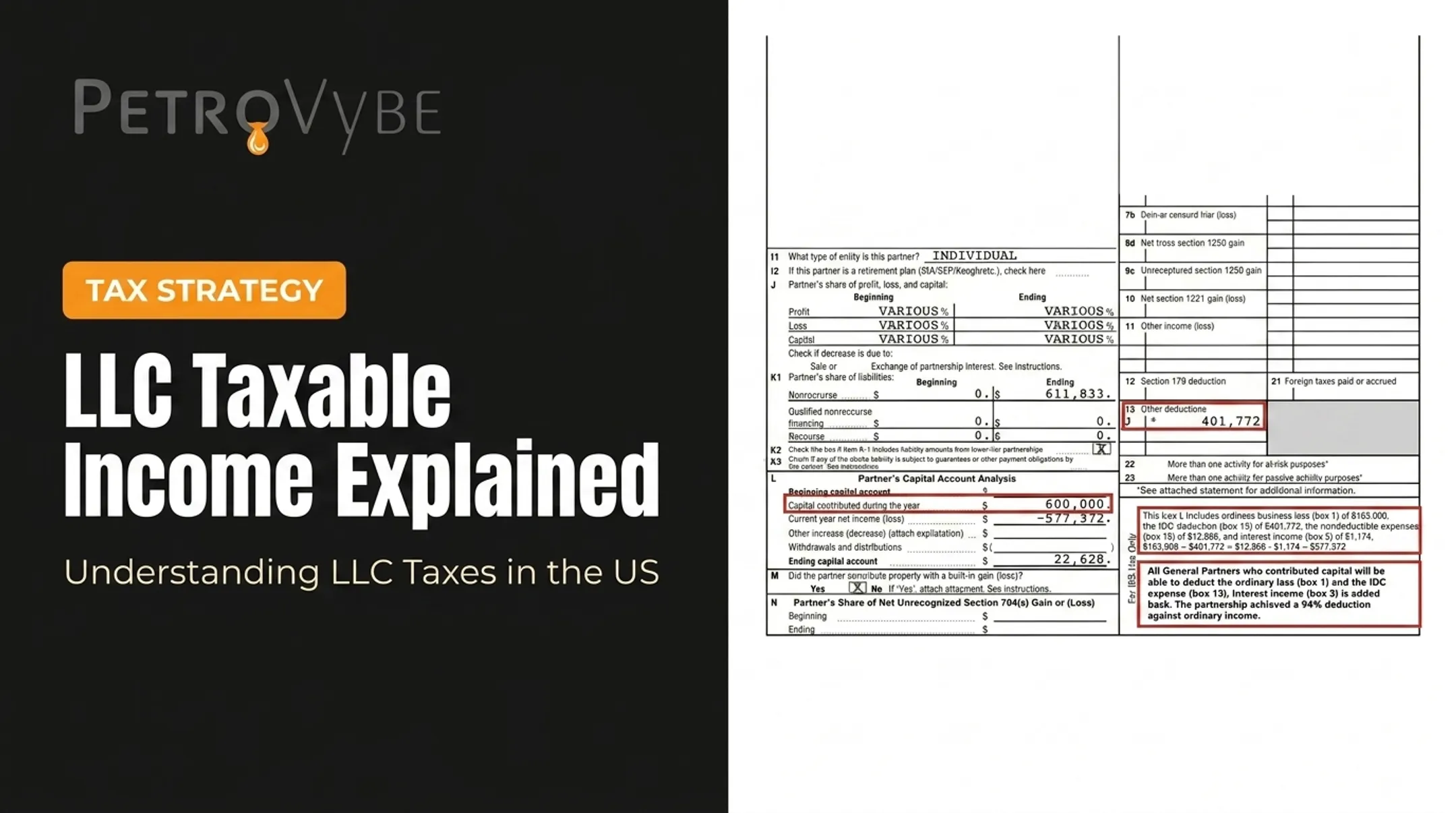
Some investments create large current-year deductions that show up as a much lower taxable income line. Direct oil and gas participation, for example, can generate intangible drilling cost (IDC) and depletion allowances that offset active income such as W-2 wages or capital gains for qualifying investors. When those deductions are sizable, taxable income can look surprisingly low even if cash earnings felt strong.
Advanced Deduction Strategies High-Income Earners Use to Legally Minimize Taxable Income
W-2 earners with big tax bills often exhaust the usual playbook — max 401(k), max HSA, itemize — and still owe a lot. Active-income deductions are the next lever.
Intangible Drilling Costs (IDC): A Deduction That Hits Active Income
Under IRC 263(c), taxpayers can deduct qualifying intangible drilling and development costs for oil and gas wells instead of capitalizing them. According to the IRS Oil & Gas Audit Technique Guide, qualifying costs include wages, fuel, repairs, and other necessary development expenses. The election is made in the year those costs are incurred.
What makes this different from typical real estate or fund deductions:
- IRC 469(c)(3) excludes a working interest in oil or gas from standard passive-activity treatment
- The deduction can offset W-2 wages and capital gains in the same tax year, not only passive income

How This Looks in Practice
PetroVybe structures direct working-interest participation in Texas natural gas drilling projects for accredited investors. The company reports that 2024 partners received a 94% first-year tax deduction against active income, and 2025 partners saw 91%, applicable against W-2 earnings and capital gains.
These figures reflect PetroVybe's own reported partner outcomes, not guaranteed results for every investor.
Important eligibility notes:
- Requires accredited investor status (generally $200,000+ individual income or $1 million+ net worth, excluding primary residence)
- Typically offered under SEC Regulation D Rule 506(c), with third-party verification through a CPA, tax attorney, or licensed advisor
- Suitability depends on your facts — have a tax professional review your situation before committing capital
It isn't right for every investor. For high earners carrying a large active-income tax burden, though, IDC is one of the few IRS-recognized deductions that can reach beyond passive-income limits.
Is a Low Taxable Income Actually a Bad Thing?
Short answer: usually not.
A low or zero taxable income is often the direct result of effective planning: maxed retirement accounts, smart deduction timing, or legitimate business losses. It's not inherently a red flag.
On audit risk: The IRS itself notes that audit selection doesn't always suggest wrongdoing. Selection often comes from random screening or computer-based methods, not from the mere fact that your taxable income dropped.
When it is worth a second look:
- If the drop stems from an unwanted income loss (layoff, business downturn)
- If deductions are being claimed without proper documentation
- If you're unsure whether a strategy was executed correctly
Otherwise, a low number on line 15 of your 1040 is often just proof the tax code worked in your favor.
Why Your Tax Refund Might Be Low Even If Your Taxable Income Dropped
Lower taxable income and a bigger refund are not the same thing. Many filers expect them to move together—and they often don't.
Your refund is simply the gap between what was withheld all year and what you actually owed. If your employer withheld less, or you adjusted your W-4, you can still owe a balance or receive a smaller refund even when taxable income fell.
Other factors that affect your refund independent of taxable income:
- Filing status changes (for example, married filing jointly to separate) that alter brackets and standard deduction amounts
- Tax credits that shrank or expired, cutting dollar-for-dollar reductions to tax owed
- Missed or underpaid estimated taxes if you have self-employment, K-1, or other non-wage income

Use the IRS Tax Withholding Estimator to match paycheck withholding to your expected liability so next year’s refund—or balance due—is intentional, not a surprise.
Frequently Asked Questions
What can lower your taxable income?
Standard or itemized deductions, retirement account contributions, HSA/FSA contributions, and specialized deductions like IDC write-offs for accredited investors in oil and gas development all reduce taxable income.
Why is my tax refund so low?
A low refund often results from adjusted withholding, reduced credits, or life changes during the year. That alone is not a sign anything went wrong with your taxes.
Does a low taxable income increase my audit risk?
No. Legitimate, properly documented deductions and credits don't inherently raise audit risk. The IRS uses random screening and other selection methods unrelated to a low taxable income figure.
Can high-income earners still reduce their taxable income significantly?
Yes. Maxing retirement contributions, tax-loss harvesting, and specialized deductions, such as IDC deductions from direct working-interest energy investments, can meaningfully lower taxable income even at high salary levels.
What's the difference between a tax deduction and a tax credit?
A deduction reduces the income you're taxed on. A credit reduces the tax you owe, dollar-for-dollar. Credits generally deliver more direct savings per dollar.
Is it possible to owe $0 in federal income tax even with a six-figure salary?
Yes, in some cases. Combining pre-tax retirement contributions, deductions, and credits can bring taxable income down substantially, though reaching exactly $0 depends heavily on individual circumstances.