
Investors have noticed. Oil and gas is drawing renewed attention as an inflation hedge and a way to diversify beyond stocks and bonds. But here's the problem: "oil and gas investment platform" means wildly different things depending on who's talking.
A CFD trading app, an energy ETF, and a private drilling partnership all fall under that umbrella. Each carries different risk, liquidity, and tax treatment. This guide breaks down the categories, shows you how to evaluate them, and explains where direct development investing fits for accredited investors.
Key Takeaways
- Match platform type to your time horizon—from short-term trading tools to long-term ownership via ETFs, stocks, or direct partnerships
- Compare liquidity, risk, and tax treatment before you commit; gaps between platform types are large
- Unlock IDC deductions through direct participation that public markets do not offer
- Vet operator track record and third-party validation on every platform, not only private deals
Types of Oil and Gas Investment Platforms
CFD and Futures Trading Platforms
These let traders speculate on Brent or WTI price swings without owning anything physical. Retail CFDs aren't authorized for U.S. traders under CFTC rules governing off-exchange transactions, and most U.S.-facing brokers don't offer them to domestic clients.
What U.S. traders actually use instead:
- CME/NYMEX futures on WTI crude and Henry Hub natural gas, regulated by the CFTC
- Short holding periods with high leverage available on margin
- No ownership stake in any underlying physical asset
ETF and Mutual Fund Platforms
This is the easiest on-ramp for most investors. Buy a ticker, get diversified exposure, sell whenever markets are open.
- XLE (Energy Select Sector SPDR): $42.35 billion in assets, 0.08% expense ratio
- USO (United States Oil Fund): tracks front-month WTI crude futures directly
- XOP (SPDR Oil & Gas Exploration & Production ETF): 0.35% expense ratio, more E&P-focused
Energy mutual funds cover similar sector exposure but typically price once daily at NAV, so they suit less active rebalancing than intraday ETF trades.
Direct Stock Ownership
Buying shares of ExxonMobil, Chevron, or smaller independents through any brokerage app. Simple, liquid, and taxed under standard capital gains rules. No special deductions here — you own equity in a company, not a working interest in a well.
Direct Participation / Private Placement Platforms
This is where accredited investors co-invest directly in drilling and development projects, often structured as limited partnerships under SEC Regulation D. Unlike stocks or ETFs, these interests can support intangible drilling cost (IDC) and depletion deductions against active income, including W2 wages and capital gains.
In 2025, Reg D offerings raised $2.39 trillion total, with non-fund issuers alone accounting for $273.2 billion across 16,960 offerings. Capital here funds specific upstream projects rather than public-market proxies.
Which Platform Fits Which Investor
| Investor Type | Best Fit |
|---|---|
| Short-term trader wanting price exposure | Futures on CME/NYMEX |
| Passive diversifier, wants liquidity | ETFs (XLE, USO, XOP) |
| Long-term buy-and-hold equity investor | Direct stock ownership |
| High-income earner seeking tax efficiency | Direct participation partnerships |

How to Evaluate an Oil and Gas Investment Platform
Before committing capital, run every platform through four checks: regulatory standing, fees, transparency, and track-record fit.
Regulatory Standing
For trading platforms, check SEC and CFTC registration status and NFA membership. For direct development operators, verify state-level licensing. In Texas, that means confirming the operator's license with the Texas Railroad Commission, which oversees drilling permits, well-plugging, and pollution prevention.
Fee and Cost Structure
- Trading platforms: spreads and commissions, usually transparent and quoted upfront
- ETFs: expense ratios (0.08%–0.35% for major energy funds)
- Private placements: carried interest, management fees, and profit-split arrangements; read the PPM closely
Transparency and Reporting
Look for regular production updates, independent investor reviews, and, for direct deals especially, third-party engineering reports. A legitimate reserve valuation follows the SEC's PV-10 standard (present value at a 10% discount rate of future net revenue), calculated under Reg S-X 4-10 rules.
Track Record and Alignment
Verify production growth trends and past project performance where disclosed. Then match the platform to your own liquidity needs and time horizon. A 10-year lockup only makes sense if you don't need that capital sooner.

Direct Participation: Investing Directly in Oil and Gas Development
Direct participation programs (DPPs) put you into a working or operating interest in actual wells, not shares of a company that owns wells. That distinction drives everything else — the tax treatment, the illiquidity, and the return structure.
The IDC Tax Advantage
Under IRC Section 263(c) and Treasury Regulation 1.612-4, taxpayers holding a working interest can elect to deduct Intangible Drilling Costs as a current business expense rather than capitalizing them. These deductions offset active income, including W-2 earnings and capital gains — something no ETF, stock, or mutual fund can offer. Public market instruments give you standard capital gains treatment. Direct participation opens a different tax pathway. PetroVybe, a Texas-based natural gas developer, illustrates this model. Partners in its 2024–2025 programs received 91–94% deductions against active income, driven by IDC and depletion allowances. On a $100,000 investment, that's roughly $94,000 deductible in year one.
Evaluating Returns: MOIC and IRR
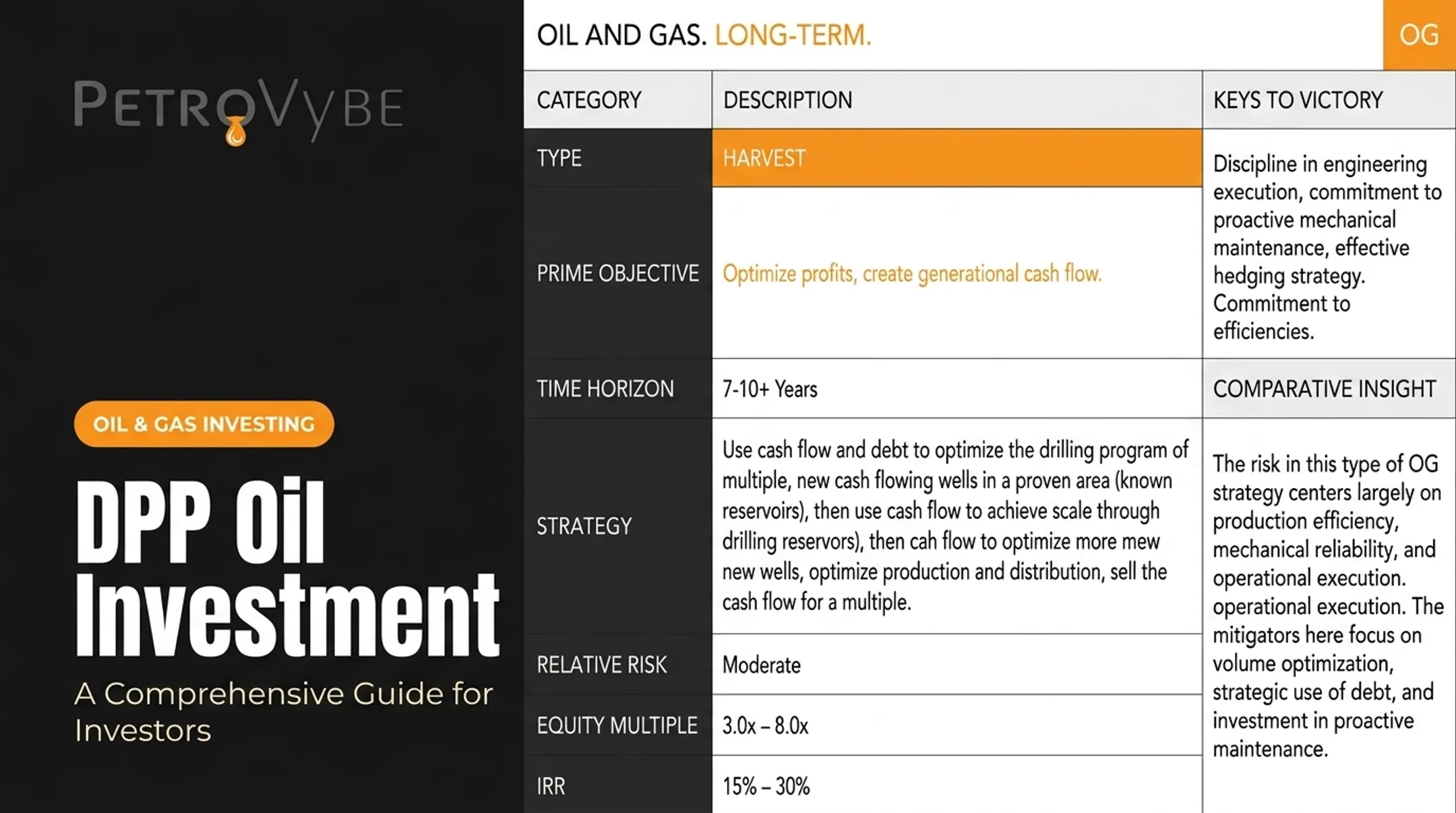
Direct deals are typically underwritten using Multiple on Invested Capital (MOIC) and Internal Rate of Return (IRR) rather than simple share-price appreciation. PetroVybe's model, for example, targets an 80/20 investor profit split and cites a projected MOIC range of roughly 2.2x to 5.8x over a 10-year horizon. PetroVybe operates through PetroVybe ONE in Lavaca County (South Texas/Gulf Coast Basin). Key project facts include:
- Roughly 58,000 acres under development
- About 400 acquired wells, plus 57+ planned new wells
- Technical team with petroleum engineering and geophysics depth in the basin

Third-Party Reserve Validation
Before committing capital to any direct deal, ask for the PV-10 reserve report from a licensed independent engineering firm. PetroVybe, for instance, cites a $48 million PV-09 valuation from a third-party engineering firm as part of its due diligence package. That is the kind of documentation you should expect from any credible operator.
The Illiquidity Trade-Off
Direct participation capital typically stays locked in for years. First distributions in many drilling programs don't arrive until year two or three, once wells reach production. In exchange, investors get equity-style upside and tax benefits public markets do not offer. If you need same-week liquidity, this category is not a fit.
Risks to Understand Across Platforms
Commodity price volatility affects every platform type—only the path differs. WTI crude averaged $77.64 per barrel in 2023 and fell to $65.46 in 2025, per EIA data. Henry Hub natural gas swung between $1.49 and $4.26 per MMBtu over the same window. Traders feel this instantly; direct participants feel it through revenue timing.
Direct participation carries additional risks:
- Geological risk: Exploratory dry-hole rates have historically run near 40%, though experienced teams typically outperform that average.
- Production decline curves: Shale wells often drop sharply early (one Eagle Ford study found a 74% first-year decline, tapering to 19% by year three).
- Liquidity risk: Public instruments sell instantly; private placements lock capital through the full term.

Tax Considerations for Oil and Gas Investors
Public market instruments (stocks, ETFs, CFDs) get standard capital gains and loss treatment. No special deductions, no working-interest election, straightforward reporting.
Direct development investments work differently:
- IDC election under IRC §263(c) can generate substantial first-year deductions against active income
- Percentage depletion offers ongoing tax relief on production revenue
These benefits vary by project and investor situation, so consult a tax professional to confirm your eligibility and the current-year deduction percentage before committing capital.
Frequently Asked Questions
Is there an ETF for oil and gas?
Yes. XLE, USO, and XOP are among the most widely held U.S. energy ETFs. They offer diversified public market exposure, not direct project ownership or IDC tax benefits.
What is the difference between oil trading and oil and gas investing?
Trading means short-term price speculation via futures or CFDs. Investing typically means longer-term ownership through equity, funds, or direct development interests.
Can retail investors access oil and gas development platforms?
Many direct participation programs require accredited investor status under SEC rules, limiting access to those meeting income or net worth thresholds. ETFs and stocks remain open to everyone.
How much capital is needed to start investing in oil and gas?
Futures trading can start with a few hundred dollars. Direct development participation typically requires $100,000 or more in accredited investor liquidity.
What tax benefits are unique to direct oil and gas investment platforms?
Intangible Drilling Cost deductions can offset active income, including W-2 wages and capital gains — a benefit unavailable through standard stock or ETF ownership.
How do I evaluate the credibility of an oil and gas investment platform?
Check regulatory licensing (SEC, CFTC, or state commissions like the Texas Railroad Commission), verified investor reviews, third-party PV-10 engineering reports, and the operator's documented track record.