
This article is general education, not investment, tax, or legal advice. Inflation is sticky, tax bills are heavy, and public markets keep lurching between rallies and gut-checks. If you've felt that squeeze in 2026, you're not imagining it. The Federal Reserve's own June 2026 projections put core PCE inflation at 3.3% for the year, while July's CPI report still showed prices up 3.4% year-over-year.
That backdrop is pushing more investors toward alternatives that can outrun taxes and inflation, not just headline returns. The smartest portfolios in 2026 aren't chasing one hot asset. They're diversifying across risk tiers, from FDIC-insured anchors to accredited-investor-only plays like direct energy development.
This guide ranks the 10 highest-ROI investment options for 2026, from the safest havens to opportunities reserved for qualified investors.
TL;DR
- High ROI means risk-adjusted return potential, not the largest headline percentage
- Rankings run from low-risk anchors (CDs, Treasuries) to higher-risk plays (private equity, natural gas, crypto)
- Accredited investors can access oil and gas development that targets double-digit returns with major tax advantages
- Ideal allocation depends on risk tolerance, time horizon, and liquidity needs
Overview of High ROI Investments in the US Market
A high-ROI investment is an asset offering above-average return potential relative to its risk class. A 5% CD isn't "worse" than a 15% venture fund; they're solving different problems for different investors.
In 2026, more investors are weighing alternatives against traditional fixed income and public equities. Demand for energy assets and other private markets tracks a wider push for inflation hedges and tax efficiency. PitchBook's late-2025 survey found 61% of private equity professionals expect exit opportunities to improve through the year—another sign capital is rotating toward higher-return private deals.
Below is a ranking of the top 10 investment types by return potential, risk profile, and how accessible they actually are to everyday investors versus accredited ones.
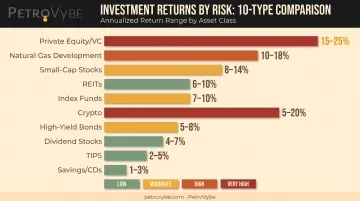
Top 10 High ROI Investments with Highest Returns in 2026
This ranking weighs return potential, risk level, liquidity, and who can actually invest (general public vs. accredited investors only).
1. Private Equity & Venture Capital
Private equity and VC let you invest in companies before they hit public markets, capturing growth that IPO investors often miss. The tradeoff: your money is locked up for years, sometimes a decade.
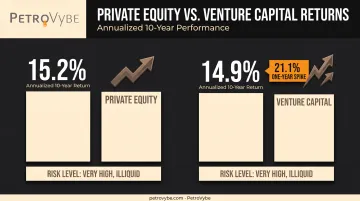
Cambridge Associates' 10-year pooled horizon data through 2025 shows US private equity returning 15.2% annualized and venture capital at 14.9%, net of fees and carry. Venture's one-year number spiked to 21.1%, showing how volatile the asset class can be year to year.
| Metric | Detail |
|---|---|
| Typical Return Range | 12%–25%+ target potential over multi-year hold |
| Risk Level | Very high; illiquid, long lockup periods |
| Best Fit | Accredited investors with diversified capital and patience |
2. PetroVybe Natural Gas Development (Accredited Investor Opportunity)
PetroVybe is a Texas-based natural gas development company giving accredited investors direct positions in early-stage NGL projects across East Texas and Gulf Coast Basins. Its flagship project, PetroVybe ONE, combines roughly 400 already-acquired legacy wells with 57+ planned new wells across a 58,000-acre position in Lavaca County.
What sets it apart is the tax structure.Intangible drilling cost (IDC) deductions apply against active income, meaning W-2 wages and capital gains, not just passive gains buried in other tax shelters. PetroVybe partners realized a in 2025, following a 94% deduction in 2025, and marketing materials describe up to 100% total deduction potential, with roughly 70% typically hitting in year one. Prior result; not a promise of any future deduction. This treatment requires the investor to elect general partner status in the Subscription Agreement and may be limited in a given year by the excess business loss limitation under IRC §461(l).
The company's Chief Geophysicist, Michael Stamatedes, brings a documented 75.2% success rate on well-location selection, well above the sub-40% industry peer average, a track record built over 48 years, much of it before modern seismic technology existed. Disclaimer: these results were achieved at prior companies.
| Metric | Detail |
|---|---|
| Target Returns | 10-year modeled net exit MOIC ~2.2x–5.8x; target IRR ~26% |
| Tax Treatment | IDC deductions usable against active income, not just passive gains |
| Investor Fit | Accredited investors seeking tax-advantaged passive income beyond stocks, bonds, and real estate This treatment requires the investor to elect general partner status in the Subscription Agreement and may be limited in a given year by the excess business loss limitation under IRC §461(l). |

These are forecast targets tied to a 10-year hold, not a guaranteed or realized track record. PetroVybe's independent third-party engineering firm valued proved reserves at $48 million (PV-09, prepared by Lee Keeling & Associates, Tulsa, March 2026) as of its most recent audit.
3. Growth & Small-Cap Stocks
Growth and small-cap stocks offer the highest upside among public equities, but they swing harder in both directions. Tech and biotech names dominate this category.
The numbers back up the volatility concern. S&P Dow Jones data through July 2026 shows the Dow Jones U.S. Small-Cap Total Stock Market Index carrying 20.80% annualized 10-year risk, compared to 15.34% for the S&P 500 large-cap index over the same window.
| Metric | Detail |
|---|---|
| Return Range | 8%–20%+ potential |
| Risk Level | High |
| Liquidity | High, publicly traded |
4. Real Estate Investment Trusts (REITs)
REITs let you own income-producing real estate without landlord headaches. You get dividend income plus a natural inflation hedge, since rents and property values tend to rise alongside prices.
Nareit's data shows publicly traded All Equity REITs posting a 10.94% compound annual return from 1972 through 2025, though the trailing 10-year figure sits closer to 6.17%. Current dividend yields for All Equity REITs stand at 3.56% as of July 2026.
| Metric | Detail |
|---|---|
| Return Range | 4%–10% |
| Risk Level | Moderate |
| Liquidity | High for public REITs |
5. Index Funds & ETFs (S&P 500 Tracking)
Index funds remain the simplest path to instant diversification. Low fees, broad exposure, and decades of consistent performance make them a core holding for most portfolios.
S&P Dow Jones Indices' July 2026 fact sheet reports a 9.41% annualized 10-year price return for the S&P 500. That figure excludes dividends, so total returns including reinvested dividends typically run a couple points higher.
| Metric | Detail |
|---|---|
| Return Range | 6%–10% long-term average |
| Risk Level | Moderate |
| Best Fit | Core long-term portfolio growth |
6. Cryptocurrency
Crypto offers the highest speculative upside on this list, paired with the highest uncertainty. Regulatory clarity is improving. In March 2026, the CFTC joined the SEC in clarifying how federal securities laws apply to crypto assets, and the SEC proposed a new Regulation Crypto Assets framework in August, though it remains a proposal, not final law.
Volatility remains crypto's defining trait. CFTC research comparing Bitcoin and Ethereum against a stock sample found both cryptocurrencies carried the highest average annualized volatility across the periods studied.
| Metric | Detail |
|---|---|
| Return Range | Highly variable, speculative upside |
| Risk Level | Very high |
| Best Fit | Small, risk-tolerant portfolio allocation |
7. Corporate & High-Yield Bonds
High-yield bonds pay more than Treasuries because you're taking on credit risk. The lower an issuer's credit quality, the higher your potential yield, and the higher your potential loss if they default.
The ICE BofA US High Yield Index showed an effective yield of 7.04% as of August 19, 2026, with an option-adjusted spread of 2.75 percentage points over Treasuries.
| Metric | Detail |
|---|---|
| Return Range | 4%–9% |
| Risk Level | Moderate to high |
| Best Fit | Yield-focused investors who can evaluate credit risk |
8. Dividend-Paying Blue-Chip Stocks
Blue-chip dividend payers combine income with steadier price behavior than growth stocks. S&P's research on its Dividend Aristocrats index, companies that have raised dividends for 25+ consecutive years, notes that dividends have contributed roughly 31% of total S&P 500 returns since 1926.
| Metric | Detail |
|---|---|
| Return Range | 2%–8% total return potential |
| Risk Level | Moderate |
| Best Fit | Income-focused, long-term investors |
9. Treasury Inflation-Protected Securities (TIPS)
TIPS adjust their principal with inflation, a rare combination of government backing and built-in inflation protection. As of August 21, 2026, the Treasury's real yield curve showed 2.40% for 10-year TIPS and 3.00% for 30-year TIPS.
| Metric | Detail |
|---|---|
| Return Range | 2%–5% plus inflation adjustment |
| Risk Level | Low |
| Best Fit | Conservative, inflation-aware investors |
10. High-Yield Savings Accounts & CDs
These FDIC-insured products anchor a portfolio's safe side. Bankrate's August 2026 data showed top online savings APYs running 3.85% to 4.10%, with top CD offers reaching as high as 4.50%.
| Metric | Detail |
|---|---|
| Return Range | 3%–5% APY |
| Risk Level | Low |
| Best Fit | Emergency funds and short-term reserves |
How This Guide Selected the Best High ROI Investments
This guide evaluated each option against five criteria:
- Return potential: scored relative to its risk class, not in isolation
- Risk-adjusted performance: historical volatility and drawdown data where available
- Liquidity: how quickly capital can be accessed if plans change
- Minimum capital: amount required to participate
- Accreditation requirements: legal restrictions that limit who can invest
Those filters matter because a common mistake is chasing headline returns without accounting for taxes, inflation, and liquidity constraints. A 12% return that's fully taxable and locked up for a decade can lose to a 6% return that's tax-advantaged and liquid.
For alternative and private investments, this guide also weighted third-party validation, operator track record, and transparency. PetroVybe's independent engineering review and $48 million third-party reserve valuation, for example, carried more weight than unverified return projections alone.
Conclusion
There's no single "best" high-ROI investment in 2026. The right answer depends on your risk tolerance, your timeline, and your tax situation.
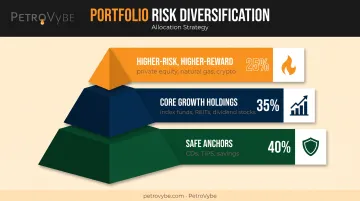
Before committing capital, assess your liquidity needs honestly. Money you'll need in two years shouldn't sit in a 10-year private equity lockup, no matter how attractive the target IRR looks. Then diversify across risk tiers:
- Safe anchors for capital preservation
- Moderate-growth core holdings for steady compounding
- A smaller slice in higher-risk, higher-reward positions
For accredited investors carrying a heavy tax burden and looking to diversify beyond stocks, bonds, and real estate, PetroVybe's natural gas development opportunities combine tax-advantaged passive income with asset-level transparency. Review the opportunity if that profile matches yours.
Frequently Asked Questions
How do I invest $10,000 for a quick return?
True quick, high returns usually mean higher risk and less liquidity. For capital you may need soon, high-yield savings or short-term Treasuries are safer baselines; stocks and alternatives can pay more but may not be "quick."
Where can I get a 20% return on investment?
Targets above 20% typically show up in private equity, venture capital, or accredited-investor opportunities like natural gas development. These come with higher risk, longer lockups, and reduced liquidity compared to public markets.
What investment has the highest ROI?
Private equity, venture capital, and direct energy development often target the highest returns among common asset classes. PE and VC have posted 10-year annualized returns above 14% historically, with higher risk and less liquidity than public markets.
What is the most profitable long-term investment?
Over long horizons, broad index funds have been hard to beat—the S&P 500 posted a 9.41% 10-year annualized price return. Real estate and private energy development can add tax-advantaged growth beside that core holding.
How much will I have if I invest $1,000 a month for 30 years?
At an illustrative 8% average annual return, monthly contributions of $1,000 over 30 years could grow to roughly $1.5 million through compounding. This is an illustrative example only, not a guarantee, since actual market returns vary year to year.
Informational requests only. PetroVybe projects are offered solely to verified accredited investors. Submitting this form does not create an investment or advisory relationship.