This article is general education, not investment, tax, or legal advice. America pumped more crude in 2025 than any nation in history. 13.6 million barrels per day, according to the EIA, edging past the prior record of 13.2 million bpd set just a year earlier. That's roughly 40% above either Russia or Saudi Arabia's individual output.
Meanwhile, something else is happening in the background. AI data centers are eating electricity at a pace grid operators haven't planned for. Natural gas already supplies 40% of US power generation, and that share isn't shrinking anytime soon.
This article breaks down where the oil and gas actually comes from, what's driving 2026 growth, and why accredited investors are paying closer attention to natural gas development right now.
Key Takeaways
- US crude production hit a record 13.6 million bpd in 2025 — about 40% above Russia or Saudi Arabia alone
- The Permian Basin in Texas and New Mexico accounts for nearly 59% of total US output
- EIA forecasts production climbing to 13.7-13.8 million bpd in 2026, reaching 14.2 million bpd by 2027
- Natural gas hit a record 39 trillion cubic feet in 2025, powering 40% of US electricity
- Accredited investors can access early-stage natural gas development positioned for this demand wave
US Oil and Gas Production Heading Into 2026: The Numbers
The headline number is simple: 13.6 million bpd of crude, including lease condensate, produced in 2025. That broke 2024's 13.2 million bpd record, and it happened despite fewer rigs running.
According to EIA data, lower-48 rig counts fell 5% year-over-year while operators drilled 1% fewer wells. Production went up anyway. The gain came from higher well productivity.
Why Output Rose While Drilling Slowed
Operators are getting more oil out of fewer wells through:
- Longer laterals and better completion designs
- Optimized well spacing based on years of Permian data
- Faster drilling cycle times that reduce cost per barrel
Pricing tells its own story. WTI averaged $65.40 per barrel in 2025, but the EIA's August 2026 Short-Term Energy Outlook forecasts $80.88 per barrel for 2026. That's a meaningful swing, and it factors into why operators are staying efficient rather than aggressive on new drilling.
Where Production Heads Next
- 2026 forecast: ~13.7-13.8 million bpd
- 2027 forecast: ~14.2 million bpd
- Natural gas: record 39 Tcf produced in 2025, up more than 4% from 2024
The US has led global oil production since 2018 and natural gas since 2011. It became the world's top LNG exporter in 2023, when exports averaged nearly 12 Bcf/d. That lead is established, and output is still climbing.
Where America's Oil and Gas Actually Comes From
Most Americans assume a chunk of their fuel comes from the Middle East. It doesn't. The US produces roughly 75% of the crude it consumes domestically, and Canada supplies most of the remainder for refining needs.
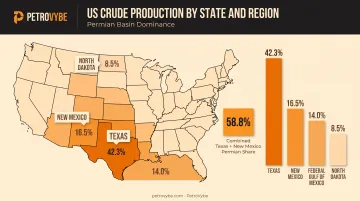
Within the US, oil output is heavily concentrated:
| State/Region | Share of US Production |
|---|---|
| Texas | 42.3% |
| New Mexico | 16.5% |
| Federal Gulf of Mexico | 14.0% |
| North Dakota | 8.5% |
Texas and New Mexico combined supply 58.8% of national crude output, mostly from one shared formation: the Permian Basin.
The Permian's Outsized Role
The Permian alone produces 6.6 million barrels per day (bpd), or 48% of total US crude output. It also drove most of 2025's production growth. Expand to the full Gulf Coast PADD 3 region—including offshore Gulf production—and that share climbs to roughly 74% of national crude.
At 5.75 million bpd, Texas alone produces more oil than most OPEC members. US crude supply is that concentrated.
Natural gas follows a similar pattern. Texas, Pennsylvania, Louisiana, and West Virginia dominate output, with the Permian, Haynesville, and Appalachian basins supplying most dry gas and NGLs that feed power generation and industrial demand.
What's Fueling the Growth: Efficiency and the AI Demand Shock
Two forces are converging right now, and they don't get talked about together often enough.
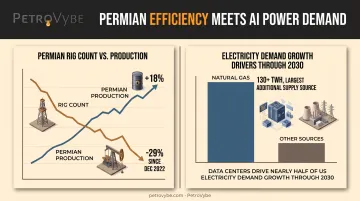
Force one: rig productivity. Total US rig counts have fallen roughly 29% since December 2022, yet Permian oil production rose 18% over a similar window, per EIA analysis. Operators aren't drilling more. They're drilling smarter.
Force two: AI electricity demand. The IEA projects data centers will account for nearly half of US electricity demand growth through 2030. Natural gas is identified as the single largest additional supply source to meet it, adding more than 130 TWh of generation capacity.
The NGL Angle
There's a quieter story running parallel to dry gas growth: natural gas liquids. Producers focused on liquids-rich acreage tend to capture better economics because NGLs:
- Burn cleaner than many liquid fuels
- Price historically between WTI crude and dry natural gas
- Improve margins per unit produced versus dry-gas-only output
PetroVybe develops natural gas and NGL assets across South Texas and the Gulf Coast Basin, with roughly 400 producing wells across 58,000 acres in Lavaca County and 57+ additional wells planned. The electrons powering AI data centers have to come from somewhere, and gas-fired generation is taking a large share of that load.
Risks and Headwinds for 2026 Production
A few factors could still complicate the 2026 production picture.
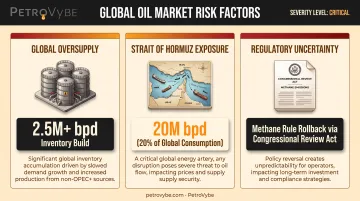
- Global oversupply. EIA data showed global liquids production exceeded consumption through 2025, with inventory builds above 2.5 million bpd in H2—the largest since 2000 outside the pandemic—while Brent averaged $69/b.
- Strait of Hormuz exposure. About 20 million bpd (~20% of global petroleum consumption) moves through this chokepoint, a persistent pricing tail risk even though it does not directly threaten US domestic supply.
- Regulatory uncertainty. Methane compliance deadlines were extended in 2025, and the Waste Emissions Charge rule was rolled back via the Congressional Review Act, so emissions policy remains fluid heading into 2026.
None of these are catastrophic for domestic output. But they're the reason operators lean on efficiency instead of betting everything on price.
Why This Matters for Accredited Investors
Record domestic production, rising electricity demand, and a natural gas market that is becoming structurally more important rarely line up in the same year. That convergence creates a narrow window for accredited investors.
PetroVybe built its investment structure around exactly this convergence:
- Direct access to early-stage natural gas development in South Texas and the Gulf Coast Basin
- Tax-advantaged structure, with partners achieving 94% in 2025, driven by IDC and depletion allowances. Prior result; not a promise of any future deduction.
- Targeted 10-year IRR of ~26%, with a projected MOIC range of 2.2x-5.8x
- Quarterly passive distributions projected to exceed $10,000 at peak production
Before committing capital to any oil and gas opportunity, third-party validation matters. PetroVybe points to a $48 million PV-09 proved-reserves valuation from a licensed third-party engineering firm and a clean 2025 audit from Weaver. Prepared by Lee Keeling & Associates, Tulsa, March 2026.
On the technical side, Chief Geophysicist Michael Stamatedes brings a 48-year track record and a documented 75.2% success rate in well-location selection—well above the sub-40% industry average. Disclaimer: these results were achieved at prior companies.
None of this eliminates risk. Oil and gas development still carries real exposure to commodity prices, drilling outcomes, and regulatory shifts.
For accredited investors who want exposure to the AI-driven electricity buildout without buying volatile energy stocks, direct development participation is a structurally different play.
Frequently Asked Questions
How much oil is the US producing today?
The US produced a record 13.6 million bpd in 2025, and the EIA forecasts production climbing to roughly 13.7–13.8 million bpd in 2026. Growth is coming from efficiency gains, not more drilling.
Where does the US get most of its crude oil?
Roughly 75% of US crude supply is produced domestically. Canada is the largest source of imports, mostly used to meet specific refining needs rather than filling a supply gap.
Which US state produces the most oil?
Texas, by a wide margin. It accounts for 42.3% of national output, driven almost entirely by the Permian Basin, which spans Texas and New Mexico.
Will US oil production keep growing in 2026 and beyond?
Yes. EIA forecasts point to roughly 13.7-13.8 million bpd in 2026 and 14.2 million bpd in 2027, driven by continued rig productivity gains rather than expanded drilling.
How does natural gas production relate to AI and electricity demand?
Natural gas already supplies 40% of US electricity generation. The IEA projects data centers will drive nearly half of electricity demand growth through 2030, with gas as the largest additional supply source.
Is investing in oil and gas development a good option for accredited investors?
It can offer meaningful tax advantages and passive income potential, but outcomes depend heavily on the operator. Look for third-party validated reserves, an experienced technical team, and a transparent track record—criteria operators like PetroVybe build around—before committing capital.
Informational requests only. PetroVybe projects are offered solely to verified accredited investors. Submitting this form does not create an investment or advisory relationship.