
Introduction
One paycheck. One employer. One layoff away from financial chaos.
That's the reality for millions of W-2 professionals, even high earners. Many feel trapped: heavy tax bills eat into income, and a single employer controls their financial future.
The numbers back up the anxiety. In the Federal Reserve's 2025 Economic Well-Being of U.S. Households survey, 30% of adults reported month-to-month income variability, and 11% said that variability made it hard to pay bills.
Add in inflation outpacing wage growth, and looking beyond a single salary for financial stability becomes essential.
This guide breaks down what income diversification actually means, the main types of income streams available, and a practical framework for building multiple revenue sources, including alternative assets most investors never consider.
Key Takeaways
- Diversifying income across uncorrelated sources cuts dependency on any single paycheck
- Active income like salary or freelancing fuels passive income streams such as dividends and royalties
- Self-made millionaires typically build three or more income streams
- Alternative assets, such as direct oil and gas interests, offer tax advantages stocks and rental real estate can't match
What Is Income Diversification?
Income diversification means generating earnings from multiple, uncorrelated sources rather than relying on a single paycheck or revenue channel. Instead of betting your entire financial future on one employer or one business, you build several independent streams of cash flow.
The purpose is straightforward: reduce your exposure to job loss, market downturns, or industry disruption while compounding wealth over the long term. If one stream slows down, others keep the lights on.
This is different from investment diversification, which spreads capital across asset classes (stocks, bonds, real estate) to reduce portfolio risk. The SEC's own guidance on diversification frames it as a way to smooth out fluctuations, not a guarantee against loss.
Income diversification is broader. It's about where the money comes from, not just what you own.
Active Income vs. Passive Income
Active income is a time-for-money trade: salary, hourly wages, freelance work, consulting fees. It's stable and predictable, but capped. You only have so many hours in a day, and once you stop working, the income stops too.
Passive income requires upfront capital or effort, then generates ongoing returns with minimal daily involvement. Think dividends, rental payments, or royalties.
Oil and gas royalty partnerships work the same way: investors in projects like PetroVybe's Texas natural gas developments receive monthly production-based distributions without any day-to-day involvement. Note: IRS Publication 925 defines "passive activity" narrowly, and not everything that feels passive to you qualifies as passive for tax purposes.
A sound diversification strategy blends both:
- Use active income to cover expenses and fund investments
- Reinvest surplus into passive-income assets
- Let compounding do the heavy lifting over years, not months
Types of Income Streams to Diversify Into
Financial professionals typically group income into distinct categories, each with its own risk, effort level, and growth ceiling. Understanding these categories helps you spot gaps in your current setup.
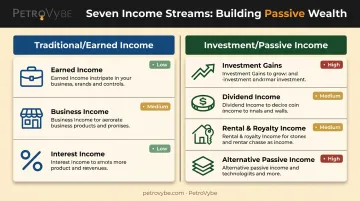
Traditional and Earned Income Streams
- Earned income: Salaries, wages, freelance and consulting fees. Stable, but capped by hours worked.
- Business income: Revenue from operating a company, side hustle, or online store. Higher risk, but far more scalable than a job.
- Interest income: Earnings from savings accounts, CDs, or bonds. Low risk, modest returns that barely keep pace with inflation.
Investment and Passive Income Streams
- Investment income and capital gains: Profits from selling stocks, mutual funds, or appreciated assets
- Dividend income: Regular payouts from dividend-paying stocks or ETFs
- Rental and royalty income: Earnings from real estate, intellectual property, or licensing deals
- Alternative passive income: A growing category that includes natural resource development, such as oil and gas royalties or direct working interests, offering income outside traditional stock and bond markets
The IRS treats each of these differently for tax purposes. You'll typically report rental income on Schedule E, where the agency treats it as passive.
A direct oil and gas working interest works differently: the IRS classifies it as nonpassive, regardless of how hands-off the investor actually is. PetroVybe structures its partnerships around this exact distinction, since nonpassive treatment allows intangible drilling cost deductions to offset active income, including W-2 wages and capital gains.
Why Diversifying Your Income Matters
Relying on one income source means one point of failure. Diversifying cushions you against job loss, economic downturns, or a single investment underperforming.
Multiple streams also stabilize cash flow throughout the year, smoothing out the gaps between one bonus cycle or one client's payment schedule.
A wealth-building pattern backs this up. Financial planner Tom Corley studied self-made millionaires over five years and found that 65% maintained at least three income streams, 45% had four, and 29% had five or more.
That's an observational study of one wealthy cohort, not a controlled experiment proving causation. Still, the pattern is hard to ignore: people who build wealth rarely depend on a single source to do it.
How to Build Multiple Revenue Streams: A Step-by-Step Approach
Building multiple income streams is a deliberate, staged process, not a scramble to chase every opportunity that crosses your feed.
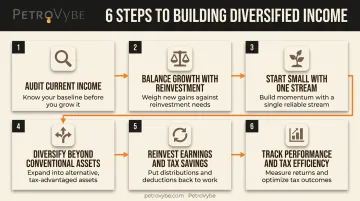
- Audit your current income: map out exactly how exposed you are. If 100% of your income comes from one employer, that's your starting risk profile.
- Balance active income growth with reinvestment: push for raises or side work, but funnel the extra income into passive, income-generating assets instead of lifestyle inflation.
- Start small with one new stream: validate that it actually works before scaling. A side hustle that generates $500/month proves the model before you go all in.
- Diversify beyond conventional assets: stocks, bonds, and rental real estate are a good start, but alternative asset classes can offer non-correlated returns and unique tax treatment unavailable elsewhere. Oil and gas development partnerships are one example — companies like PetroVybe structure deals so accredited investors can offset a large share of active income through intangible drilling cost deductions, a tax treatment stocks and rental property simply can't match.
- Reinvest early earnings and tax savings: use gains from one stream to fund and compound the next, creating a self-sustaining growth cycle.
- Track performance and tax efficiency regularly: cut underperformers and double down on what's actually working.
This is an ongoing rebalancing exercise, not a one-time project. It mirrors how the CFP Board recommends periodic portfolio rebalancing rather than letting any single holding dominate.
Exploring Alternative Investments: Oil & Gas as a Diversification Tool
Accredited investors looking to move beyond public markets increasingly explore private natural gas and oil development. It's a tangible-asset income source that behaves differently than stocks or rental property.
The Tax Advantage Most Investors Miss
Here's what sets direct working interests apart: unlike rental real estate, oil and gas Intangible Drilling Costs (IDCs) are not restricted by passive loss rules. That means qualifying deductions can offset active income, including W-2 wages and capital gains, not just passive income.
This distinction traces back to a 1913 tax code provision designed to incentivize domestic energy exploration. PetroVybe, a Texas-based natural gas development company, structures its projects around this advantage. Partners who joined in 2024 received a 94% tax deduction against active income; that figure was 91% in 2025.
Deductions like this remain subject to at-risk rules, so the exact benefit depends on your individual tax situation. Always confirm specifics with a qualified tax advisor before investing.
Why the Demand Story Matters
AI data centers need electricity at a scale the grid hasn't seen before. The International Energy Agency projects US data-center electricity use will rise by roughly 240 TWh by 2030, with natural gas supplying over 130 TWh of the additional generation required.
That's demand context, not a guaranteed return. But it explains why companies like PetroVybe are positioning natural gas projects in South Texas and the Gulf Coast Basin as long-term infrastructure plays rather than speculative drilling bets.
What Due Diligence Should Look Like
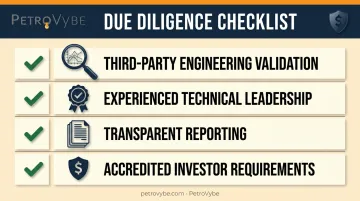
Before committing capital to any alternative income opportunity, verify:
- Third-party engineering validation: PetroVybe's proved reserves carry a $48 million valuation, determined by an independent licensed engineering firm
- Experienced technical leadership: A geophysicist's decades-long track record picking productive well locations matters more than marketing claims
- Transparent reporting: Independent review platforms and public regulatory filings, such as those with the Texas Railroad Commission, let you verify claims outside company materials
- Accredited investor requirements: SEC Rule 501 requires $200,000 individual income (or $300,000 joint) or $1 million net worth excluding your primary residence
The SEC's own investor alert on private oil and gas offerings describes them as speculative and potentially illiquid. Accreditation confirms eligibility, not safety. Do the homework anyway.
Common Mistakes to Avoid When Diversifying Income
Building multiple streams sounds simple. Executing it well is not. Watch for these traps:
- Spreading too thin. Chasing five income streams at once dilutes your focus and can undermine your best-performing source.
- Skipping due diligence. Entering unfamiliar asset classes—such as real estate syndications, private placements, or energy development—without researching risk, tax treatment, and operator track record invites costly surprises.
- Neglecting tax strategy. Missing available deductions, whether Intangible Drilling Cost (IDC) write-offs in energy investments or standard retirement account contributions, leaves money on the table every single year.
The fix for all three is the same: slow down, verify claims independently, and scale only what's already proven to work.
FAQs
What is income diversification?
Income diversification means generating earnings from multiple, uncorrelated sources instead of depending on a single paycheck. The goal is reducing financial risk while building long-term stability.
What are the types of income diversification strategies?
Major categories include earned, business, interest, investment, dividend, rental, royalty, and alternative asset income. Each carries different risk levels, effort requirements, and tax treatment.
How many income streams should I realistically have?
There's no fixed number. Quality and low correlation between streams matter far more than hitting a specific count. Two well-chosen, uncorrelated streams beat five overlapping ones.
How much money do I need to start diversifying my income?
You can start small with freelancing or index funds requiring little capital. Accredited alternative investments, like direct oil and gas working interests, typically require higher minimums, often $100,000 or more.
Is investing in oil and gas a good way to diversify income?
Oil and gas can offer tax-advantaged, passive-style cash flow outside traditional stock and bond markets. Firms like PetroVybe reported first-year deductions of 91-94% against active income for 2024-2025 partners, but the asset class is accredited-investor only, so vet the operator's track record carefully.
What's the difference between income diversification and investment diversification?
Income diversification focuses on varying your earning sources. Investment diversification focuses on spreading capital across asset classes to reduce portfolio risk. They work together, but they're not the same strategy.