This article is general education, not investment, tax, or legal advice. Every gallon of gasoline, every cubic foot of natural gas heating a home, starts the same way: as a discovery buried thousands of feet underground. Someone had to find it, drill for it, and bring it to the surface before it ever reached a pump or a pipeline.
That "someone" operates in what the industry calls upstream. Many people lump oil and gas into one giant industry, missing how upstream, midstream, and downstream serve completely different functions with different risks, equipment, and business models.
This guide breaks down what upstream operations actually involve, the key phases from exploration to production, and why this segment matters more than ever for energy security and investment opportunity.
Key Takeaways
- Exploration, drilling, and production define upstream—where hydrocarbons are found and brought to the surface
- Midstream handles transport and storage; downstream covers refining and retail
- Natural gas liquids (NGLs) gain value as electricity and AI-driven energy demand rise
- Accredited investors can access upstream gas development with meaningful tax advantages
What Is Upstream Oil and Gas Operations?
What Are Upstream Oil and Gas Operations?
Upstream, often called Exploration & Production (E&P), covers the companies, equipment, and processes involved in locating, drilling, and extracting crude oil and natural gas. The EPA draws this boundary clearly: upstream means exploring for, extracting, and producing hydrocarbons, full stop.
This is the riskiest and most capital-intensive part of the value chain. Success depends heavily on geological accuracy before a single barrel comes out of the ground.
The numbers back this up. An EIA exploratory-well dataset from 2010 shows 1,712 of 2,805 wildcat wells succeeded, a 61% success rate with a 39% dry-hole rate nationally. That's a dated national average, not a guarantee for any specific basin or prospect. Individual project success depends heavily on the geoscience team behind it.
Upstream companies range widely in size and structure:
- Major integrated players like Chevron and ConocoPhillips, which handle upstream, midstream, and downstream
- Independent E&P developers focused on specific basins or plays
- Private development companies offering direct project access to accredited investors
Because everything before oil or gas leaves the ground falls under this umbrella, industry veterans sometimes call it the "wellhead economy."
Key Phases of Upstream Operations
Exploration: Finding the Resource
Leasing and land acquisition come first. No physical exploration occurs until an operator secures legal rights to the mineral estate.
Once rights are in place, geologists map subsurface structures with seismic, gravity, and magnetic surveys to identify hydrocarbon potential. Reflection seismic sends energy into the ground and records how it bounces back, building an underground picture with sound waves.
Drilling: Accessing the Reservoir
Modern drilling looks nothing like the vertical shafts of a century ago. By 2021, 81% of all US well completions were horizontal or directional, according to EIA data. Horizontal drilling paired with hydraulic fracturing unlocked reserves that were previously inaccessible or uneconomical.
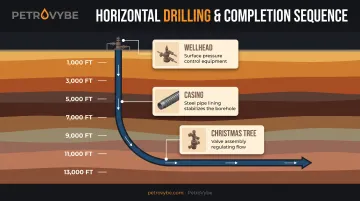
Once a well reaches target depth, completion begins:
- Casing — steel pipe lines the wellbore for structural integrity
- Wellhead — the surface equipment controlling pressure
- Christmas Tree — the valve assembly regulating flow once production starts
Production: Extracting and Processing
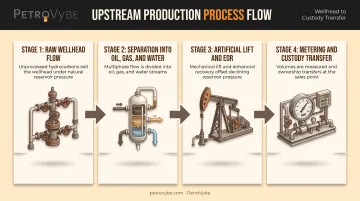
Raw wellhead flow isn't sellable as-is. Separator vessels split the stream into oil, gas, and water, using a two- or three-phase system depending on the well's fluid mix.
As reservoir pressure naturally declines, operators turn to:
- Artificial lift — rod pumps, gas lift, or electric submersible pumps to keep fluid flowing
- Enhanced oil recovery (EOR) — thermal, gas-injection, or chemical methods to squeeze out additional reserves later in a well's life
Finally, metering and custody transfer mark the handoff point: hydrocarbons are measured and prepared for sale to midstream buyers. This is where upstream's job ends.
Upstream vs. Midstream vs. Downstream: How the Sectors Connect
| Segment | Core Function | Typical Equipment | End Goal |
|---|---|---|---|
| Upstream | Exploration, drilling, production | Seismic tools, rigs, wellheads, separators | Extract hydrocarbons from the ground |
| Midstream | Gathering, transport, storage | Pipelines, tanker trucks, storage tanks | Move product to processing/refining |
| Downstream | Refining, distribution, retail | Refineries, retail pumps | Deliver finished fuels to consumers |
The three segments form one value chain, but risk and return sit in very different places.
Midstream is the bridge: it gathers raw production and moves it to processing plants and refineries. Downstream turns that feedstock into gasoline, diesel, and petrochemicals for the end consumer.
An integrated oil major may operate across all three segments. A well-level investment, by contrast, is exposed almost entirely to upstream risk—geology, drilling execution, and commodity price.
Why Upstream Matters for Today's Energy Landscape
Natural gas demand is shifting for a reason most people haven't connected yet: AI data centers. The IEA projects US data-center electricity consumption will rise about 240 TWh, or 130%, by 2030 from 2024 levels, with data centers accounting for nearly half of total US electricity demand growth through the decade.
Natural gas already supplies close to half of US electricity generation. As that power load grows, gas-focused upstream development sits at the center of how new demand gets met.
The molecules themselves matter too. NGLs such as ethane and propane follow pricing tied to both crude and gas markets, and they burn cleaner than heavier fuel alternatives.
For investors, tax treatment is another reason upstream stands apart from most asset classes:
- Intangible drilling costs (IDCs) can be expensed against active income, including W-2 earnings, not just passive income (IRS Publication 535)
- Percentage depletion, generally 15% of gross income from the property, can add further efficiency for eligible producers. This treatment requires the investor to elect general partner status in the Subscription Agreement and may be limited in a given year by the excess business loss limitation under IRC §461(l).
This is where PetroVybe operates. As a private natural gas development company, PetroVybe gives accredited investors direct access to early-stage upstream projects across a 58,000-acre position in the Gulf Coast Basin in Lavaca County, Texas, combining roughly 400 acquired legacy wells with 57+ planned new wells.
Projects are backed by third-party engineering validation, including a $48 million PV-09 proved-reserves valuation from a licensed engineering firm. Prepared by Lee Keeling & Associates, Tulsa, March 2026. As the company puts it: "AI doesn't run on software alone. It runs on electricity. And electricity increasingly runs on natural gas."
Challenges and Risks in Upstream Development
Geological risk is the first-order threat. A dry hole wastes time and erases capital. Experienced geoscience teams reduce that risk, though never to zero.
PetroVybe points to its Chief Geophysicist's 75.2% career success rate in profitable well-location selection, against an industry peer average the company cites as below 40%. Disclaimer: these results were achieved at prior companies.
Beyond geology, operators face:
- Regulatory compliance — permitting, environmental standards, and state oil and gas commissions like the Texas Railroad Commission govern nearly every phase
- Capital intensity — EIA's cost study found onshore well costs ranging from $4.9 million to $8.3 million, with completion alone often exceeding half that figure
- Price volatility — WTI crude swung from roughly $39 a barrel in 2020 to nearly $95 in 2022, illustrating how fast project economics can shift
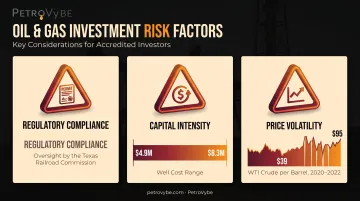
Disciplined risk management, diversified project portfolios, and conservative reserve assumptions matter far more here than in most other asset classes.
Frequently Asked Questions
What are upstream and downstream operations?
Upstream is exploration, drilling, and production—finding and extracting crude oil and natural gas. Downstream is refining, distribution, and retail of finished products like gasoline and diesel.
What is an example of an upstream company?
Major players include ConocoPhillips, Chevron, and EOG Resources. Private developers like PetroVybe also operate in this space, focused on natural gas assets in Texas.
What equipment is used in upstream oil and gas production?
Common equipment includes separators (to split oil, gas, and water), wellheads and Christmas tree valve assemblies, and artificial lift systems like rod pumps or electric submersible pumps.
How long does it take to bring an upstream well into production?
Timelines vary widely by basin and well type. Once a rig is in place, drilling can take up to a month, with another two months typically needed for casing and completion work.
Why is natural gas becoming more important in upstream development?
Rising electricity demand from AI and data centers is pushing gas-fired power generation higher. Natural gas already supplies nearly half of US electricity, so upstream gas development is central to meeting that load growth.
Can individual investors participate in upstream oil and gas projects?
Accredited investors can access direct upstream development opportunities through private operators like PetroVybe, often paired with tax-advantaged structures involving IDC and depletion deductions.
Informational requests only. PetroVybe projects are offered solely to verified accredited investors. Submitting this form does not create an investment or advisory relationship.