For all the interest, most investors get stuck on the same questions. What's the difference between a GP, an LP, and an LLC? How do the tax deductions actually work? And how do you tell a legitimate operator from a sponsor selling a good story?
This guide breaks down partnership structures, tax advantages, real risks, and what to look for when evaluating an operator like PetroVybe before you commit capital.
Key Takeaways
- Direct working interests offer tax deductions no stock, bond, or REIT can match
- Entity choice (individual, LLC, GP, or LP) affects liability exposure, not deduction size
- Intangible drilling cost deductions can offset W-2 wages, 1099 income, and capital gains
- Exploratory drilling carries far more risk than developmental or income-producing programs
- Operator track record and third-party validation matter more than any pitch deck
What Are Oil and Gas Partnerships?
An oil and gas partnership is a pooled investment vehicle. Capital funds drilling or production, and investors receive a working interest or royalty interest in the resulting wells. Most direct offerings are structured as Direct Participation Programs (DPPs), a FINRA-defined category built around flow-through tax treatment, meaning income, losses, and deductions pass straight to investors rather than sitting inside a taxable corporate entity.
Returns come from two separate components that investors often conflate: revenue interest, your share of production revenue, and working interest, your share of costs, which drives your tax deductions.
These percentages are frequently different, and that gap is exactly what allows the IRS-sanctioned deductions covered later in this guide. Because working interest owners are treated as active participants in a trade or business rather than passive shareholders, they gain access to deductions that public stockholders simply can't claim.
Working Interest vs. Royalty Interest
Working interest owners share in both the costs and the revenue. They pay their portion of drilling and operating expenses, and in exchange, they're eligible for intangible drilling cost (IDC) deductions. Royalty or mineral interest owners, by contrast, collect a share of production revenue with no cost exposure and no IDC deductions. A typical deal might carry an 80% working interest paired with a 75% net revenue interest, illustrating the cost-versus-revenue gap that drives those deductions.
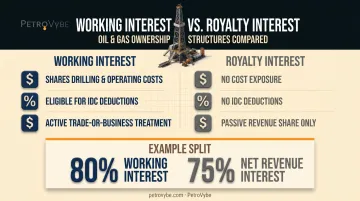
This distinction matters because working interest is the structure most tax-advantaged programs use, including PetroVybe's. It's the only interest type eligible for full IDC deductions against active income.
General Partner vs. Limited Partner
General Partners manage the drilling operation, assume unlimited liability, and often earn additional compensation for that risk. Limited Partners contribute capital, and their liability exposure is generally capped at their investment amount.
Most accredited investors choose the LP or LLC-member route specifically to limit downside risk. However, the tax exception that allows working-interest losses to offset active income under IRC §469(c)(3) applies only to interests held directly or through an entity that doesn't limit the investor's liability for that specific interest.
A standard liability-limiting LLC or LP interest doesn't automatically qualify. Confirming the exact structure with a CPA before wiring funds matters more than most marketing materials suggest.
Types of Oil and Gas Investment Structures
Investors typically face three decisions: how to invest (public versus private), what entity to invest through, and what operational role to take. Each choice shapes liability, reporting, and — in some cases — tax treatment.
Operating vs. Non-Operating Partnerships
Non-operating partners own a share of the working interest without managing drilling or daily field operations. An experienced operator handles that. The trade-off: less technical burden for you, but heavier reliance on due diligence, since your returns depend entirely on someone else's execution.
Operating partners take on that E&P role directly, sourcing leases, managing rigs, and making daily production decisions. Few individual investors choose this route, since it demands technical expertise most partners don't have. PetroVybe structures its limited partnership units as non-operating interests, giving accredited investors exposure to Lavaca County development projects while the operating team handles drilling and production.
Individual vs. LLC Ownership
| Factor | Individual Ownership | LLC Ownership |
|---|---|---|
| Tax reporting | Direct K-1, simpler | Added K-1 layer |
| Liability | Personal exposure | Liability protection |
| Flexibility | Limited | Allocation among multiple members/family |
Both structures can preserve working interest tax treatment. Under Internal Revenue Code §469(c)(3), working interest income and losses aren't automatically classified as passive, but that exception doesn't extend to liability protection the same way. The choice mainly affects liability protection and reporting complexity, so confirm the tax mechanics with your CPA regardless of which entity you use.
Direct Participation vs. Public Energy Stocks
Direct partnership ownership gives you a tangible working interest, IDC and depletion deductions, and a longer, illiquid hold. Public E&P stocks give you liquidity and diversification, but no direct tax pass-through.
PetroVybe's model reflects the direct-participation side of that trade-off: a $100,000 minimum buy-in, a 10-year hold period, and monthly distributions once wells reach production, rather than daily share-price liquidity.
U.S. crude oil production hit a record 13.6 million barrels per day in 2025, up 3% from 2024. Dry natural gas production also set a record at 39 trillion cubic feet, according to EIA data on U.S. energy production. That domestic production boom is why direct participation in specific wells remains a distinct asset class from buying shares in a diversified energy index.
Tax Benefits of Oil and Gas Partnerships
Tax advantages are the primary reason high-income earners and capital-gains investors look at this asset class in the first place. These benefits are written into the tax code deliberately, to incentivize domestic energy development.
Three provisions do most of the work:
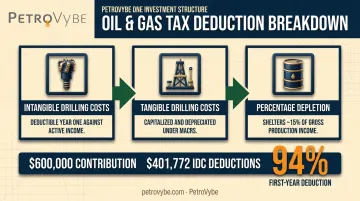
- Intangible Drilling Costs (IDCs): Labor, chemicals, site prep, and drilling mud — items without salvage value that typically make up the bulk of a well's cost. Deductible in the year incurred against active income, including W-2 wages, 1099 income, business income, and capital gains.
- Tangible Drilling Costs: Equipment with salvage value, such as casing, wellheads, and tanks. Capitalized and depreciated over several years under MACRS, adding a second layer of deductions.
- Percentage Depletion: Shelters a portion of gross production income from taxes, generally 15%, subject to IRS limits on taxable income from the property and overall taxpayer income.
Here's what that looks like in practice. PetroVybe's partners achieved a 94% first-year tax deduction against ordinary income in 2024, and 91% in 2025. A redacted K-1 sample from the program shows a $600,000 capital contribution generating $401,772 in IDC-related deductions, a concrete illustration of what "up to 100% deduction" can mean when the numbers actually flow through.
Tax outcomes vary by individual circumstances, entity structure, and how the working interest is legally held. Confirm eligibility with a qualified CPA before committing capital: getting this wrong can turn a promising deduction into one that gets disallowed on audit.
Risks of Oil and Gas Partnerships
No tax-advantaged investment class comes without real risk. The core categories:
- Commodity price volatility: revenue swings with oil and gas prices, which you don't control
- Geological/dry-hole risk means some wells simply don't produce
- Illiquidity locks up capital for years, often with no secondary market for an early exit
- Regulatory and environmental liability: exposure varies by state and project
Beyond these baseline risks, exposure also varies enormously by program type:
| Program Type | Risk Profile |
|---|---|
| Exploratory (wildcat) | Highest: targets undiscovered reserves, no production history |
| Developmental | Moderate: drills near proven reservoirs, but completion and reserve risk remain |
| Income/producing | Lower discovery risk, though decline rates and operating costs dominate instead |
This is exactly why third-party reserve validation and an operator's historical well success rate function as critical risk-mitigation checkpoints. A pitch deck can claim anything. An independent engineering report, like a PV-09 reserve valuation from a licensed third-party firm, can't be talked around.
How to Evaluate and Choose an Oil and Gas Partnership
Before wiring capital, run through these due diligence questions:
- Who is the operator, and what's their track record on prior projects?
- What is their historical drilling success rate compared to industry averages?
- Is there independent third-party engineering validation of reserves?
- How transparent is production reporting — do you get regular updates, or radio silence between K-1s?
- What's the K-1 delivery timeline, and can you reach a real person with questions?
Experienced geology and financial leadership materially affects outcomes, and this is where the gap between operators becomes obvious. PetroVybe's Chief Geophysicist, Michael Stamatedes, has a documented 75.2% well success rate over a 48-year career, compared to a sub-40% industry peer average. That gap matters because location selection directly feeds decline curve calculations and long-term recoverable production estimates.
President and COO Blaine Yeary brings similar scale on the operations side. He previously grew a $5 billion asset from zero to 35,000 barrels of oil equivalent per day in eight years, giving PetroVybe's operational team direct experience at institutional scale.
Third-party trust signals worth confirming before you invest:
- Verified reviews on platforms like Invest Clearly (PetroVybe holds a 5.0 rating across 8 verified reviews, 100% five-star)
- Regulatory operator licensing, such as Texas Railroad Commission status (searchable at rrc.texas.gov)
- Independent PV-09 or PV-10 reserve engineering reports, not just internal projections
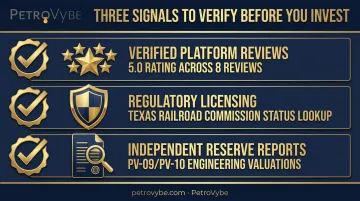
None of these signals guarantee returns. But operators who welcome this level of scrutiny tend to be the ones worth a closer look.
Frequently Asked Questions
What is the riskiest type of oil and gas limited partnership?
Exploratory, or wildcat, drilling partnerships carry the highest risk since they target undiscovered reserves with no production history. Developmental and income-producing programs invest in proven or already-producing wells, which lowers discovery risk considerably.
What is the minimum investment required to join an oil and gas partnership?
Minimums vary by sponsor, though many programs—including PetroVybe—require $100,000 per unit for accredited investors. Confirm current minimums directly with the specific company, since terms change between offerings.
Who qualifies as an accredited investor for oil and gas partnerships?
Under SEC accredited investor rules, you need $200,000+ in individual income (or $300,000 joint) for the past two years, or a net worth over $1 million excluding your primary residence.
How and when do investors receive distributions from an oil and gas partnership?
Distributions typically arrive monthly or quarterly once wells begin producing, based on your revenue interest share, net of operating costs. Timing depends heavily on drilling and completion schedules.
Can I invest in oil and gas partnerships through a self-directed IRA?
Yes, self-directed IRAs can hold working interests, though UBIT (unrelated business income tax) considerations may apply since a working interest counts as an active trade or business. You'll also need a qualified custodian to hold the asset.
How long does it typically take to see returns on an oil and gas partnership investment?
Timelines vary by project, but developmental wells often begin producing within months of completion. Full capital recovery and target returns typically span several years to a decade—PetroVybe's structure, for instance, targets a 10-year hold with a projected 2.2-5.8x MOIC.