

Introduction
Most investors track investment income by watching their bank account. When the deposit arrives, they count it. When it doesn't, they don't. That approach works fine for casual tracking — but it creates a misleading picture of actual portfolio performance, and it can produce real surprises at tax time.
Accrued investment income bridges the gap between when income is earned and when cash actually lands. Under accrual accounting, a bond generates interest every single day, whether or not a coupon check has arrived. A royalty interest produces income when production occurs, not when the operator cuts a check.
For high-income investors managing meaningful tax exposure, understanding accrual is the difference between an accurate picture of total return and a number that flatters your portfolio — until it doesn't.
This guide breaks down what accrued investment income is, how it's recorded, and what it means for your tax position — so you can evaluate performance and obligations accurately, not just when cash clears.
Key Takeaways
- Accrued investment income is earned from investments but not yet received in cash.
- It appears on the balance sheet as a current asset — typically "interest receivable" or "dividends receivable."
- Common sources include bond interest, stock dividends, royalties, and partnership distributions.
- Tax timing depends on your accounting method: accrual-basis taxpayers owe tax when income is earned, not when cash arrives.
- Accurate accrual entries prevent understated income and assets on financial statements.
What Is Accrued Investment Income?
Accrued investment income is income generated by a financial or real asset — such as a bond, stock, or royalty interest — that has been earned during an accounting period but for which cash has not yet been received.
The concept is rooted in accrual accounting: income is recognized when earned, not when collected. This is the foundation of GAAP financial reporting — it reflects economic activity as it occurs, not when cash changes hands.
Balance Sheet Classification
Accrued investment income is recorded as a current asset under ASC 210-10-45, which classifies resources expected to be realized in cash within the normal operating cycle as current. In practice, this means near-term accruals — coupon interest, declared dividends — are normally current, labeled as "interest receivable" or "dividends receivable."
That "normally" carries weight: if collection extends beyond 12 months or the operating cycle, long-term classification may be appropriate. The expected realization period controls the classification, not the label. For active investors, this distinction affects how liquidity and near-term income are read on a balance sheet.
Why It Matters Beyond the Balance Sheet
For investors managing real portfolios, accrued income isn't just an accounting technicality:
- Total return accuracy — A portfolio that earned six months of bond interest before year-end has generated real income, even without a cash deposit.
- Tax planning — Accrual-basis taxpayers may owe taxes on income not yet received. Missing this creates surprises.
- Financial statement integrity — Understated income in one period distorts performance metrics, can mislead stakeholders, and complicates audits.
The NAIC uses the combined line "Investment Income Due and Accrued" for statutory reporting — a classification that treats earned-but-unpaid investment income with the same weight as cash already in hand. For insurers and large institutional holders, the amounts involved are material enough to move reported surplus figures.
Types of Accrued Investment Income
Bond and Fixed-Income Interest
Bond interest accrues daily between scheduled coupon payment dates. A bond paying semi-annual interest doesn't generate income twice a year — it generates income every day. The coupon payment is simply the cash settlement for six months of accumulated accrual.
Per FINRA's accrued interest calculator, interest accrues between scheduled payments using day-count conventions that vary by instrument type: a 360-day year for corporate and municipal bonds, and a 365-day year for government bonds. MSRB Rule G-33 governs the calculation for municipal securities specifically.
Hypothetical example: A bond with a $100,000 face value and a 6% annual coupon pays $3,000 every six months. If your accounting period ends two months into the coupon cycle, you've earned $1,000 in interest (roughly $100,000 × 6% × 2/12). That $1,000 is accrued investment income — it belongs in this period's financials even though the check doesn't arrive until month six.

The governing measurement under ASC 310-20 is the effective-yield (interest) method, not a flat daily allocation. The security's contractual terms and day-count convention control the precise accrual.
Dividend Income
Dividend accounting depends on which side of the transaction you're on. The issuer records its dividend obligation at the declaration date. The investor, under U.S. GAAP, has no single prescribed recognition date — but SEC-registered funds commonly recognize dividend income on the ex-dividend date, as documented in Eaton Vance fund filings.
The practical implication: a dividend declared before your period-end but payable after may or may not be accrued depending on your adopted policy and the applicable recognition date. What matters is applying the same recognition date consistently across periods — switching methods mid-stream creates comparability problems in your financials.
Royalty and Production Income
Investors holding royalty or working interests in oil and gas production accrue income as production occurs — not when the operator distributes cash. SEC filers commonly recognize royalty revenue when products are removed or when control transfers, sometimes estimating monthly royalties from production data and adjusting later when operator statements arrive.
This creates a clear timing gap. PetroVybe's partnership structure illustrates it concretely: December production royalties earned by partners were not distributed until March of the following year — roughly a three-month lag. January royalties followed a four-to-five month processing delay.
Partners receive K-1 tax documents annually reflecting their distributive share of income regardless of when cash distributions arrive.
This isn't unusual. Production volumes must be measured, revenue calculated, expenses reconciled, and funds processed before distributions reach investors. Income is earned when production occurs; cash arrives later.
Other Sources
Additional accrued investment income categories investors may encounter:
- Money market funds: Interest accrues daily but typically settles to your account once a month — meaning your period-end balance reflects more than your last credit
- Notes receivable: Loans and seller-financed arrangements generate interest continuously; accrual tracks what's earned, not what's been collected
- Trust distributions: Income earned by trust assets before distribution is accrued at the trust level, then passed to beneficiaries on distribution
- Partnership income: Partners owe tax on their distributive share of partnership income in the year it's earned — regardless of whether a cash distribution was actually made

How to Record Accrued Investment Income: Step-by-Step
At period-end — month, quarter, or year — any investment income earned but not yet received requires an adjusting journal entry. Skipping this step understates both income and assets.
The Journal Entry
The standard accrual entry uses double-entry bookkeeping:
| Account | Debit | Credit |
|---|---|---|
| Interest Receivable (asset) | $1,000 | — |
| Interest Income (revenue) | — | $1,000 |
Using the bond example above: if $1,000 of interest has accrued through the period-end date, you debit Interest Receivable and credit Interest Income for that amount. The same structure applies to dividends — debit Dividends Receivable, credit Dividend Income.
This entry recognizes the economic reality: you've earned the income even though cash hasn't moved.
When Cash Is Received
When the payment arrives in the next period, a settlement entry clears the receivable:
| Account | Debit | Credit |
|---|---|---|
| Cash | $3,000 | — |
| Interest Receivable | — | $1,000 |
| Interest Income | — | $2,000 |
The $1,000 previously accrued clears through the receivable. The remaining $2,000 represents interest earned in the current period (months three through six in our example) and hits income now. This two-step process prevents double-counting — the $1,000 already recognized in the prior period doesn't flow through income again.
Important terminology note: What's described above is a settlement entry, not necessarily a reversing entry. Some accounting workflows use an optional first-day reversal — debiting Interest Revenue and crediting Interest Receivable at the start of the new period, then recording the full cash receipt as a single current-period income entry. Both work — pick one and apply it consistently across every period.
Why Period-End Cutoffs Matter
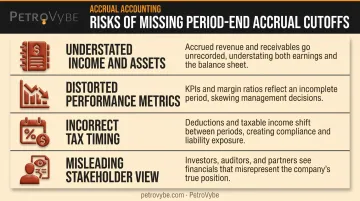
Missing accrual entries at year-end creates real problems:
- Income and assets are understated on financial statements
- Performance metrics are distorted across periods
- Tax filings may reflect incorrect timing of income recognition
- Auditors and stakeholders see a misleading picture of the period's activity
The NAIC investment-income formula captures this mechanically: period interest includes cash collected plus the change in due and accrued interest, adjusted for discount, premium, and purchased interest. Miss the cutoff, and that adjustment tells the wrong story — to regulators, auditors, and investors alike.
Tax Implications of Accrued Investment Income
Timing: Earned vs. Received
Tax timing depends on your accounting method. Under IRS Publication 538:
- Cash-method taxpayers include income when actually or constructively received — book accruals don't create current tax liability.
- Accrual-method taxpayers include income when earned under the all-events test (IRC §451) — meaning the right to receive is fixed and the amount is determinable with reasonable accuracy.
An accrual-basis investor who earned $10,000 of bond interest in December but received cash in January owes tax on that income in December's tax year, not January's.
Tax Treatment by Income Type
| Income Type | General Tax Treatment |
|---|---|
| Taxable bond interest | Ordinary income (IRC §61) |
| Qualified dividends | Net capital gain rates under IRC §1(h)(11), subject to holding period and issuer requirements |
| Municipal bond interest | Generally tax-exempt (verify per instrument) |
| Mineral royalties | Gross income under IRC §61; reported on Schedule E; reduced by depletion and allowable expenses |
IDC Deductions for Direct Participation Investors
Mineral royalties appear in the table above, but oil and gas direct participation investments carry a more powerful tax feature: the ability to expense Intangible Drilling Costs (IDCs). Under IRC §263(c), investors may elect to deduct IDCs — which typically represent 60–80% of invested capital in new drilling projects — rather than capitalize them.
For accredited investors in structures like PetroVybe Partners LP, this deduction flows through the K-1. Crucially, it can offset active income — including W-2 earnings and capital gains — not just passive income. PetroVybe's 2024 and 2025 partner classes achieved 91–94% first-year deductions against active income through this mechanism.
Critical limitation: The active-income offset only applies under specific conditions. Key constraints to verify with a CPA include:
- IRC §469(c)(3) excludes a working interest from passive-activity rules only when held through an entity that does not limit the investor's liability
- A conventional limited-partner interest ordinarily limits liability, which affects the scope of the exception
- IDC deductions also interact with at-risk limitations, AMT rules, and basis requirements
This is not a blanket offset. The specifics depend entirely on how the interest is held and structured. Every investor's interaction of IDC deductions with their full tax picture requires individualized analysis — consult a CPA familiar with oil and gas partnerships before projecting outcomes.
Accrued Investment Income vs. Investment Income Due
These terms are often used interchangeably, but they describe different stages in the income lifecycle.
The clearest distinction comes from NAIC statutory accounting guidance (SSAP No. 34 and INT 20-05):
- Accrued investment income — earned as of the reporting date but not yet legally payable. The payment date hasn't arrived.
- Investment income due — earned and legally payable at the reporting date. The scheduled payment date has passed.

Neither term means the income is overdue or in default. "Past due" applies only when an amount remains uncollected after its due date — a separate condition with separate consequences. Under SSAP No. 34, investment income more than 90 days past due is generally non-admitted for statutory purposes. That rule concerns delinquency, not the standard definitions.
How This Affects Financial Reporting
Under U.S. GAAP, there is no mandatory requirement to split "due" and "accrued" investment income into separate balance sheet line items. Key points for financial statement preparers and reviewers:
- Regulation S-X Rule 5-02 requires relevant receivable categories and separate disclosure when items exceed 5% of total current assets
- NAIC's two-category framework (due vs. accrued) is specific to statutory accounting — not a universal GAAP mandate
- Insurance company filers follow NAIC guidance; most other entities do not have the same bifurcation requirement
When reviewing a balance sheet, the practical question is straightforward: has the payment date passed or not? If yes, the amount is "due" and should be settling soon. If no, it's accrued — earned but still within its normal payment window. Preparers who flag material amounts in each category give readers a clearer picture of near-term cash timing.
Frequently Asked Questions
What is accrued investment income?
Accrued investment income is income earned from investments — such as bond interest, dividends, or royalties — during an accounting period for which cash has not yet been received. Accrual accounting recognizes this income when earned, not when collected.
What is an example of accrued investment income?
A bond that pays semi-annual interest is still generating income daily. If your accounting period ends two months into a six-month coupon cycle, the interest earned during those two months is accrued investment income — earned and recognizable, but not yet paid out.
Is accrued investment income a current asset?
Yes, in most cases. Under ASC 210, accrued investment income expected to be realized within the normal operating cycle — typically 12 months — is classified as a current asset, recorded as "interest receivable" or "dividends receivable."
What is the difference between investment income due and accrued investment income?
Investment income due is legally payable at the reporting date but hasn't been collected yet — the payment date has passed. Accrued investment income is earned but not yet legally payable — the payment date hasn't arrived. Both are receivables, but at different points in the income lifecycle.
How is accrued investment income taxed?
Tax timing depends on your accounting method. Accrual-basis taxpayers generally owe tax in the year income is earned; cash-basis taxpayers owe tax when received. Interest is typically ordinary income; qualified dividends may receive lower capital gains rates.
How do you calculate accrued investment income?
For bond interest: multiply the principal by the annual rate, then by the fraction of the period elapsed (for example, 2/12 for two months of a year) — record that figure as interest receivable. The applicable day-count convention — 360 or 365 days — depends on the instrument type.