The gap matters more than textbook comparisons suggest. Risk tolerance, income needs, tax exposure, and inflation sensitivity all shift depending on which asset class you hold and how much of each. For high-income investors in particular, the decision between equity and fixed income has meaningful consequences that extend well beyond return percentages.
This article covers what equity and fixed income each are, how they compare across key dimensions, and what accredited investors should consider when the traditional binary stops being enough.
Key Takeaways
- Equity = ownership with variable returns; fixed income = lending with contractual payments
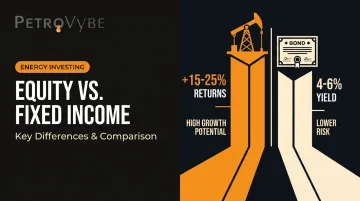
- Long-term return potential is higher with equity; fixed income trades that upside for predictable, contractual income
- The right allocation depends on your risk tolerance, time horizon, and income objectives
- Tax treatment differs significantly — bond interest is taxed as ordinary income, while long-term equity gains qualify for preferential rates
- Accredited investors with high tax liability increasingly use direct energy partnerships — which can generate 91%+ IDC deductions against active W2 income — to reduce tax exposure beyond what stocks or bonds allow
Equity vs. Fixed Income: Quick Comparison
| Dimension | Equity | Fixed Income |
|---|---|---|
| What you're doing | Owning a share of a company | Lending capital to an issuer |
| Primary return type | Capital gains and dividends | Coupon payments and interest |
| Risk level | Higher, variable | Lower, more predictable |
| Income predictability | Variable — not guaranteed | Fixed schedule, contractually set |
| Typical investor profile | Growth-focused, longer time horizon | Income-focused, capital preservation |
| Tax treatment | Long-term gains/qualified dividends taxed at preferential rates | Interest generally taxed as ordinary income |
| Liquidity | Generally high (public markets) | Varies — Treasuries are liquid, some bonds are not |
This table is a starting point. Your actual allocation decision shifts based on income level, tax bracket, time horizon, and whether you're in accumulation or distribution mode. A 35-year-old with high W2 income and a 25-year runway typically tilts equity-heavy, chasing long-term growth. A 62-year-old drawing down a retirement portfolio usually prioritizes predictable income and capital preservation — which is where fixed income earns its place.
What Is Equity?
Buying stock means acquiring partial ownership in a company — a proportional claim on its assets, earnings, and future growth. When the company performs well, shareholders benefit. When it doesn't, they absorb the downside. Equity spans several structures, from individual stocks to diversified funds — each with a different risk and return profile.
Common Stock vs. Preferred Stock
The two main types behave quite differently:
- Common stock — carries voting rights, participates in capital appreciation, and may receive discretionary dividends. Returns depend entirely on company and market performance.
- Preferred stock — pays a fixed dividend with priority over common shareholders, offers no voting rights, and behaves more like a bond in practice.
- ETFs and mutual funds — hold diversified baskets of stocks, reducing company-specific risk without changing the fundamental ownership structure.
How Equity Investors Make Money
Two mechanisms drive equity returns:
- Capital appreciation — the stock price increases over time as the company grows
- Dividends — periodic cash distributions paid at the company's discretion
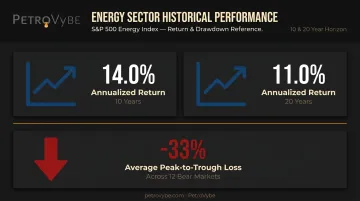
Neither is guaranteed. According to S&P Dow Jones Indices, the S&P 500 delivered 14.0% annualized total returns over 10 years and 11.0% over 20 years — but those figures come with meaningful drawdown risk. Across 12 bear markets since the S&P 500's launch, the average peak-to-trough loss was -33%.
Understanding Equity Risk
Two categories of risk define equity investing:
- Systematic risk — broad market volatility tied to economic conditions. Diversification cannot eliminate this.
- Unsystematic risk — company-specific factors like management decisions or sector disruption. A diversified portfolio can reduce this significantly.
Equity suits investors with a 5+ year time horizon who can ride out downturns without being forced to sell at a loss — prioritizing long-term growth over near-term income stability.
What Is Fixed Income?
Fixed income represents a lending arrangement. You provide capital to a government, corporation, or municipality. In return, the issuer promises periodic interest payments — called coupons — and return of your principal at maturity. The "fixed" part refers to the scheduled cash flow, not the instrument's market value, which can fluctuate.
Types of Fixed Income Instruments
Fixed income instruments range from near-zero default risk to speculative territory:
- Government bonds — lowest default risk, used as market benchmarks
- Corporate bonds — higher yields reflecting issuer credit risk (BBB-rated bonds carry a three-year cumulative default rate of 0.91%; CCC/CC-rated bonds reach 45.67%, per S&P Global)
- Municipal bonds — often federally tax-exempt, attractive for high-bracket investors
- Treasury bills — short-term government instruments
- CDs — bank-issued, FDIC-insured, lowest yield within the category
As of July 14, 2026, Treasury yields ranged from 4.18% at 2 years to 5.08% at 30 years, with the broad U.S. corporate index yielding 5.32%.
Three Core Risks Every Bond Investor Faces
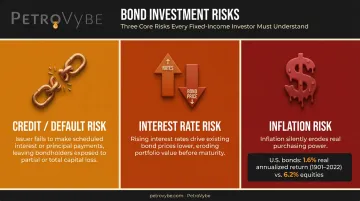
Fixed income is not risk-free. Three risks matter most:
- Credit/default risk — the issuer may fail to make payments on time or in full
- Interest rate risk — when rates rise, existing bond prices fall, and vice versa.
- Inflation risk — fixed coupon payments lose purchasing power when inflation accelerates
That third risk is underappreciated. CFA Institute research shows U.S. bonds returned just 1.6% annualized in real terms from 1901–2022, compared to 6.2% for equities. In high-inflation environments, bond investors can watch their real wealth erode even while receiving coupon payments on schedule.
For investors carrying significant tax burdens or seeking to outpace inflation, fixed income's predictable cash flows come with a real cost: after taxes and inflation, the net return often trails what more growth-oriented alternatives can deliver over a 10-year horizon.
Equity vs. Fixed Income: Which Is Right for You?
The decision comes down to four variables:
- Risk tolerance — how much drawdown can you absorb emotionally and financially?
- Time horizon — when do you need access to this capital?
- Income needs — do you need current cash flow, or are you building for future growth?
- Tax situation — this is where most mainstream comparisons fall short
Situational Guidance
| Your Situation | Lean Toward |
|---|---|
| 10+ year horizon, high risk tolerance, growth focus | Equity-heavy allocation |
| Shorter horizon, capital preservation priority | Fixed income emphasis |
| Nearing retirement, current income needed | Fixed income with some equity |
| Building long-term wealth, can absorb volatility | Equity-heavy with fixed income buffer |
The Tax Dimension
The after-tax return gap between the two asset classes is wider than most comparisons acknowledge.
IRS guidelines for 2025 set ordinary income rates between 10% and 37%, while long-term capital gains and qualified dividends use preferential rates of 0%, 15%, or 20% depending on taxable income. Bond interest is generally taxed as ordinary income — meaning a high-bracket investor paying 37% on coupon income receives far less than the headline yield suggests.
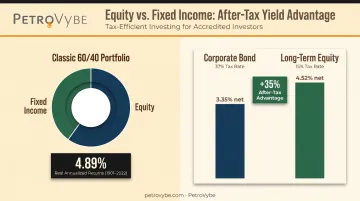
An investor earning 5.32% on corporate bonds at the 37% federal rate nets roughly 3.35% after tax. A long-term equity investor at the 15% capital gains rate nets closer to 4.52% on the same pre-tax return — a 35% improvement in after-tax yield from rate structure alone, before any return differential is factored in.
Why Many Investors Hold Both
That after-tax gap shapes how investors weight their portfolios — but it doesn't resolve the question of whether to hold one or both. Stocks and bonds have historically exhibited low or negative correlation across certain periods, meaning they don't always move together. Combining them can reduce overall portfolio volatility without proportionally reducing returns. The traditional 60/40 framework (60% equities, 40% fixed income) delivered 4.89% annualized real returns from 1901–2022, according to CFA Institute research.
Common allocation frameworks — including age-based heuristics and target-date fund glide paths — use this principle to gradually shift toward fixed income as investors approach retirement.
The Gap Neither Asset Class Fully Addresses
Both equity and traditional fixed income share one vulnerability: during broad market selloffs, their correlation tends to rise. Fixed income also struggles structurally in inflationary environments. For high-income investors already maximizing traditional accounts, this creates a real gap — one that direct participation programs with inflation-linked commodity exposure and front-loaded tax deductions, such as oil and gas IDC structures, are specifically designed to address.
Thinking Beyond the Binary: What Accredited Investors Should Consider
Accredited investors — those with net worth exceeding $1 million excluding their primary residence, or income above $200,000 individually/$300,000 jointly — have access to investment structures unavailable to the general public. Direct participation programs, private placements, and real asset investments represent a third allocation category that can complement a conventional portfolio.
Direct Oil and Gas Investment as a Third Layer
Direct participation in oil and gas development offers structural characteristics unlike anything in a stock or bond portfolio:
- Production revenue scales with energy commodity prices, which tend to rise with the same inflationary forces that erode fixed-rate instruments
- Monthly distributions tied to actual production revenue, not public market sentiment
- Substantial upfront tax deductions through Intangible Drilling Costs (IDCs), applicable against active W2 income and capital gains — not just passive income
That third point is what most investors miss. Real estate deductions are generally restricted to passive income under passive loss rules. The IDC deduction for qualifying oil and gas working interests held directly carries no such restriction. This has been a feature of the U.S. tax code since 1913.
PetroVybe, a Texas-based private oil and gas development company, structures accredited investor participation around these principles. Partners in 2024 received a 91% tax deduction against active income; 2025 partners achieved 94%, both documented via K-1 tax forms.

The company operates development projects in Lavaca County, South Texas, with a third-party proved reserves valuation of $48 million (PV-09). Its chief geophysicist carries a 75.2% career hit rate on well location selection — nearly double the industry peer average of below 40%. Minimum participation is $100,000, limited to verified accredited investors under SEC Regulation D 506(c).
Important Caveats
These characteristics come with risks that stocks and bonds don't carry: drilling risk, commodity price volatility, illiquidity, and concentration. Direct oil and gas investments are not suitable for every accredited investor and are not substitutes for a diversified equity and fixed income foundation. IRS passive activity and at-risk rules apply; individual tax outcomes vary by circumstance. Consulting a qualified tax advisor before committing capital is essential.
Frame it as a third allocation: a complementary layer for investors whose primary concern is reducing tax drag and generating income independent of public market performance.
Frequently Asked Questions
Is a bond fixed income or equity?
A bond is a fixed income instrument, not equity. It represents a lending relationship where the investor receives scheduled interest payments and return of principal at maturity. Bondholders have no ownership stake in the issuing entity.
What is the difference between fixed income and equity?
Equity represents ownership with variable returns tied to company performance. Fixed income represents a contractual lending arrangement with predetermined interest payments. The two differ most sharply in risk level, income predictability, and what legal claim the investor holds against the issuing entity.
Which is better for investors: equity or fixed income?
Neither is universally better. The right choice depends on risk tolerance, time horizon, income needs, and tax situation. Most experienced investors don't choose one exclusively — they size each allocation to match their specific financial position.
Can you hold both equity and fixed income in the same portfolio?
Yes, holding both is standard practice. Combining the two is the foundation of asset allocation strategy, helping investors balance higher-return equity exposure with the stability of fixed income. The 60/40 portfolio is the most common framework built on this principle.
What are the tax implications of equity vs. fixed income investments?
Bond interest is generally taxed as ordinary income at the investor's marginal rate (up to 37% in 2025). Long-term equity gains and qualified dividends are taxed at preferential rates of 0%, 15%, or 20%.
What is the risk profile of equity compared to fixed income?
Equity carries higher risk due to market volatility and the absence of guaranteed returns. Fixed income carries lower but still real risks — including interest rate sensitivity, credit default risk, and inflation erosion. Risk level varies significantly by specific instrument within each category.