Introduction
The decisions you make when setting up a Specialized Investment Fund shape everything that follows. A SIF is a regulated, strategy-specific private investment vehicle designed for accredited or institutional investors — and structural mistakes made at the start are expensive to reverse.
This guide is written for high-income accredited investors, wealth managers, and fund sponsors evaluating SIF structures for sophisticated capital deployment. Getting it right matters: errors in fund documentation or exemption filings can expose sponsors to SEC enforcement, erode investor trust, and undermine long-term returns before a single dollar is deployed.
This guide covers:
- What a SIF is and how it's defined under current regulatory frameworks
- The step-by-step setup process, from entity formation to SEC filings
- The main structural types and which fit which capital strategies
- Key factors that drive complexity and cost
- When a SIF may not be the right vehicle at all
For some accredited investors — particularly those seeking concentrated oil and gas exposure with immediate tax advantages — a direct participation structure achieves the same outcome with fewer administrative layers.
private fund gross assets reached $26.9 trillion in Q3 2025, Private fund gross assets reached $26.9 trillion in Q3 2025 — a 10.5% year-over-year increase — according to the SEC Private Fund Statistics report. That figure signals how much sophisticated capital is already flowing through these structures.
Key Takeaways
- A SIF is a privately structured investment vehicle restricted to accredited or institutional investors, offering more strategic flexibility than registered mutual funds
- US private funds require two separate legal decisions: a Securities Act exemption (Rule 506(b) or 506(c)) and an Investment Company Act exclusion (3(c)(1) or 3(c)(7))
- Core setup steps: define strategy → select legal structure → register exemption → draft fund documents → establish operations → onboard investors
- Oil and gas direct participation programs pass IDC deductions through to partners against active income — including W-2 earnings and capital gains
- Direct investment partnerships offer concentrated, asset-specific exposure with fewer administrative layers than a formal SIF structure
What Is a Specialized Investment Fund (SIF)?
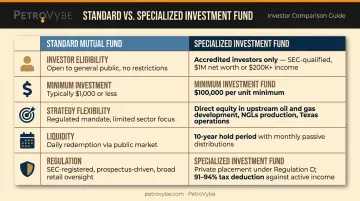
A SIF is a privately structured investment vehicle that pools capital from accredited or institutional investors to deploy a focused, strategy-driven mandate. It differs from publicly registered mutual funds in investor eligibility, strategy flexibility, and regulatory treatment — each of which the table below breaks down directly.
How SIFs Differ from Standard Mutual Funds
| Feature | Standard Mutual Fund | Specialized Investment Fund |
|---|---|---|
| Investor eligibility | Any retail investor | Accredited investors or qualified purchasers |
| Minimum investment | Often $1,000–$5,000 | Typically $50,000–$1M+ |
| Strategy flexibility | Diversification mandates apply | Concentrated, sector-specific strategies permitted |
| Liquidity | Daily redemption (usually) | Defined lock-up periods, quarterly or annual windows |
| Regulation | Full SEC registration required | Operates under exemptions |
The Two-Layer Exemption Structure
"Specialized Investment Fund" isn't a defined US federal category — it describes a privately offered pooled vehicle using two separate exemptions that must be chosen independently:
- Investment Company Act exclusion: either 3(c)(1) (no more than 100 beneficial owners, no public offering) or 3(c)(7) (all investors must be qualified purchasers, no numerical cap under that section)
- Securities Act exemption: either Rule 506(b) (no general solicitation, up to 35 sophisticated non-accredited purchasers) or Rule 506(c) (general solicitation permitted, but every purchaser must be a verified accredited investor)
These decisions aren't administrative formalities — choosing the wrong combination can bar you from the investors you need or expose the fund to registration requirements you weren't prepared to meet. Getting both right is where the setup process begins.
How to Set Up a Specialized Investment Fund: Step-by-Step
The end-to-end process follows a logical sequence: define strategy → select legal structure → register exemption → draft documents → establish operations → launch to investors.
Step 1: Define Your Investment Mandate and Strategy
Before any legal or regulatory work begins, the fund's core mandate must be locked in. Every subsequent decision — entity type, exemption choice, document structure, operational infrastructure — flows from the strategy.
Define these elements upfront:
- Asset class focus (private equity, private credit, real estate, energy, commodities)
- Geographic scope (domestic, international, specific states)
- Risk profile and return targets (income vs. appreciation vs. hybrid)
- Liquidity terms (when investors can redeem capital)
- Investment horizon (3-year fund vs. 10-year closed-end structure)
Strategy clarity serves a dual purpose: it satisfies regulatory expectations and positions the fund to attract the right investors. In a market with $26.9 trillion in gross private fund assets already deployed, differentiation starts with a well-defined mandate.
Step 2: Choose the Right Legal Structure
Most US private funds use one of three vehicles:
- Limited Partnership (LP) — Most common. Favorable tax pass-through, established GP/LP legal precedent, clear governance framework. PetroVybe Partners LP, for example, is structured as a Texas limited partnership with Peter A. Snell serving as Founder, CEO, and Managing Partner.
- Limited Liability Company (LLC) — Flexible governance, fewer formalities, common for smaller funds or single-asset vehicles.
- Statutory Trust — Less common, used in specific asset classes.
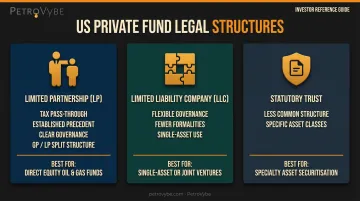
LPs dominate for one reason: the GP/LP structure cleanly separates the sponsor's management authority from investor rights, and tax treatment on distributions is well-established.
Step 3: Register the Regulatory Exemption
Form D must be filed electronically within 15 calendar days after the first sale. The SEC charges no Form D fee, but states where sales occur may require their own notices, fees, and copies — this is called Blue Sky compliance. Rule 506 securities are federally covered, so states cannot require merits review, but they can require notice filings.
Choose your exemption path before building onboarding procedures:
- Rule 506(b) — No general solicitation. Allows up to 35 sophisticated non-accredited purchasers.
- Rule 506(c) — General solicitation permitted. Every purchaser must be a verified accredited investor.
PetroVybe, for example, operates explicitly under Rule 506(c) — which allows broad public marketing of the investment opportunity but requires mandatory third-party accredited investor verification (from a CPA, tax attorney, or licensed financial advisor) before any capital is accepted.
Step 4: Draft the Core Fund Documents
Three documents form the foundation of every private fund offering:
- Private Placement Memorandum (PPM) — Discloses strategy, risks, fees, conflicts of interest, and offering terms. Antifraud and full-disclosure obligations make a PPM the practical standard in every private offering. All material investment decisions should be qualified by its contents.
- Limited Partnership Agreement or Operating Agreement — Governs fund operations, fee structures, capital call mechanics, distribution waterfalls, and investor rights.
- Subscription Agreements — Collects investor representations, eligibility certifications, and capital commitments.
All three require qualified securities counsel. Errors here create lasting liability.
Step 5: Establish Fund Administration and Operations
Once documents are executed, the operational layer needs to be in place before any capital moves. First-time fund sponsors routinely underinvest here — the legal structure gets attention while operations get underfunded.
Required infrastructure includes:
- Fund administrator — handles NAV calculation, investor reporting, and capital account tracking
- Qualified custodian — safekeeps fund assets (requirements vary by adviser registration status)
- Dedicated fund banking and accounting systems — separate accounts, software, and expense tracking
- Compliance protocols — covers ongoing SEC reporting, investor communications, and conflict management
Note: The SEC's 2023 universal private-fund audit rule was vacated in 2024 by the Fifth Circuit. Annual audits are not universally mandated, but they remain a credibility-building practice — particularly for funds seeking institutional capital.
Step 6: Onboard Investors and Launch
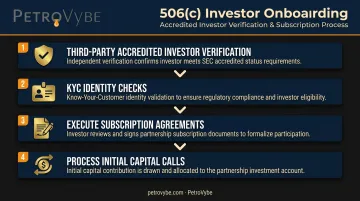
The onboarding sequence for a 506(c) fund:
- Conduct third-party accredited investor verification (income/net worth records, or written confirmation from a registered broker-dealer, SEC-registered investment adviser, attorney, or CPA)
- Complete KYC identity checks (document authenticity, sanctions screening, fraud detection)
- Execute subscription agreements via digital signature
- Process initial capital calls per the LP agreement schedule
For 506(b) funds, verification standards are lower — reasonable belief based on facts and circumstances is sufficient — but general solicitation is prohibited.
Types of Specialized Investment Fund Structures
SIFs fall into three broad structural categories, each suited to different return profiles, risk tolerances, and investor objectives. Understanding these distinctions helps you match the right structure to your capital strategy.
Equity-Oriented SIFs
Funds that concentrate in specific sectors (energy, technology, healthcare) or strategies (long-short equity, value, growth). Typically structured as closed-end vehicles with multi-year investment horizons and defined exit timelines. The GP raises a committed pool, deploys capital over an investment period, then harvests over a harvesting period.
Debt and Private Credit SIFs
Funds that deploy capital into direct lending, mezzanine financing, or distressed debt. These typically target consistent income distributions and lower volatility than equity strategies, making them a natural fit for investors who want predictable cash flow rather than long-term appreciation.
Real Asset and Commodity-Focused SIFs
Funds that invest in physical assets — real estate, infrastructure, or natural resource development (oil, gas, minerals). These structures can offer unique tax advantages:
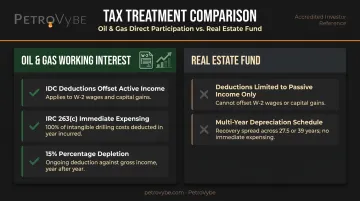
- IRC 263(c) allows qualifying domestic oil and gas IDCs to be expensed immediately — a full deduction in year one rather than multi-year amortization
- Percentage depletion runs at 15% for qualifying independent producers and royalty owners, subject to production and taxable-income limitations
The key distinction from real estate: IDC deductions for qualifying working interests are not restricted to passive income. They can offset active income — including W-2 earnings and capital gains — subject to basis, at-risk, and excess business loss rules. This makes direct oil and gas participation particularly compelling for high-income investors.
Key Factors That Affect the SIF Setup Process
Several variables shape both the complexity and the ongoing cost of operating a private fund:
Structural factors:
- Funds under $10M face proportionally higher per-investor setup costs than larger vehicles
- Investor count and exemption type — 3(c)(1) caps beneficial owners at 100; 3(c)(7) requires every investor to be a qualified purchaser ($5M+ in investments for individuals)
- Geographic investor base — International investors trigger FATCA documentation (W-8BEN for individuals, W-8BEN-E for entities) and potential 30% withholding on US-source income
- Solicitation method — 506(c) permits broader marketing but requires documented third-party verification for every investor
Regulatory thresholds:
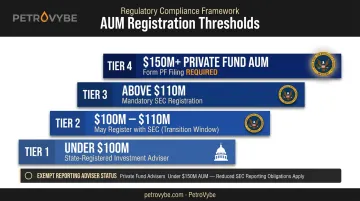
- Advisers with $100M–$110M in regulatory AUM may register with the SEC; registration becomes mandatory above $110M
- Advisers solely managing private funds with less than $150M in US private-fund AUM may qualify as exempt reporting advisers
- Form PF filing applies to SEC-registered advisers with at least $150M in private-fund AUM
- FinCEN's investment adviser AML rule has been postponed to January 1, 2028 — present obligations flow from administrator, bank, and contractual diligence practices
These thresholds interact — and errors at any layer compound quickly. Mistakes in exemption filings, PPM disclosures, or investor onboarding documentation can trigger SEC enforcement action. Experienced securities counsel isn't a line item to cut; it's the difference between a compliant launch and a deficient one that requires expensive remediation.
When a Specialized Investment Fund May Not Be the Right Structure
A full fund structure isn't always the right tool. Three situations where a SIF adds overhead without proportional return:
1. Concentrated single-asset exposure If an investor wants targeted exposure to one specific asset class — particularly one with built-in tax advantages like oil and gas development — the administrative burden of a full fund structure may be unnecessary. Direct participation models can achieve equivalent asset exposure with fewer legal layers and more immediate tax treatment.
PetroVybe's direct participation model illustrates this well. Rather than routing capital through a diversified fund, investors hold limited partnership units in PetroVybe Partners LP — a direct position in Texas natural gas development. IDC deductions pass through via K-1 and apply against active income, including W2 earnings. Documented partner results showed deduction rates of 91% in 2024 and 94% in 2025.
2. Small investor groups When fewer than 10–15 investors are involved, or when capital is concentrated with one or two anchor investors, a simpler LLC or joint venture accomplishes the same objective with fewer legal and administrative requirements. The governance overhead of a full LP structure with formal PPM, fund administrator, and ongoing compliance reporting rarely makes sense at that scale.
3. Structure chosen by default, not by design Sponsors who choose a fund structure before validating investor demand or strategy mandate create administrative burden with no proportional benefit. It's one of the most consistent failure patterns in early-stage fund formation. Validate interest and mandate first. Then select the legal structure that serves those goals.
If any of these scenarios apply, a direct participation structure or simplified LLC may deliver the same economic outcome with significantly less friction. The fund structure conversation is only worth having once the investment thesis and investor base are clearly defined.
Frequently Asked Questions
What is a specialized investment fund?
A SIF is a privately structured investment vehicle restricted to accredited or institutional investors. It allows deployment of focused strategies — private equity, real asset development, long-short equity — under regulatory exemptions that provide more flexibility than publicly registered funds.
What are the types of specialized investment funds?
The main categories are equity-oriented (sector or strategy focused), debt and private credit (direct lending, mezzanine financing), and real asset or commodity funds (real estate, energy, infrastructure). Each carries distinct risk profiles, liquidity terms, and potential tax treatment.
Is a Specialized Investment Fund better than a Systematic Investment Plan?
These serve fundamentally different purposes. SIPs are a disciplined contribution mechanism within standard retail investment accounts. SIFs are sophisticated private vehicles for accredited investors seeking concentrated strategies, higher minimums, and often stronger tax efficiency.
Who qualifies as an eligible investor in a specialized investment fund?
In the US, eligible investors are typically accredited investors (individuals with $200K+ annual income, $300K joint, or $1M+ net worth excluding primary residence) or qualified purchasers ($5M+ in investments for individuals). The applicable threshold depends on which Investment Company Act exclusion the fund uses.
How long does it take to set up a specialized investment fund?
Timeline depends on legal document preparation, fund term negotiation, state Blue Sky filings, and investor sourcing. Entity formation, governing documents, service-provider agreements, and compliance setup typically run in parallel — all must be complete before a first close.
What are the main tax advantages of a specialized investment fund?
Tax treatment depends on the underlying assets. Equity funds are taxed on capital gains timelines. Oil and gas funds can pass through IDC deductions and percentage depletion allowances directly to investors — and for qualifying working interests, IDC deductions can offset active income, not just passive income.