

Introduction
Take a hard look at your last tax return. For high earners, the IRS reports that the top marginal federal rate alone sits at 37% — before state taxes, FICA, and capital gains treatment layer on top. On a $500,000 W2 income, that's $185,000 or more gone before a single investment dollar gets deployed.
Tax cuts address that gap directly. Yet the conversation around them often stays abstract, buried in policy debates and economic models that feel distant from portfolio returns, capital allocation decisions, and estate strategy.
What high-income earners often miss: you don't have to wait for Congress to reduce your tax burden. This article covers how tax policy actually works, what it delivers for investors and businesses, and — more practically — what strategies are available right now to legally reduce what you owe against active income and capital gains.
Key Takeaways
- When income tax rates fall or deductions rise, working families keep more of every paycheck that same pay period
- Lower business taxes freed up capital that drove 8–14% higher corporate investment following 2017 tax reform, per NBER research
- High marginal tax rates suppress entrepreneurship and discourage productive risk-taking at every income level
- Accredited investors can access legal deductions through oil and gas development projects — reducing active income taxes in the year of investment
- The tax code rewards those who understand it — oil and gas IDC deductions can offset W2 income and capital gains in the same year
What Are Tax Cuts and How Do They Work
A tax cut is a reduction in what individuals or businesses owe the government — keeping more money in private hands rather than routing it through government spending programs.
The main types relevant to most households and business owners:
- Marginal rate reductions — lowering the percentage applied to each income bracket
- Standard deduction increases — reducing the amount of income subject to tax before rates even apply
- Tax credits — dollar-for-dollar reductions in tax liability (more powerful than deductions, since they reduce what you owe rather than what's taxed)
- Investment-linked deductions — tied to specific economic activities like capital expenditure, energy development, or hiring; examples include bonus depreciation, Section 179, and Intangible Drilling Cost (IDC) elections

The 2017 Tax Cuts and Jobs Act (TCJA) delivered all of these simultaneously:
- Top individual rate dropped from 39.6% to 37%
- Standard deduction nearly doubled — from $6,350 to $12,000 for single filers and $12,700 to $24,000 for joint filers
- Child Tax Credit increased from $1,000 to $2,000 per qualifying child
- Corporate rate fell permanently from 35% to 21%
Tax cuts matter because they change behavior. When people retain more of what they earn, they spend differently, invest more confidently, and redirect capital toward long-term goals. That shift shows up in household spending data, business investment figures, and employment trends — and it's the foundation for everything discussed in the sections ahead.
Key Advantages of Tax Cuts for the Economy and Working Families
More Take-Home Pay Strengthens Working Family Budgets
The most direct benefit of any tax cut is the simplest one: more money reaches the household.
When marginal rates fall or the standard deduction rises, working families see the difference in their first paycheck after the change takes effect. No delay, no trickle. The Congressional Budget Office found that the TCJA lowered average federal tax rates across all five income quintiles in 2018. The Tax Policy Center estimated that TCJA's individual provisions increased 2018 after-tax income by 1.6% for middle-quintile households.
What do families do with that additional income? The pattern is predictable and consequential:
- Cover rising costs — groceries, fuel, rent, utilities
- Pay down high-interest consumer debt
- Build emergency savings
- Invest in children's education or career development
Federal Reserve data shows that real disposable personal income grew at least 3% in 2018, bolstered by lower personal income taxes, while real consumer spending grew approximately 2.5%. The personal saving rate averaged around 6.5% in Q4 2018 and rose to 7.7% by Q4 2019.
That saving trend matters most during inflationary periods. When purchasing power is already being eroded by rising prices, tax relief functions as a wage increase — without requiring any action from employers. For families squeezed between stagnant wages and climbing costs, that distinction is real.
Business Investment, Job Creation, and Wage Growth
Lower business taxes don't just benefit owners — they change what owners do with capital.
When a business retains more after-tax profit, that money faces a genuine decision point: distribute it, hold it, or put it back to work. Investment-linked tax incentives push that decision toward productive deployment.
A 2024 NBER study estimates that the TCJA raised total tangible corporate investment by 8% to 14%, with an 11% central estimate. That's a significant reallocation of capital toward new equipment, facilities, and expansion. BLS data reported payroll growth averaging 223,000 jobs per month in 2018 and 176,000 in 2019, with unemployment reaching 3.5% by December 2019. Private-industry compensation increased 3.0% during 2018 and 2.7% during 2019.
Not all tax reductions produce the same economic response:
| Type of Tax Reduction | Primary Effect |
|---|---|
| Unrestricted corporate rate cut | Raises returns on existing capital; benefits owners |
| Investment-linked deductions (bonus depreciation, IDCs) | Incentivizes new activity; stronger employment and capex link |
| Pass-through deductions (Section 199A) | Mixed evidence on real investment or employment response |
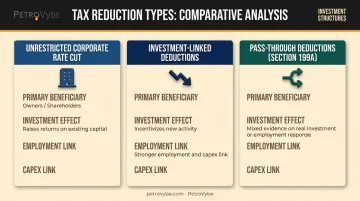
Activity-incentivizing deductions — those tied to specific economic actions like hiring, drilling, or capital expenditure — produce more defensible and broad-based growth effects than profit windfalls alone. The NBER analysis supports this: bonus depreciation delivered roughly half as much capital growth as the corporate rate cut while costing approximately one-third as much in foregone revenue.
Reducing Government Dependency and Restoring Economic Agency
There's a structural benefit to tax cuts that often gets overlooked in the immediate debate about rates and brackets: they shift who makes the economic decisions. When people control more of their income, they make spending and investment choices aligned with their own needs and local realities. Government spending programs make those same choices at scale, with far less precision.
The difference shows up in the data. A Federal Reserve study found that a 1-percentage-point increase in a state's corporate tax rate reduces employment at firms under two years old by 3.7% — a direct hit to entrepreneurship and early-stage economic activity.
NBER research also found that a 1% increase in top earners' net-of-tax income through lower state marginal rates is associated with a 1.8% increase in annual patent counts. A 1% corporate rate reduction correlates with a 2.8% increase. Innovation, in other words, responds to what earners are allowed to keep.
This advantage compounds most significantly for middle and upper-middle income earners — professionals whose incomes are high enough to generate real surplus, but whose financial flexibility is meaningfully constrained by marginal rates above 30–40%. For this group, tax relief doesn't just improve cash flow. It opens the door to capital deployment that would otherwise go to the government — whether that's accelerated debt payoff, direct investment in a business, or a tax-advantaged position in an income-producing asset.
What Happens When Tax Burdens Stay High
High tax burdens don't just reduce take-home pay — they change behavior in ways that slow economic activity across the board.
For working families:
- Reduced disposable income operates as an effective pay cut
- Harder to absorb inflation, build emergency savings, or invest in education
- Intergenerational wealth accumulation slows or stalls entirely
For business owners:
- High marginal rates suppress investment decisions and discourage productive risk-taking
- Capital moves toward tax-avoidance structures rather than domestic economic activity
- Tax Policy Center research estimates that a permanent 10% increase in capital-gains rates reduces realizations by 7–8%, reflecting behavioral shifts in timing, deferral, and asset holding
Most people don't account for the compounding cost of inaction. Families and business owners who don't actively manage their tax exposure lose not just current dollars — they lose a decade of returns on those dollars.
Delaying cost deductions compounds the damage. Inflation and the time value of money erode deferred deductions, making delayed expensing meaningfully more expensive than taking deductions when they're available.
How High-Income Earners Can Reduce Their Tax Burden Right Now
Legislative tax cuts are helpful, but they're passive — and they're slow. High-income earners and accredited investors don't have to wait for Congress to act. Several legal tax reduction mechanisms are available now, through strategic investment.
The IDC Deduction: An Often-Overlooked Legal Strategy
Under IRC Section 263(c), qualifying Intangible Drilling Costs — wages, fuel, engineering services, drilling and fracing costs, drill bit rentals — are fully deductible in the year they're incurred for oil and gas development projects. This provision has been in the tax code since a 1913 amendment, codified at 26 CFR 1.612-4, and continues to serve as one of the most powerful available deductions for high-income earners.
The critical distinction that separates IDC deductions from most other investment-related deductions: they can be applied against active income, including W-2 wages and capital gains (not just passive income).
In real estate, unless an investor qualifies as a full-time real estate professional, deductions are restricted by passive loss rules. They can't touch W-2 earnings or capital gains. Oil and gas IDC deductions carry no such restriction for investors in qualifying structures, making them especially powerful for high-earning professionals with significant active income exposure.
How the Deduction Works in Practice
A qualifying investment typically generates a deduction of 60–80% of invested capital in the year of investment, since IDCs represent the majority of new drilling costs. Investors take the deduction via a K-1 tax form, either in full during the first year or divided equally over five tax years.

Practical illustration:
- $100,000 investment → $60,000–$80,000 deduction against ordinary income
- For an investor in a 37% marginal bracket, that deduction eliminates $22,000–$30,000 in actual tax liability
- That preserved capital — money that would have gone to the IRS — can then be deployed into producing assets generating long-term passive income
PetroVybe's Track Record on IDC Deductions
PetroVybe, a Texas-based natural gas development company, has delivered documented results for its accredited investor partners through this structure. Partners who joined in 2024 received a 91% tax deduction against active income. Partners in 2025 achieved a 94% deduction. These are delivered results, not projections.
One verified investor, Nizar A., reported that his $30,000 tax liability was completely eliminated through PetroVybe's investment structure.
Beyond the deduction, the strategy compounds when tax savings are reinvested into producing assets. PetroVybe ONE, the company's flagship project in Lavaca County, Texas, has delivered the following verified results:
- Proved reserves valuation: $48 million (PV-09, third-party engineered)
- Current operations: 33% EBITDAX positive
- Projected peak distributions: $10,000+/month during production phase
- 10-year target MOIC: approximately 2.2x–5.8x
- Target IRR: approximately 26%
For investors carrying a significant active income tax burden, this structure offers a direct path to reducing liability while gaining a position in a producing energy asset. Participation requires accredited investor status and a minimum $100,000 investment. For a personalized tax deduction illustration, contact PetroVybe at info@petrovybe.com.
Conclusion
Tax cuts work because they return economic decision-making to the people closest to the need. Families stretch budgets further. Business owners invest more confidently. Communities grow from the bottom up, not from redistribution trickling down.
The compounding nature of that advantage is what makes it matter over time. Capital retained and deployed — through savings, business investment, real assets, or strategic deductions (such as IDC write-offs in energy development) — builds on itself. The difference between a 25% and a 37% effective rate isn't just the money lost this year. It's the wealth not built over the next decade.
That calculus is why high-income earners increasingly look beyond W2 withholding and into structures that legally redirect tax dollars toward productive assets. The policy debate will continue. The opportunity to act on it, right now, won't wait.
Frequently Asked Questions
Who will benefit from tax cuts?
Working families benefit through higher take-home pay from rate reductions and expanded deductions. Small business owners gain capital for reinvestment. Middle-to-upper-income earners typically see the largest proportional gains from bracket changes, though the exact distribution depends on which provisions pass.
What are the main advantages of tax cuts?
The core benefits include increased disposable income for families, more capital available for business investment and job creation, reduced financial pressure during inflationary periods, and greater individual control over economic decisions. Investment-linked cuts also stimulate entrepreneurship and innovation.
Do tax cuts actually create jobs?
Investment-linked cuts tied to hiring, capital expenditure, or specific business activity have a documented relationship with job creation. Unrestricted rate cuts show more mixed results. Activity-incentivizing deductions tend to produce more employment impact per dollar of foregone revenue than broad profit windfalls.
How do tax cuts help working families specifically?
Lower income tax rates and expanded deductions increase the net pay working families receive per paycheck. That additional income — even $50–$200 per check — meaningfully improves a household's ability to manage everyday expenses, reduce debt, build savings, and plan for the future.
What is the difference between a tax cut and a tax deduction?
A tax cut reduces the rate at which income is taxed. A deduction reduces the amount of income subject to taxation. Both lower the overall tax bill, but deductions are tied to specific activities or investments and can often be accessed strategically — independent of legislative changes.
How can high-income earners reduce their tax burden beyond standard policy changes?
Accredited investors can access legal deductions through qualifying oil and gas development projects, allowing them to deduct a significant portion of invested capital against ordinary income (including W-2 wages) in the year the investment is made. These strategies operate under existing tax law and are available now, regardless of what Congress does with rates.