

Introduction
Market crashes get the headlines. But for high-income professionals, the real wealth destroyers are quieter and far more consistent: taxes that compound year after year, liability exposure that exceeds your insurance limits, and inflation that steadily erodes purchasing power regardless of how carefully you've planned.
If you've spent decades building wealth — as a physician, executive, real estate investor, or business owner — assuming it's protected is dangerous. A single lawsuit or a decade of tax drag can undo years of careful accumulation. So can a poor entity structure you never thought to question.
This guide covers the full range of asset protection strategies available to accredited investors and high-income earners: legal structures, tax efficiency tools, insurance frameworks, and alternative investments that actually move the needle.
The focus is proactive planning. Most of these tools are unavailable the moment you anticipate a specific liability — which means timing matters as much as the strategy itself.
Key Takeaways
- Asset protection is a layered system of legal, financial, and tax tools — not a single strategy
- Timing is everything: most protection structures must be in place before any claim arises
- Taxes are your largest and most predictable annual creditor — and the most addressable one
- LLCs and irrevocable trusts limit what creditors can reach — filing a lawsuit is still anyone's right
- Hard assets and direct energy investments offer inflation protection and first-year IDC deductions against active income — including W2 and capital gains
What Is Asset Protection — and Why High Earners Are Most Exposed
Asset protection is the legal and financial practice of shielding accumulated wealth from creditors, litigants, tax authorities, and unforeseen financial events. It's distinct from wealth preservation, which focuses on maintaining purchasing power against inflation and market erosion. Both matter. They serve different functions.
High-income earners face a disproportionate threat. Physicians, executives, landlords, and business owners are more likely to be sued, carry more assets worth pursuing, and face higher effective tax rates than most Americans.
IRS data from 2022 shows the top 1% of earners pay an average federal income tax rate of 26.09%, with the top 5% averaging 23.07% — and that's before state taxes kick in.
The Four Primary Erosion Threats
Every wealth builder faces these four compounding risks:
- Legal liability and lawsuits — personal and professional claims that exceed insurance limits
- Creditor claims — personal guarantees on business debt, bankruptcy scenarios, and collection actions
- Tax drag — a recurring annual cost that compounds against returns over decades
- Inflation — purchasing power erosion that makes a dollar today worth significantly less tomorrow

The critical point: asset protection only works when built before a claim arises. Courts can — and regularly do — reverse asset transfers made after a liability is anticipated. Waiting until a threat appears removes your most effective options entirely.
The Threats High-Income Earners Most Underestimate
Lawsuit Exposure Is Not Hypothetical
U.S. state courts processed an estimated 13.7 million civil case filings in 2022, according to the National Center for State Courts. Federal courts added another 347,991 civil filings in the 12 months ending March 2024.
For physicians specifically, AMA's 2024 survey found that 28.7% had faced a career malpractice claim, with rates reaching 59.6% for OB/GYNs and 53.1% for general surgeons. The financial stakes are high: median medical malpractice jury awards hit $1,271,500 in 2020, while premises liability claims reached a median of $200,000.
Standard insurance policies rarely cover these amounts in full. The gap between policy limits and actual verdict size is where personal assets become vulnerable.
Tax Drag as a Compounding Wealth Killer
Consider a high earner in the top bracket who loses an additional $50,000 to taxes annually beyond what careful planning would require. Invested at a 7% annual return over 20 years, that $50,000 per year compounds to over $2 million in foregone wealth. The tax bill isn't just an annual expense — it's a compounding subtraction from your future net worth.
That math applies equally to creditor exposure. Every unprotected asset sitting in your personal name is potential recovery territory if a claim escalates.
Creditor Risk Most Investors Don't See Coming
Many business owners sign personal guarantees on commercial debt without fully registering what that means for their personal balance sheet. When a business fails or a deal goes sideways, the creditor's next call is to your personal accounts. Most people don't realize their exposure until they're already inside the legal process.
Taken together, these three threats compound each other:
- Lawsuit exposure can wipe out assets that tax drag spent decades eroding
- Tax inefficiency shrinks the capital base available to absorb legal judgments
- Personal guarantees create direct lines from business failures to personal wealth
Each threat is manageable with the right structure in place — but only if that structure exists before a claim is filed.
Legal Entity Structures: LLCs, LPs, and Trusts
Limited Liability Companies and Limited Partnerships
An LLC creates a legal separation between your personal assets and your investment holdings. A lawsuit targeting a rental property held inside an LLC cannot automatically reach your personal bank accounts, primary residence, or retirement savings — provided corporate formalities are properly maintained.
The key caveat: an LLC limits what's reachable, not whether a lawsuit gets filed. A disgruntled tenant or business partner can still name you in a claim. The entity structure determines what they can actually collect.
In states like Texas, Delaware, and Nevada, statutes restrict a personal creditor's remedy against an LLC member to a charging order — meaning they can only intercept distributions from the LLC, not seize the underlying assets or take management control. For plaintiffs expecting a quick recovery, that's a significant deterrent.
Limited partnerships (LPs) serve a complementary role, particularly for family wealth structures. A general partner manages the assets; limited partners hold economic interest with reduced personal liability. This structure works well for investors holding multiple asset types across different vehicles.
Trusts for Asset Protection
The most common trust misunderstanding: a revocable living trust provides zero creditor protection. Because the grantor retains control, creditors can reach those assets as freely as any other personal property.
Irrevocable trusts work differently. When assets are properly transferred into an irrevocable trust — with no retained powers to revoke, amend, or control distributions — they are legally removed from the grantor's estate and shielded from creditor claims.
Dynasty trusts extend this further. A properly drafted irrevocable trust preserves family wealth across generations, sheltering assets from estate taxes, beneficiary creditors, and divorce proceedings. Four states lead on trust-friendly statutes:
- South Dakota — no rule against perpetuities; strong directed trust laws
- Nevada — short statute of limitations on fraudulent transfers; no state income tax
- Delaware — deep body of trust case law; flexible decanting provisions
- Alaska — self-settled spendthrift trust permitted; robust privacy protections
The trade-off is real. Both irrevocable trusts and LLCs require surrendering control and flexibility. That's not a technicality — it's a meaningful decision requiring qualified legal counsel before transferring significant assets.
Tax Efficiency: The Most Underrated Asset Protection Strategy
For most high-income earners, the federal and state government functions as their single largest annual creditor. Lawsuits are uncertain. Taxes are not. That predictability is also what makes them the most actionable financial threat you face.
Retirement Accounts as Dual-Purpose Tools
401(k)s and IRAs serve two functions most investors only partially recognize. First, they defer taxes and allow compounding on a larger pre-tax base. Second, under ERISA's anti-alienation rules — affirmed by the Supreme Court in Patterson v. Shumate (1992) — qualified plan assets are generally excluded from the bankruptcy estate and shielded from most creditor claims. IRAs carry state-level protections that vary, so confirm your state's treatment with a qualified attorney.
Capital Gains Management
Three strategies most investors underutilize:
- Tax-loss harvesting — realizing losses to offset gains, reducing taxable income without materially changing portfolio exposure
- Asset location — placing tax-inefficient assets (REITs, high-yield bonds) in tax-advantaged accounts, and holding tax-efficient assets in taxable accounts
- Gain timing — delaying or accelerating capital gains realizations to manage bracket exposure year-to-year
Oil and Gas IDC Deductions: A Powerful, Often-Overlooked Tool
Under IRC Section 263(c), qualifying Intangible Drilling Costs — the labor, fuel, chemicals, and supplies used in drilling that have no salvageable value — can be expensed in the year incurred rather than capitalized. What makes this different from most investment deductions is where it applies.
IDC deductions are not restricted to passive income. They can be applied directly against W-2 wages, capital gains, and other active income — a specific carve-out under IRC Section 469 for working interests in oil and gas.
For accredited investors participating in oil and gas development through a limited partnership structure — such as those offered by PetroVybe in South Texas — this mechanism can be substantial:
| Scenario | Detail |
|---|---|
| W-2 Income | $500,000 |
| Investment | $100,000 |
| IDC Deduction (~70%) | ~$70,000 |
| Adjusted Taxable Income | ~$430,000 |
| Estimated Tax Savings | ~$21,000+ |
| Document Received | K-1 Partnership Form |
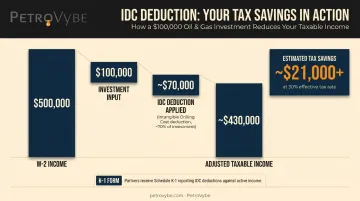
PetroVybe partners achieved a 94% tax deduction against active income in 2024 (91% in 2025), documented through K-1 tax forms. One verified investor, Nizar A., reported eliminating a $30,000 tax liability entirely through PetroVybe's deduction structure.
This strategy requires consultation with a CPA experienced in energy investments — but for high-income earners with significant annual tax liability, it's one of the most direct legal tools available.
The Compounding Power of Redirected Tax Savings
Tax savings only become wealth when reinvested. Even $20,000–$30,000 in annual tax savings, deployed into productive assets at a 7% compounding rate, generates over $400,000 in additional wealth over 20 years. Tax efficiency, done consistently, is one of the quietest wealth-building levers available to high-income earners.
Insurance: The First Line of Defense
Legal structures handle liability after the fact. Insurance absorbs the financial impact first — before a lawsuit reaches your assets. Five policy types form the foundation for any serious wealth protection plan:
- Health insurance — prevents medical events from becoming financial catastrophes
- Disability insurance — protects earned income, the engine of all future wealth accumulation
- Homeowner's/property insurance — baseline protection for physical assets
- Umbrella liability coverage — excess coverage above auto and homeowner limits
- Life insurance — protects dependents and can serve estate planning functions
Umbrella Coverage: Affordable, Underutilized
Standard auto and homeowner's policies have liability limits that a serious verdict can exceed in minutes. An umbrella policy provides excess coverage above those limits. The cost is far lower than most assume.
Mercury Insurance's 2026 published ranges put umbrella coverage at:
- $300–$600/year for $1M in coverage
- $600–$1,000/year for $2M in coverage
- $1,000–$1,800/year for $5M in coverage
Against a median medical malpractice verdict of $1.27M, a $5M umbrella policy costing under $2,000 annually costs less than most professionals spend on a single business dinner — while covering verdicts that would otherwise liquidate years of accumulated wealth.
Disability Insurance: Protecting the Source
The SSA estimates a 25% probability that a worker entering the workforce at age 20 will become disabled before normal retirement age. For high-income professionals, losing earned income without coverage is a wealth-destruction event, even when every other asset remains intact.
There's a key structural difference between employer-sponsored and privately purchased coverage: employer disability benefits are typically taxable when received. Privately purchased disability policies pay benefits tax-free, making them more efficient for high earners who need to preserve replacement income at full value.
Diversification Into Hard Assets and Alternative Investments
A portfolio concentrated in publicly traded stocks and bonds carries risks that aren't always visible: correlation during market stress, real return erosion during inflationary periods, and liquidity that can work against long-term positioning.
Hard assets (real estate, commodities, and direct ownership stakes in income-producing resources) provide resilience that paper portfolios cannot replicate.
Inflation Performance: What the Data Shows
A 2021 study covering eight U.S. inflationary regimes from 1926–2020 found average annualized real returns of -7% for equities and +14% for commodities during inflationary surges. Energy was consistently the strongest equity sector during these periods, while broad stocks and fixed income generally underperformed.
Diversifying into assets with direct exposure to real-economy demand — energy, commodities, physical real estate — provides a hedge that financial instruments struggle to replicate.
Natural Gas and AI-Driven Demand
Data center electricity consumption reached 176 TWh in 2023, and Lawrence Berkeley National Laboratory projects this could reach 325–580 TWh by 2028 — representing 6.7% to 12% of total U.S. electricity consumption. Natural gas is the primary fuel source meeting this surging demand.
For accredited investors seeking both inflation protection and tax efficiency, direct positions in natural gas development can serve a dual purpose: generating inflation-linked passive income while simultaneously providing significant first-year IDC deductions against active income.
PetroVybe's South Texas operations , anchored in Lavaca County's liquids-rich Wilcox formation, sit within this demand thesis. The project holds a $48MM proved reserves valuation (PV-09) determined by independent engineering review. Key investment parameters:
- ~400 producing wells across ~58,000 acres
- Target MOIC over a 10-year horizon: approximately 2.2x–5.8x
- Target IRR: ~26%
- Minimum investment: $100,000 (accredited investors only)

The structure is designed for a 10-year hold, giving investors direct exposure to energy assets that compound over time while generating first-year tax deductions against active income — including W2 earnings and capital gains.
Frequently Asked Questions
What are examples of asset protection?
Common examples include LLCs to separate business assets from personal wealth, irrevocable trusts to shelter inherited assets from beneficiary creditors, umbrella insurance to absorb lawsuit costs beyond standard policy limits, ERISA-qualified retirement accounts protected from most creditor claims, and oil and gas IDC deductions to legally reduce active income subject to taxation.
Does an LLC really protect your assets?
An LLC limits what a creditor can reach — a judgment against the LLC generally cannot access your personal bank accounts or home. But it does not prevent lawsuits from being filed, and protection can be lost if corporate formalities (separate accounts, proper documentation, no commingling of funds) are not maintained.
Is it worth having income protection?
Disability coverage matters most to high-income earners because earned income funds all future savings and investment capital. Losing it without protection can erase years of financial progress — and privately purchased policies pay benefits tax-free, making them more efficient than employer-sponsored plans.
When should you start asset protection planning?
Start before any claim exists. Most protective structures — irrevocable trusts, LLCs, certain asset transfers — must be established before a liability is anticipated. Courts can reverse transfers made after a claim is known or foreseeable, which makes reactive planning largely ineffective.
What is the difference between asset protection and wealth preservation?
Asset protection shields wealth from external claims: lawsuits, creditors, and tax authorities. Wealth preservation maintains the purchasing power and real value of assets over time against inflation and market erosion. Both are necessary because they address different threats operating on different timelines.
Can you protect your assets from a lawsuit?
No strategy eliminates lawsuit risk entirely. A layered approach — insurance to absorb initial damages, LLCs to limit what's reachable, and irrevocable trusts to shelter long-term wealth — can significantly reduce what a plaintiff can collect, making pursuit of your personal assets not worth the effort.