

Introduction
If you've built significant wealth, 2026 is a year to pay attention. Three major wealth tax proposals are moving simultaneously through federal and state legislatures — the Ultra-Millionaire Tax Act, the Sanders Billionaire Tax, and California's ballot initiative — each targeting different thresholds and using different mechanisms. That level of coordinated legislative activity hasn't happened in prior Congresses.
What's changed from earlier attempts isn't just the number of proposals. The projected revenue figures are substantially larger, the anti-evasion provisions are more aggressive, and the One Big Beautiful Budget Act (OBBBA) tax cuts for high-income households have intensified the inequality debate — giving renewed political urgency to each of these bills.
That said, none of these proposals target high-income W2 earners or accredited investors directly — the thresholds sit well above that range. But the direction of tax policy matters to anyone building wealth. Knowing what's actually on the table is how you plan ahead, not after the fact.
Key Takeaways
- Three major 2026 proposals target net worth above $50M or $1B — not ordinary high-income earners
- Revenue projections for the Sanders bill range from $2.3T to $4.4T depending on behavioral assumptions — a $2T spread that reflects how uncertain these estimates are
- A 5% annual wealth tax on a 5%-returning asset is economically equivalent to a 100% tax on that return
- Only 3 OECD countries currently operate broad net wealth taxes — down from 12 in 1990
- Legal, proactive tax strategies under current law already exist for high earners ready to act before 2026
What Is a Wealth Tax and Why Is It Back Now?
The Basic Mechanics
A wealth tax is an annual levy on total net worth — assets minus liabilities — above a defined threshold. It's fundamentally different from an income tax, which only applies to money earned in a given year.
A simple example: if someone has $60 million in total assets and $5 million in liabilities, their net worth is $55 million. Under the Ultra-Millionaire Tax Act, the taxable amount would be $5 million (the portion above the $50M threshold), generating a $100,000 annual tax bill — regardless of whether any income was earned that year.
The obligation exists even if the underlying assets produced zero income that year.
The Political Context
The driving argument behind the 2026 push is wealth concentration. Federal Reserve distributional data shows the top 10% of households held 60.6% of national wealth in Q1 1990 — a figure that rose to 68.0% by Q1 2026, while the bottom 50%'s share fell from 3.7% to 2.5% over the same period.
Proponents also point to the OBBBA reconciliation law as accelerant. According to the Tax Policy Center, it cut average 2026 taxes by about $2,900 — with the largest dollar benefits flowing to the highest-income households. That outcome has given the inequality argument more staying power in Congress.
Key data points shaping the debate:
- Top 10% wealth share: rose from 60.6% (Q1 1990) to 68.0% (Q1 2026)
- Bottom 50% wealth share: fell from 3.7% to 2.5% over the same period
- OBBBA average tax cut: ~$2,900, disproportionately benefiting top earners
Why Now, Specifically
Those distributional conditions — widening wealth concentration combined with a tax cut that favored the top — created political pressure that previous congresses didn't face at the same intensity.
Earlier versions of the Ultra-Millionaire Tax Act were introduced in both the 117th and 118th Congresses without advancing past committee referral. The 2026 versions carry larger coalitions — 45+ co-sponsors at introduction — and substantially higher revenue projections, attracting scrutiny from both supporters and critics alike.
The Key 2026 Wealth Tax Proposals on the Table
Three Very Different Approaches
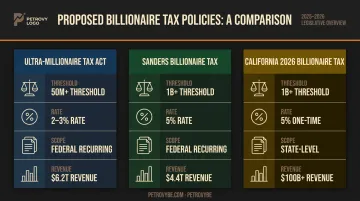
The three proposals differ meaningfully on threshold, rate, scope, and structure:
| Proposal | Threshold | Rate | Type | Revenue Claim |
|---|---|---|---|---|
| Ultra-Millionaire Tax Act | $50M+ net worth | 2% (3% above $1B) | Federal, recurring | $6.2T over 10 years (Saez-Zucman) |
| Sanders Billionaire Tax | $1B+ net worth | 5% annual | Federal, recurring | $4.4T over 10 years (sponsor estimate) |
| California 2026 Billionaire Tax | $1B+ (CA residents) | 5% one-time | State, one-time | Proponents cite $100B+ (LAO says "tens of billions") |
The Ultra-Millionaire Tax Act (H.R.8085/S.4246)
Introduced March 25–26, 2026 by Warren, Jayapal, and Boyle, this bill imposes a 2% annual wealth tax on net worth above $50 million and a total 3% rate on net worth above $1 billion. It would apply to approximately 260,000 households — the top 0.15%.
The Saez-Zucman revenue score commissioned by sponsors projects $6.17 trillion over 2026–2035. This is a sponsor-commissioned estimate, not a congressional CBO score, and it assumes a 15% revenue reduction for avoidance and evasion.
The Sanders Billionaire Tax (S.3956/H.R.7767)
This bill imposes a 5% annual wealth tax on individuals with net assets exceeding $1 billion. Key enforcement provisions include a 60% exit tax on expatriating wealth, a required federal asset-ownership registry, and mandatory audit rates of at least 50% for covered taxpayers.
Sponsor estimates project $4.4 trillion over 10 years. Independent analysts put the figure considerably lower, as the next section covers in detail.
The California 2026 Billionaire Tax
This is a state-level ballot initiative, not a federal bill. It imposes a one-time 5% wealth tax on California billionaires (net worth above $1 billion as of December 31, 2026), payable in five annual installments of 1% each.
Proponents cite over $100 billion in projected revenue from roughly 200 California billionaires. The independent Legislative Analyst's Office forecasts only "tens of billions" and explicitly flags uncertainty from avoidance, migration, valuation disputes, and market movements.
Anti-Evasion Provisions
All three proposals include enforcement mechanisms designed to address the weaknesses that undermined earlier wealth tax debates:
- Ultra-Millionaire Tax Act: 40% exit tax on expatriating wealth, 30%+ mandatory annual audit rate, $100B IRS appropriation through 2037
- Sanders bill: 60% exit tax, federal asset-ownership registry, 50%+ audit rate, IRS funding set at 1% of revenue collected
- California: 7.5% nondeductible deferral charge on unpaid installment balances
Why Critics Say Wealth Taxes Raise Less Than Promised
The Revenue Gap Problem
The Sanders 5% wealth tax illustrates the revenue uncertainty clearly. Three credible projections exist for the same bill:
| Source | 10-Year Estimate | Behavioral Assumption |
|---|---|---|
| Sanders/Saez-Zucman | $4.4T | 10% taxable-wealth reduction from avoidance |
| Tax Foundation | ~$3.3T | ~33% base reduction (semi-elasticity of –8) |
| Kyle Pomerleau, AEI | ~$2.3T | Larger behavioral response + baseline avoidance |
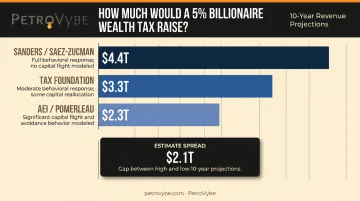
The $2.1 trillion spread between the high and low estimates reflects real disagreement about how billionaires will respond to a 5% annual charge — not a modeling footnote.
The 100% Effective Tax Rate Problem
The Tax Foundation explains the core economic distortion: a 5% annual wealth tax on an asset earning 5% annually absorbs the entire annual return — making it economically equivalent to a 100% tax on investment income from that asset.
At those effective rates, the rational response for wealthy individuals is to shift from investment to consumption, restructure assets into exempt categories, or change domicile. Each of these behaviors permanently reduces the taxable base, compounding the revenue shortfall over time.
Valuation and Enforcement Challenges
The IRS already projects a $696 billion gross tax gap for tax year 2022 — representing an 85.0% voluntary compliance rate under the current system, which primarily taxes relatively straightforward income streams.
Wealth taxes require accurate annual valuations of private business stakes, real estate, art, and other non-traded assets. These valuations involve inherent subjectivity, create legal dispute opportunities, and would require substantially expanded IRS capacity even beyond the funding provisions included in these proposals.
The Constitutional Question
Beyond enforcement, there's a structural legal problem. Article I of the Constitution requires direct taxes to be apportioned among states by population — a rule that's difficult to reconcile with a uniform tax on geographically concentrated wealth. Legal scholars are divided on whether a federal wealth tax satisfies this requirement.
An originalist analysis by Schizer and Calabresi concludes a net wealth tax is a direct tax requiring apportionment — and absent workable apportionment, a constitutional amendment would be needed. Johnsen and Dellinger reach the opposite conclusion. The question is unresolved, and any enacted federal wealth tax would almost certainly face immediate litigation.
How Wealth Taxes Have Fared Internationally
The Repeal Pattern
The OECD documented 12 countries with broad net wealth taxes in 1990. The repeal list is long:
- Austria — repealed 1994
- Denmark, Germany — repealed 1997
- Netherlands — repealed 2001
- Finland, Iceland, Luxembourg — repealed 2006
- Sweden — repealed 2007
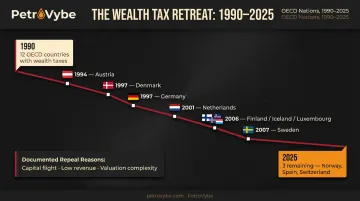
Documented reasons: low revenue relative to administrative cost, valuation complexity, base-narrowing exemptions, avoidance, and capital flight.
What the Remaining Countries Show
Three OECD members currently operate broad net wealth taxes:
| Country | Revenue (% of GDP) |
|---|---|
| Norway | ~0.46% (2022) |
| Spain | ~0.19% (2022) |
| Switzerland | ~1.19% (2022) |
Switzerland's relatively strong performance reflects low exemption thresholds and cantonal-level administration — structural features that make direct comparison to proposed U.S. designs difficult.
The OECD's own conclusion: there are "limited arguments" for a net wealth tax on top of well-designed capital income and inheritance taxes, though the case strengthens where those taxes are weak. That context matters for evaluating U.S. proposals: American capital income taxes are already substantial, which — by the OECD's own logic — weakens the economic rationale for layering a net wealth tax on top.
What High-Income Earners and Accredited Investors Should Understand Now
Who These Proposals Actually Target
Current proposals set thresholds at $50M (Ultra-Millionaire) and $1B (Sanders and California). The vast majority of high-income W2 earners and accredited investors sit well below both thresholds.
Two factors matter regardless of the final thresholds:
- Tax proposals rarely hold their original thresholds as they move through political negotiations
- The broader policy direction — toward taxing accumulated wealth and high earners more aggressively — is accelerating regardless of whether any specific bill passes
The Structural Difference That Matters
Income taxes apply to money earned in a year. Capital gains taxes apply to realized gains. A wealth tax would apply annually to total accumulated net worth — regardless of whether any income was generated.
For investors holding concentrated positions in private businesses, real estate, or other illiquid assets, this creates a fundamentally different problem: a recurring tax obligation that doesn't correlate with cash flow. Understanding this distinction now — before new legislation changes the planning landscape — is essential for anyone holding illiquid assets.
What High Earners Can Do Under Current Law
The most effective tax strategies don't require waiting to see which proposals survive. Under current law, Intangible Drilling Cost (IDC) deductions from oil and gas development projects offer one of the few legal mechanisms that offsets active income directly — including W2 earnings and capital gains — not just passive income.
This is the critical distinction from real estate: real estate deductions are generally restricted to passive income unless an investor qualifies as a full-time real estate professional. IDC deductions carry no such restriction.
PetroVybe, a Texas-based natural gas development company, reported that partners achieved a 94% tax deduction against active income in 2024 and 91% in 2025 — both applied directly against W2 and capital gains income. One verified investor eliminated a $30,000 tax liability through the structure. A sample K-1 shows a $600,000 capital contribution generating $401,772 in deductions in year one.
The partnership structure offers flexibility for accredited investors:
- Minimum investment: $100,000, accredited investors only
- Hold period: 10-year partnership with monthly passive distributions during production
- Deduction timing: Taken fully in year one via K-1, or spread across five tax years
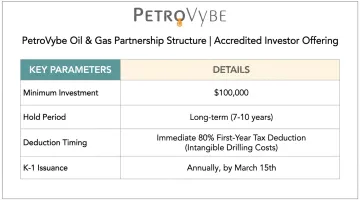
The window under current law is open. Waiting for legislation to finalize before acting typically means losing the deduction year.
Frequently Asked Questions
Who pays the majority of federal taxes in the US?
The top 1% of earners pay roughly 40% of all federal income taxes, and the top 10% pay about 70% — figures both sides of the wealth tax debate cite for opposite conclusions. Supporters argue this still doesn't capture wealth concentration at the very top; opponents argue it already demonstrates a progressive system before any new legislation.
What is Bernie Sanders' proposed wealth tax?
Sanders introduced legislation in 2026 proposing a 5% annual wealth tax on individuals with net worth exceeding $1 billion, paired with a federal asset registry and a 60% exit tax on expatriating wealth. Sponsors project $4.4 trillion in revenue over 10 years, though independent analysts project $2.3–3.3 trillion due to evasion and behavioral responses.
Is a federal wealth tax constitutional?
Genuinely uncertain. The Constitution requires direct taxes to be apportioned by state population — a rule difficult to reconcile with a uniform tax on geographically concentrated wealth. Some legal scholars argue a constitutional amendment would be required, similar to the 16th Amendment that enabled the income tax; others contend existing authority is sufficient.
How is a wealth tax different from an income tax?
An income tax applies to money earned in a year — wages, dividends, realized gains. A wealth tax applies annually to total accumulated net worth, meaning assets are taxed even if they produce no income that year. For investors holding illiquid positions, this creates a tax obligation without corresponding cash flow.
Which countries currently have a wealth tax?
As of 2025, only Norway, Spain, and Switzerland levy broad annual net wealth taxes among developed nations — down from 12 OECD countries in 1990. Most repealed them after facing capital flight, enforcement failures, and revenue that rarely justified the administrative cost.
Would the 2026 wealth tax proposals affect accredited investors or W2 earners?
Current proposals specifically target billionaires ($1B+ net worth) and ultra-millionaires ($50M+), so the vast majority of accredited investors and high-income W2 earners would not be directly impacted. That said, the legislative direction is clear: accumulated wealth is increasingly the target. Using tax-advantaged structures available under current law — while they exist — is worth prioritizing now.